Trees gallery - Isle of Mull
Scotland

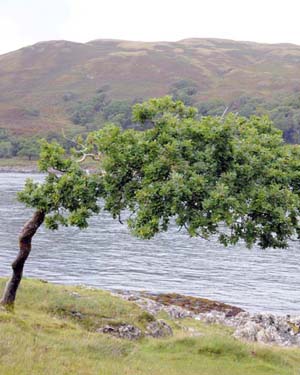
Oak woodland
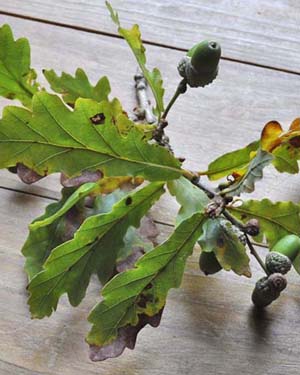
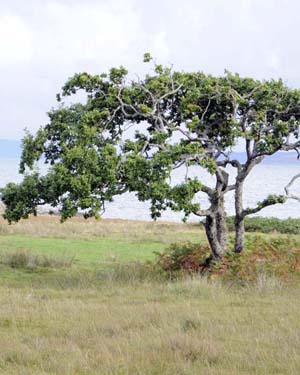
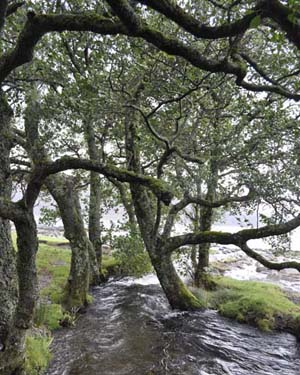
Oak woodland cover many of the shorelines of the sea lochs, blown into contorted shapes but hanging on for life. Usually covered in moss and lichen and harbouring a wealth of insect life. People often coppiced cut back to ground level periodically to stimulate growth the trees to provide charcoal for the iron furnaces and for fuel, and the bark was used for tanning leather. Oaks share the space with birch, hazel and rowan.Having first thought these would be sessile oaks, closer inspection showed most had long stalks on the acorns and the two back-turned lobes at the base of the leaf, which indicates pedunculate oak (common oak). There were sessile without a stem (usually of leaves, or acorns) oaks mixed in as well - see the photo above right.

Fraxinus excelsior
Ash
Ash woodland is one of the richest types of woodland in Argyll. Found on better types of soil and near steep stream sides, often where ground is rocky and inaccessible. A relative newcomer to Mull, arriving long after man, around 3000 - 4000 years ago. Ash woodland also supports hazel and elm, and its bark supports many kinds of lichen, some of which are very rare. I didn't see any signs of ash die back on any of the many ash trees in the area.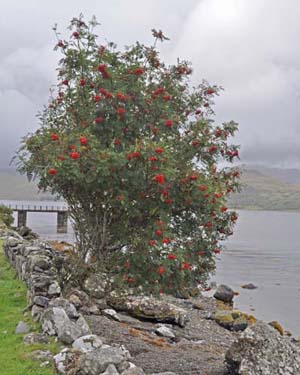

Sorbus Aucuparia
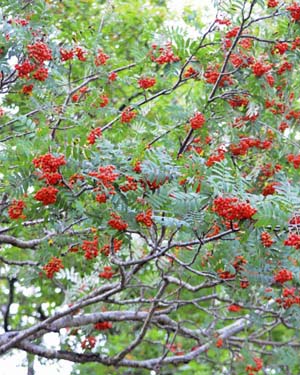
Rowan; mountain ash
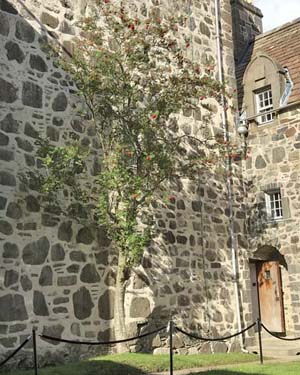
Rowan trees can be found in the most extreme conditions, mixed with other trees along the coast and throughout the inland woods. People planted them by their houses to ward off evil spirits, such as the one planted in the courtyard of Duart Castle in 1935, to mark the 100th birthday of Sir Fitzroy Maclean, chief of the clan Maclean.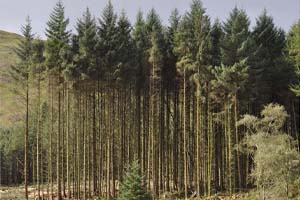
Picea sitchensis
Sitka spruce plantation
A different kind of woodland: sitka spruce planted for commercial logging near Glen More, off the A684 Craignure to Fionnphort road. These were gradually being felled when this picture was taken, and may no longer be there. Tall, straight, planted close together to minimise side shoot growth. Cut down, picked up and fed through grabber jaws like pencils, trimmed to size and stacked, all by a large mechanical monster.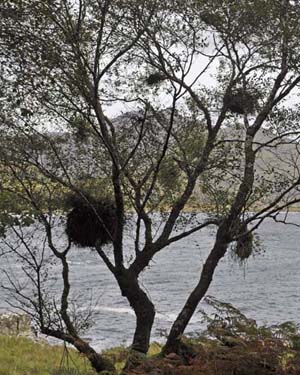
Betula pendula
Birch - Witches' broom
A common feature of birch trees is the development of dense clusters of twiggy growth on the branches, similar to burrs on the trunks of larger trees. They look like a dense tangled birds nest. These are known as witches' brooms for obvious reasons.The scientific name is phyllanthies, phyllodies or chloranthies. Collectively, these are known as virescences. A virescence is a growth consisting of distorted and multiplied parts of a plant, either green and leafy or woody and twiggy. (Details from the Woodland Trust)

Alnus glutinosa
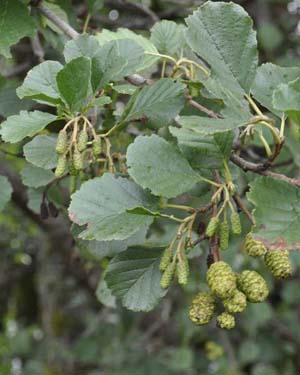
Alder
Alder is a tree of wetlands, happy to grow on stream sides and waterlogged ground. The female catkins are usually present all year round, showing as small cones. The picture here shows male and female catkins forming on a branch - alder is monoecious male and female reproductive parts are on the same plant - and also the racquet shaped leaves, with indented end points.
Tilia x europaea
Lime
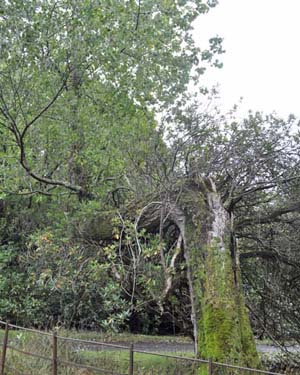
Trees have a remarkable determination to live and grow. This lime just behind Moy Castle has a 90 degree bend in its trunk, presumably from some accident, but it then picks up growth almost vertically again. I suspect this was planted in Lochbuie house grounds in the past, along with other common estate trees.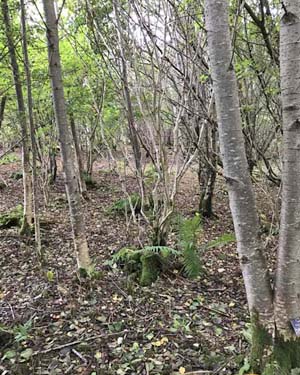
Millenium Wood
Duart Castle
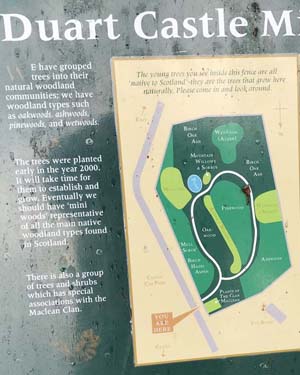
A woodland area planted in 2000 gives a living guide to the type of woodland to be found on Mull - wetwood, mountain, oakwood, ashwood, pinewood, willow, mull scrub, and "plants of the clan Maclean". Lots of small information posts are dotted around this wonderfully wild, naturally planted area.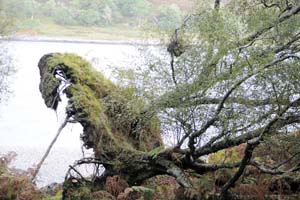
Betula pendula or pubescens?
Birch
Another one of many trees hanging on for life despite past adversity. Most of the roots of this birch are up in the air, yet what remains in contact with the ground is still feeding the tree, and there are plenty of green leaves still to be seen. I am not sure whether this is silver birch, downy birch, or a cross between the two.


Fungi
Loch Spelve
Late September into October was always going to be a good time to see fungi, but we were amazed by how many there were, and the variety was incredible. I know far too little about fungi, but intend to find out more. For now here are three examples of bracket fungi, growing on decaying trunks in the coastal woodlands by the shores of Loch Spelve, a sea-loch.