Trees Gallery - St Andrews Botanial Gardens. Page 1
Fife, Scotland
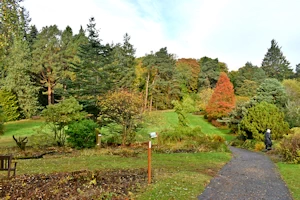
St Andrews Botanic Garden covers 18 acres of woodland walks, meadows, ponds and living laboratories in the university town of St Andrews in Fife, Scotland. It is located on the banks of the wooded Kinness Burn in Canongate on the southern edge of the town. The gardens are supported by the University of St Andrews and Fife Council. It contains more than 8000 species of native and exotic plants, laid out in zones of woodland, meadow, shrubbery, herbaceous bedding, sand dunes, a large rockery and a series of ponds. There are also vegetable and herb gardens, and two large greenhouses. The gardens were founded in 1889 on a different location, the current site developing from the 1960s.
 October 2024
 October 2024
 October 2024
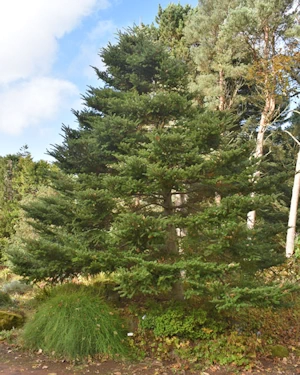
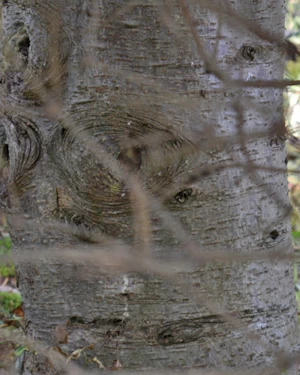
Korean fir
Compact evergreen conical tree to 18 m, native to the higher mountains of S Korea, with thick dark green needles, slightly notched at the tip, with white bands of stomata beneath. The cones are cylindrical blue or purple cones, some with protruding green or yellow bracts, often borne on young trees. .
 October 2024
 October 2024
 October 2024
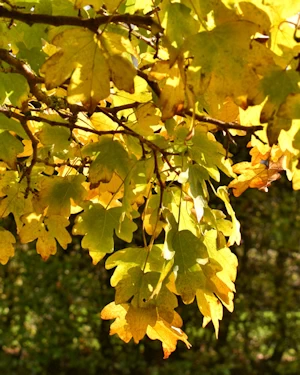
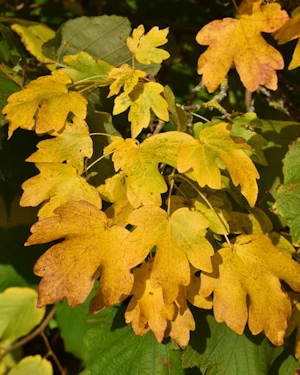
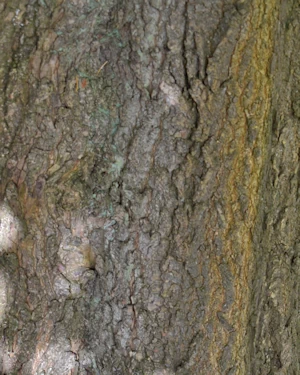
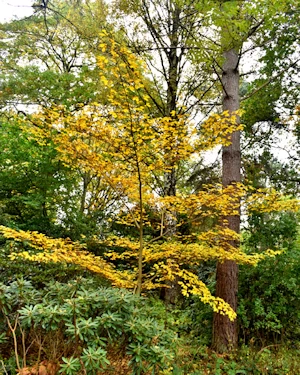
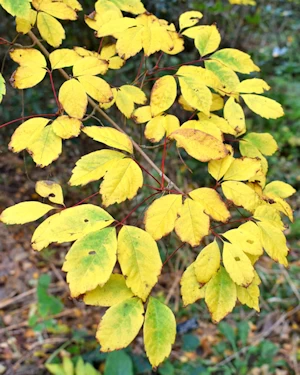
Field maple
Britain's only native maple, it is found growing in woods, scrub and hedgerows, and on chalk lowland. It is widely planted in gardens and parks due to its compact habit, tolerance of pollution and rich autumn colours. The flowers are , the seeds are , paired horizontally. [Woodland Trust]'.
 October 2024
 October 2024
 October 2024
Ivy-leaved maple
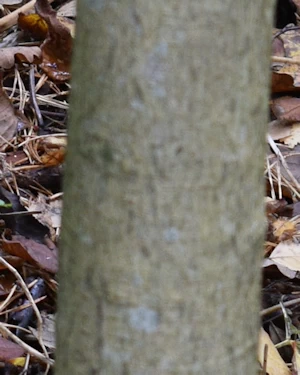
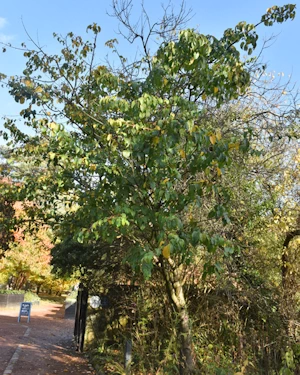
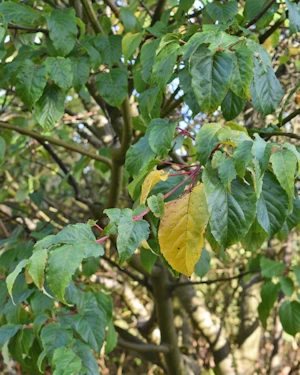
A fairly small deciduous tree growing to 10 m, native to mountainous areas of Japan. Initial growth is upright oval, with age it becomes distinctly mushroom-like with a wide-spreading, globose form. In spring long catkins appear and are followed by two winged samaras spreading at an acute angle. It is . The leaves turn a modest yellow to red in autumn. The bark is smooth and grey.
 October 2024
 October 2024
 October 2024
Snake bark maple
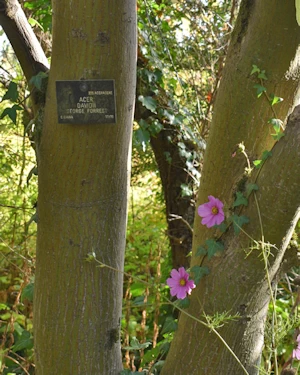
A.k.a. Père David's maple, a small deciduous tree native to China, with arching branches, growing 10–15 m tall with a trunk up to 40 cm in diameter, though often with multiple trunks. The small yellow flowers have five sepals and petals about 4 mm long, produced on arching 7–12 cm racemes in late spring, with male and female flowers on different racemes. "George Forrest" is perhaps the most common form, a fine, vigorous, often multistemmed tree with spreading branches and large leaves up to 20 cm long. These emerge red, the blades turning green later, with distinctively red petioles.
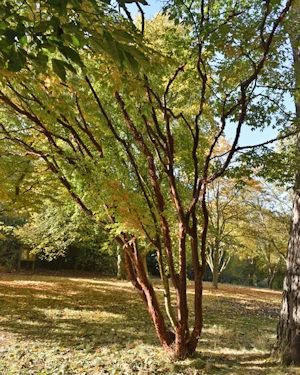 October 2024
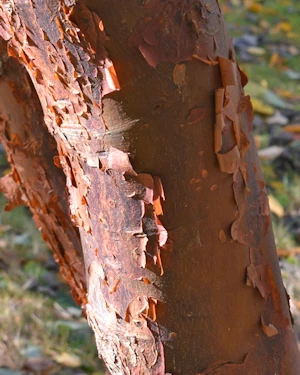 October 2024
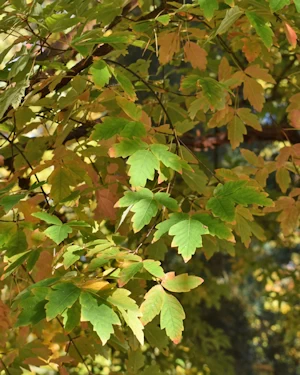 October 2024
Paper bark maple
A.k.a. blood-bark maple, a small to medium-sized, deciduous, oval rounded tree reaching 6–9 m, with slender upright branching, native to mixed forests in C China. The yellow flowers are , produced in small pendent corymbs in spring, the fruit being a paired samara with two winged seeds about 1cm long with a 3cm wing.
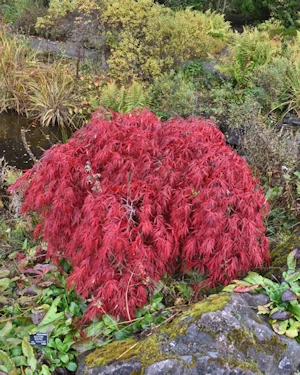 October 2024
 October 2024
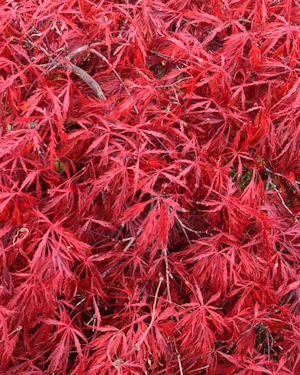
dissectum
Japanese maple
A slow growing, mound forming shrub or small tree, prized for its deeply dissected leaves which can almost look as if they have been shredded. Varieties can have deep purple foliage (purpureum) or deep red (garnet) or many colours in between.
 October 2024
 October 2024
 October 2024
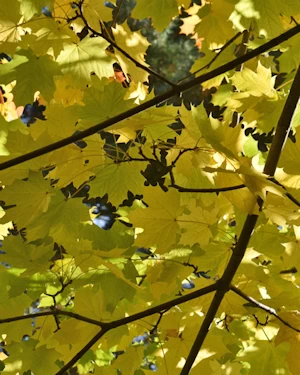
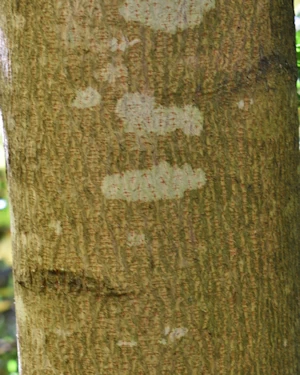
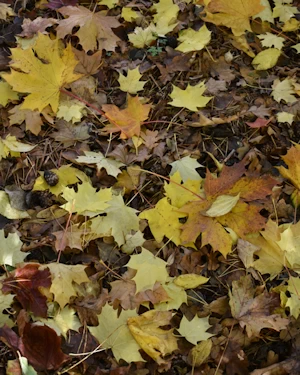
Drummondii
Variegated Norway maple
A maple cultivar with creamy white edged variegated leaves, turning orange in autumn. Masses of bright yellow flowers in spring. Named after Scottish botanist Thomas Drummond (1790 - 1855).
 October 2024
 October 2024
 October 2024
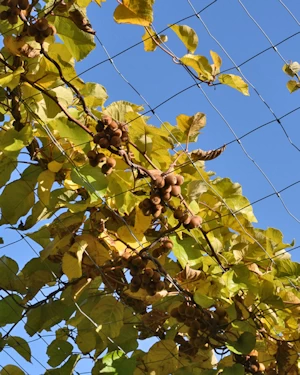
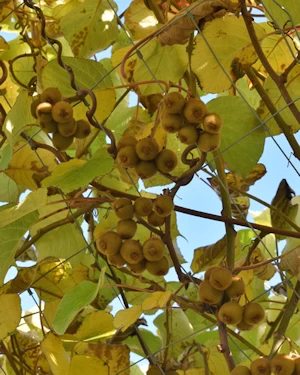
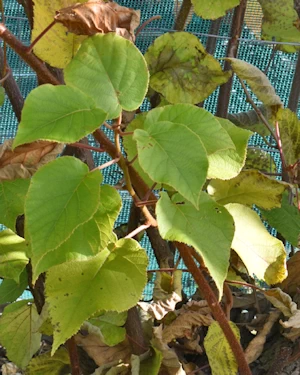
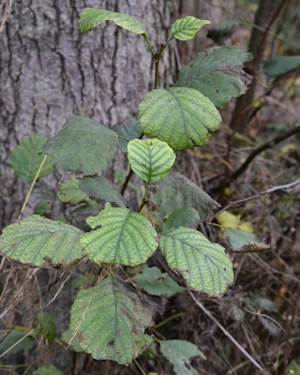
Kiwi fruit
A.k.a. Chinese gooseberry. A fruiting vine native to China. It is one of some 40 related species of the genus actinidia, with a. chinensis the origin of most commercial varieties of kiwifruit. Fruit colour may vary from green through brown to gold, depending on cultivar.
 October 2024
 October 2024
 October 2024
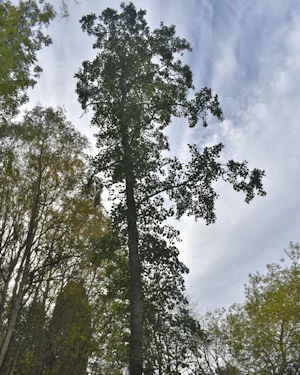
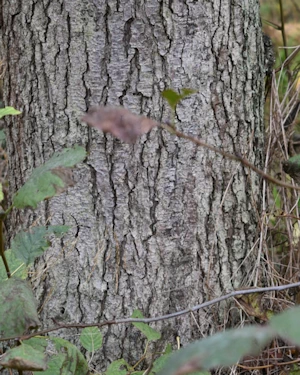
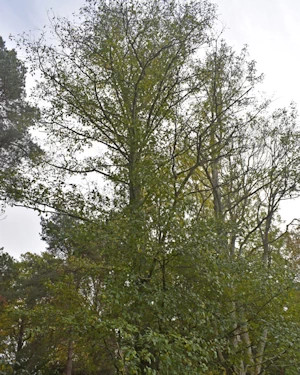
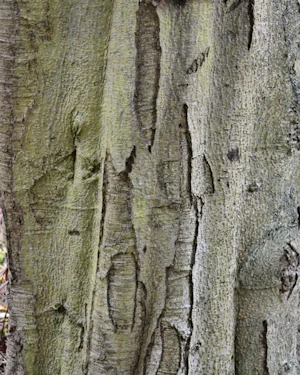
Alder
A.k.a. common alder, black alder, European alder, a medium-sized, short-lived tree growing to a height of up to 30 m, native to most of Europe, SW Asia and N Africa. It thrives in wet locations where its association with the bacterium Frankia alni enables it to grow in poor quality soils. It is a pioneer species, colonising vacant land and forming mixed forests. Eventually it dies out of woodlands because the seedlings need more light than is available on the forest floor. Its more usual habitat is forest edges, swamps and riverside corridors. The timber has been used in underwater foundations and for manufacture of paper and fibreboard, for smoking foods, for joinery, turnery and carving.
 November 2023
 November 2023
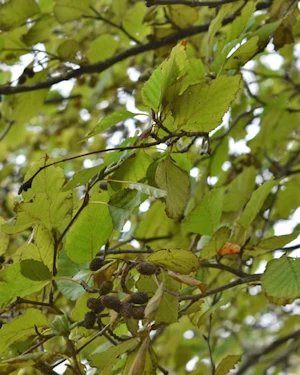
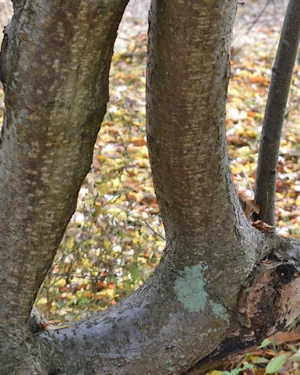
Red alder
A deciduous broadleaf tree native to western North America, the largest species of alder in North America and one of the largest in the world, reaching heights of 20 to 30 metres. The leaves are , a diagnostic character which distinguishes it from all other alders. Rather than turning yellow in autumn, its leaves darken in colour and wither before they are shed. The male flowers are dangling reddish catkins 10 to 15 cm (4 to 6 in) long in early spring. Female catkins are erect during , but otherwise pendant. They develop into small, woody, superficially cone-like oval dry fruit. The seeds develop between the woody bracts of the 'cones' and are shed in late autumn and winter. Seeds have a membranous winged margin that allows long-distance dispersal. [Wikipedia].
 October 2024
 October 2024
sinuata
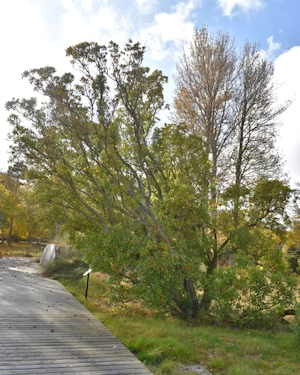
Sitka alder
A.k.a. alnus alnobetula, a large shrub or small tree growing to 12 m, common across much of Europe, Asia, and North America.Catkins appear late in spring after the leaves emerge (unlike other alders which flower before leafing out); the male catkins are pendulous, 4–8 cm long, the female catkins are 1 cm long when mature in late autumn, in clusters of 3–10 on a branched stem. The roots have nitrogen-fixing nodules.
 October 2024
 October 2024
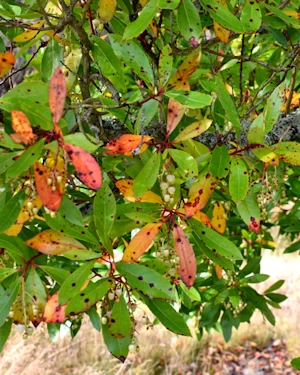 October 2024
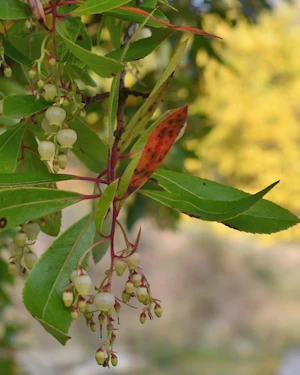
Strawberry tree
The noticeboard by the tree says: Native to the Mediterranean, N Africa, and Ireland (possibly linked to bronze age miners' migration). It flowers in autumn, usually as last year’s fruits are ripening. It sprouts easily from the stump, a useful adaptation in areas prone to fires. Despite the Latin name, the fruits are widely consumed across Europe, made into jams and puddings, and a Portuguese liquer called aguardente de medronhos.
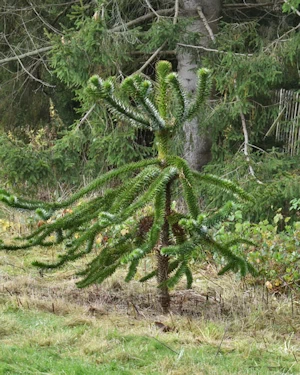 October 2024
Monkey puzzle
A.k.a. monkey tail tree, pewen, pehuen pine or piñonero, an evergreen tree growing to 30–40 m, native to C and S Chile and W Argentina. It is on the IUCN list as endangered in its native region due to logging, forest fires, and grazing. It is usually . The male (pollen) cones are oblong and cucumber-shaped. It is wind pollinated. The bark can be up to 15 cm thick, possibly an adaptation to resist wildfires. I have noticed young monkey puzzle trees planted in many gardens and woodlands visited recently.
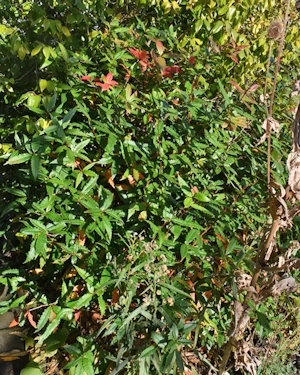 October 2024
 October 2024
Silver holly
A.k.a. violet-bead barberry, or Burmese barberry, a small evergreen shrub up to 2.5m tall and wide, native to Myanmar, with arching reddish-green stems and holly-like, rigid, triangular-spined, grey-green leaves to 15cm long, often white beneath. Dense clusters of lemon-yellow flowers 1 cm across in early summer are followed by white tinged, blue-black fruit in autumn
 October 2024
 October 2024
A.k.a. golden birch, or swamp birch, or in Quebec, merisiera, and previously classified as Betula lutea. It is a medium sized deciduous tree native to NE North America, growing to 25 m with a trunk up to 0.9 m in diameter, making it the largest North American species of birch. It is long-lived, typically 150 years, sometimes up to 300 years. Dark green leaves are alternate, oval, with a pointed tip and often a slightly heart shaped (cordate) base, with a finely serrated (doubly serrate) margin. It is
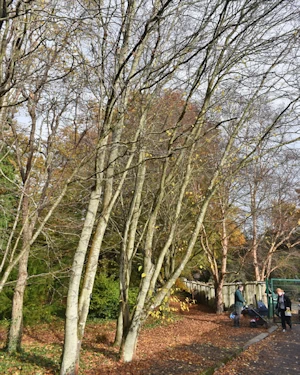 October 2024
 October 2024
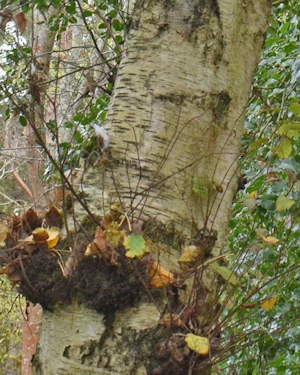
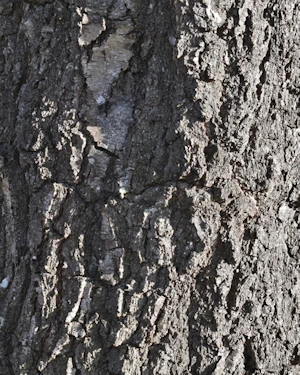
Sweet birch
A.k.a. black birch, cherry birch, mahogany birch, or spice birch, a medium-sized deciduous tree reaching 30 m, native to E North America.
al. The twigs, when scraped, have a strong scent of wintergreen due to methyl salicylate, which is produced in the bark. The leaves are alternate, ovate, with a finely serrated margin. The flowers are wind-pollinated catkins, the male catkins pendulous, the female catkins erect.
 October 2024
 October 2024
 October 2024
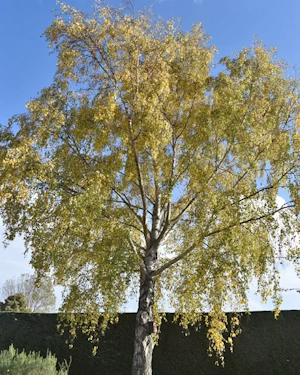
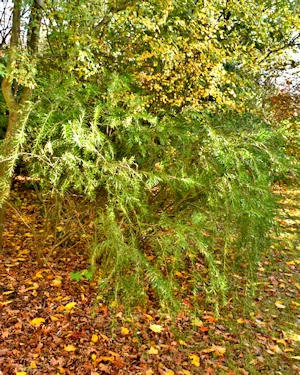
Silver birch
Leaves are light green, small and triangular-shaped with a toothed edge, which fade to yellow in autumn. catkins emerge from April to May, the male catkins long, yellow-brown, hanging in groups of two to four, like lambs' tails. Female catkins are smaller, short, bright green and erect.
 October 2024
 October 2024
Weeping bottle-brush
A small tree with willowy foliage, with striking red bottlebrush flowers, mostly in summer. When the flowers go, groups of seed capsules encircle the branchlets like knobby sleeves, where they remain for years without releasing their powdery seed. The sleeves of previous years can be tracked back along the branches where they may in due course become engulfed by new wood. Australians steeped the flowers in water to make a bush remedy for sore throats.
 October 2024
 October 2024
 October 2024
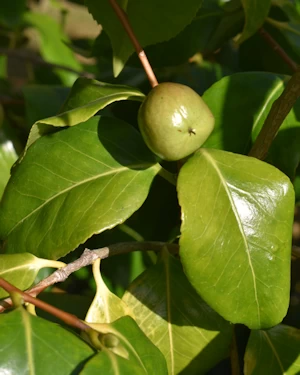
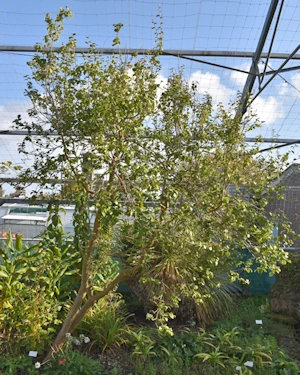
Camellia cuspidata
A large, upright, evergreen shrub to around 3 m tall that becomes bushy with age. Solitary, pure white, cup-shaped flowers 2-3 cm in diameter are borne in spring.
 October 2024
 October 2024
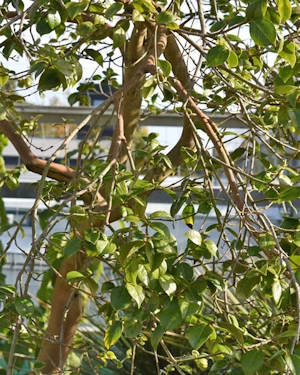
Grijs' camellia
A bushy, upright, evergreen shrub eventually forming a small tree of about 3-4m high, with dark green leaves and single, scented, white flowers with heart-shaped, notched petals in late winter (January to March). It was discovered in Fujian province in China by de Grijs in 1861.
 October 2024
 October 2024
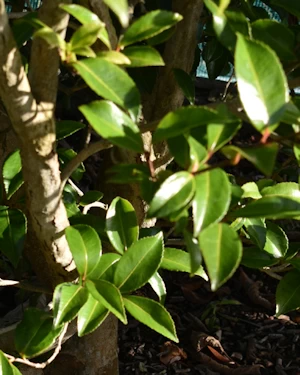
Oil-seed camellia
A large shrub or small tree widely distributed in China and cultivated extensively there as an important source of edible oil (known as tea oil or camellia oil). It grows to 6 m with thin, upright, multiple trunks and branches. It is found in forests, thickets, banks of streams and foothills. Single, white, fragrant flowers are produced in mid to late autumn.
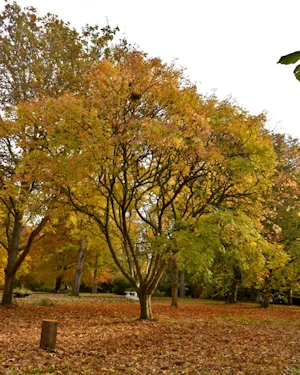 October 2024
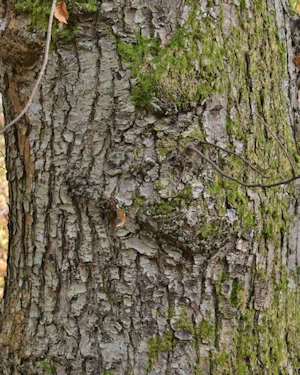 October 2024
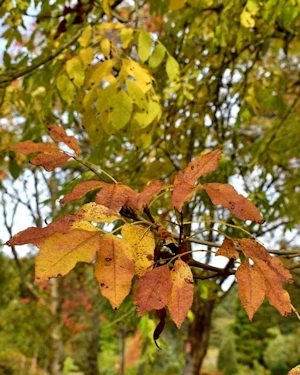 October 2024
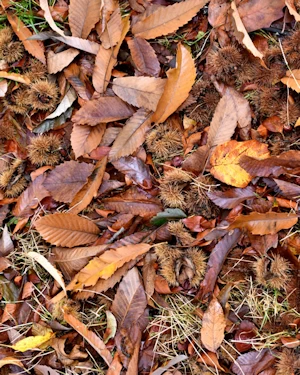 October 2024
Sweet chestnut
A.k.a. Spanish chestnut or European chestnut, a tree native to S Europe and Asia Minor, growing to 25m with a trunk often 2 m or more in diameter. The flowers of both sexes are borne in 10–20 cm long, upright catkins, the male flowers in the upper part and female flowers in the lower part. The female flowers eventually form a spiky sheath that deters predators from the seed. It is naturally . Trees can live to an age of 500 to 600 years, even 1,000 years or more.
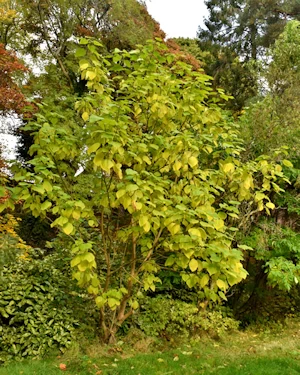 October 2024
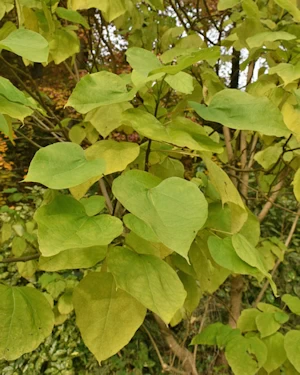 October 2024
Northern catalpa
A.k.a. hardy catalpa, western catalpa, cigar tree or catawba. It is a medium-sized, deciduous tree growing to 30 m. It has a trunk up to 1 m in diameter, with brown to gray flaky bark, native to the midwestern United States. The flowers are 3–6 cm across, trumpet shaped, white with yellow stripes and purple spots inside; growing in panicles of 10–30. The fruit is a long, thin legume-like capsule, 20–40 cm long,which turns brown in autumn and often stays attached to tree during winter. The pod contains numerous flat, light brown seeds with two papery wings.
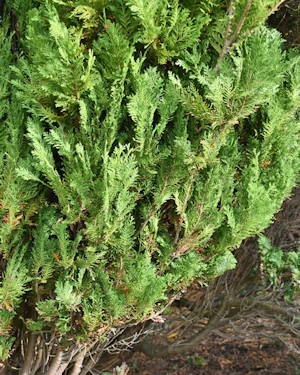 October 2024
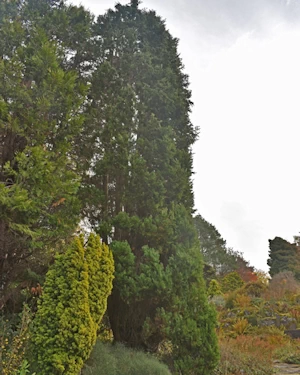 October 2024
lawsoniana Kilmacurragh
Lawson's cypress
A large evergreen tree growing to 50 m with trunk up to 2 m in diameter. The bark is silver-brown, vertically furrowed, and up to 25 cm thick at the base. The seed cones are globose, 7–14 mm in diameter, green at first, maturing brown in autumn. Trees can live up to about 600 years of age.Leaves rich green; habit columnar, resembling that of the Italian cypress. It bears the name of the once-famous Irish garden where it originated. The parent tree perhaps no longer exists but it was propagated before the garden fell into decay and is now well established in cultivation.
 October 2024
 October 2024
 October 2024
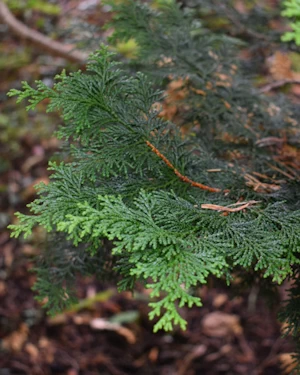
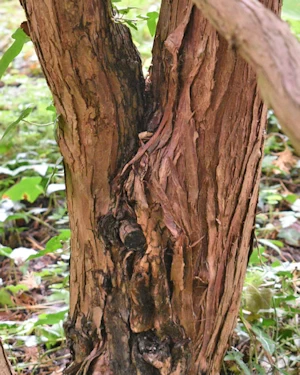
lawsoniana aurea
Wissell's Lawson cypress
A native of Oregon and California. This Cypress was first introduced by plant hunters working for the Lawson & Son nursery in Edinburgh. Nurserymen found it amenable for breeding colourful cultivars. Eight of these, including Wisselii have the RHS Award of Garden Merit. Note the attractive chunky red bark: the timber is strong but light, with great rot resistance. It has a fragrant ginger smell. The straight grain made it perfect for arrow shafts and its heartwood is often used in the sounding boards of musical instruments.
 October 2024
 October 2024
 October 2024
 October 2024
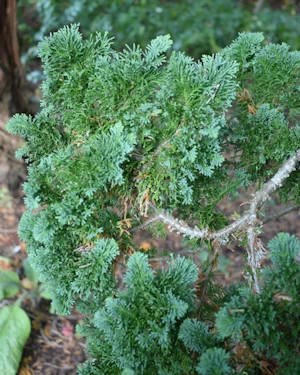
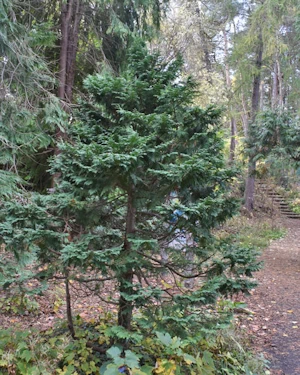
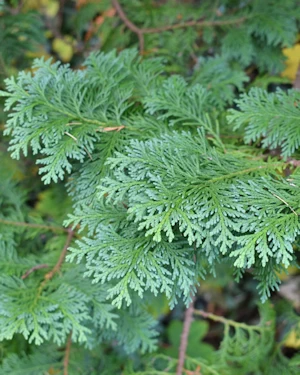
flabelliformis
Hinoki False cypress
This is a dwarf, slow-growing cultivar of the Japanese Hinoki false cypress, known for its dense, irregularly globose shape and fan-like sprays of slightly bluish-green foliage. It grows only a few cm per year, reaching a height of perhaps 1.8 m in 50 years.
 October 2024
 October 2024
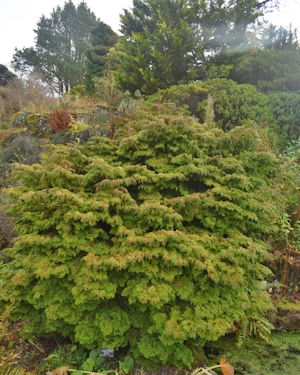
nana
Hinoki False cypress
This cultivar is very slow-growing and after 10 years may only reach 20 cm inches tall, although it eventually will reach 90 cm.
Dark-green foliage forms twisting, fan-shaped branchlets in dense, tiered layers and have a sweet fragrance when crushed. At maturity, it forms a compact, flattened globe with horizontal branches.
 October 2024
 October 2024
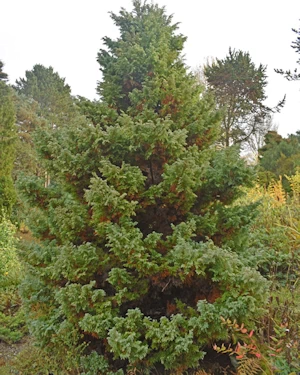
pygmaea
Hinoki cypress 'Pygmaea'
A dwarf evergreen conifer with a globose, spreading habit, reddish-brown stems and fan-shaped bronze-green foliage which becomes darker in cooler conditions or during the winter. Growth rate: It is a very slow grower, adding about 5–7 cm per year. After 10 years it might be 60 - 90 cm.
 October 2024
 October 2024
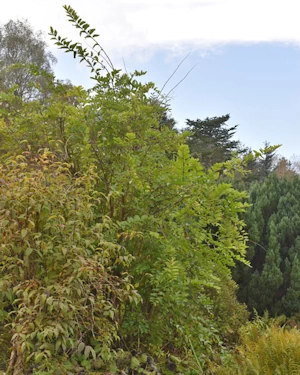
Boulevard
Sawara cypress 'Boulevard'
A dense, slow-growing evergreen conifer forming a large, conical shrub to 8m, with soft, silvery blue-grey foliage, often tinged purple in winter.
 October 2024
 October 2024
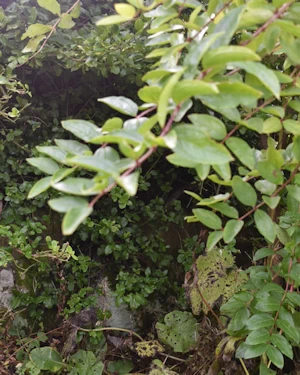
Masuri berry
A.k.a. tanner's tree, mansur shrub and macchaino (Nepalese). It is a shrub that grows in the foothills of the Himalayas growing to 2.5 m. It blooms in spring and has bright yellow flowers and red to dark purple fruits in summer, which resemble berries but are actually protected by enlarged coloured petals.
 October 2024
 October 2024
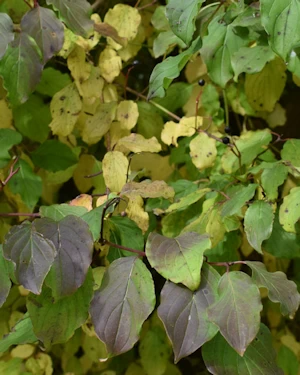
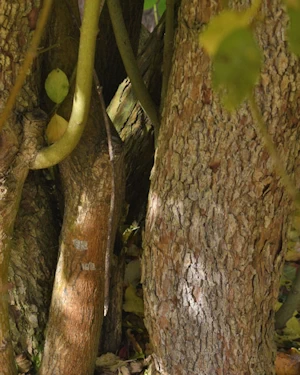
Southern dogwood
A.k.a. Black Sea dogwood. A deciduous shrub growing up to 4 m. The flowers are white, in dense terminal clusters about 5 cm across. It is native to W. Asia, and has been in cultivation since 1915. It is very hardy, but its only claim to special notice is in its red foliage in autumn.
 October 2024
 October 2024
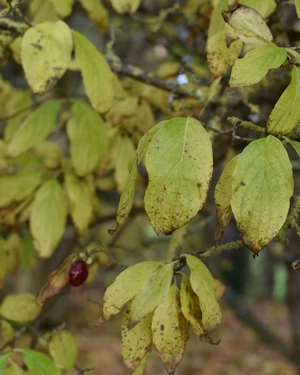
Common name: The common name "" comes .
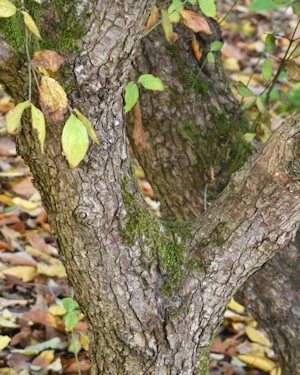
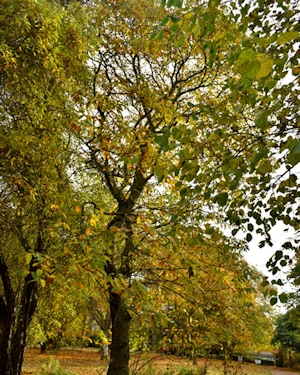
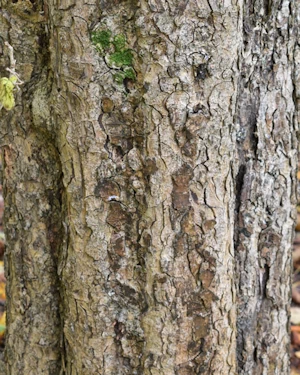
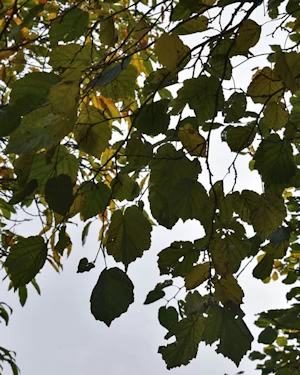
A.k.a. European cornel or Cornelian cherry dogwood, a medium to large deciduous shrub or small tree native to W Europe, S Europe, and SW Asia, growing to 5–12 m. It has dark brown branches and greenish twigs. The flowers are small with four yellow petals, produced in clusters of 10–25 in the late winter (between February and March in the UK), well before the leaves appear. The fruit is an oblong 2 cm long containing a single seed.
 October 2024
 October 2024
 October 2024
Turkish hazel
This is a true hazel, bearing nuts not unlike our British cobs - but smaller and lacking their taste - and surrounded by a softly spiny husk. Native across SE Europe and into W Asia, it is indeed found in Turkey. Its characteristic pendulous yellow catkins appear in late winter, with the nuts maturing in autumn as the leaves fade to a lustrous yellow. Its elegant conical shape and thick corky bark are features that can be admired year round. Although its nuts are inferior, Turkish hazel is important to commercial hazelnut production. Its non-suckering habit makes it an ideal rootstock for orchards, onto which to graft the common hazel cultivars.
 October 2024
 October 2024
Smoke bush
The species is a.k.a. Rhus cotinus, European smoketree, Eurasian smoketree, smoke tree, Venetian sumach, or dyer's sumach. It is a multiple-branching deciduous shrub growing to 5–7 m with an open, spreading, irregular habit, only rarely forming a small tree. Royal purple is a popular cultivar developed for its deep purple leaves. Large feathery, pink inflorescences in summer. Most of the flowers in each inflorescence abort, elongating into yellowish-pink to pinkish-purple feathery plumes (when viewed en masse these have a wispy 'smoke-like' appearance, hence the common name).
 October 2024
 October 2024
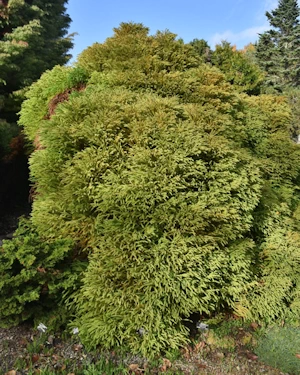
Armenian cotoneaster
An evergreen or semi-evergreen shrub. Like many cotoneasters, it features clusters of small flowers in spring and summer, followed by showy red berries in autumn and winter. The plant is native to a region spanning from NE Turkey to NW Iran. Like other species in its genus, it has the potential to become an invasive non-native species.
 October 2024
 October 2024
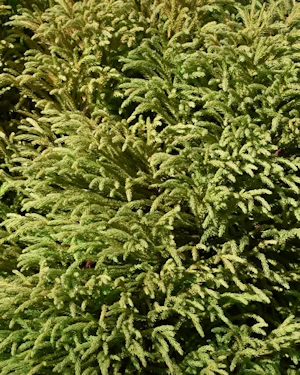
globosa nana
Dwarf Japanese cedar
An evergreen dwarf conifer forming a dense, dome-shaped plant with rich green awl-shaped leaves closely appressed to the shoots. The soft, needle-like foliage turns bronze in winter..
 October 2024
 October 2024
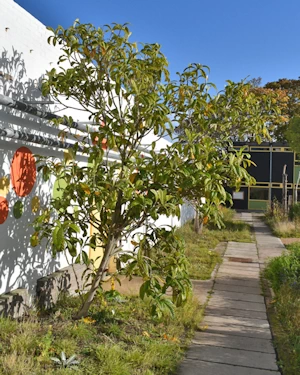
Bush honeysuckle
Diervilla splendens is a hybrid cross between D. sessilifolia and D. lonicera that originated in European cultivation in the mid-19th century. The common name that refers to the resemblance of its flowers to those of the lonicera genus, but the two genera are distinct. It has bright, yellow, trumpet-shaped flowers that bloom from early summer to autumn, and its foliage that turns vibrant colours in autumn.
 October 2024
 October 2024
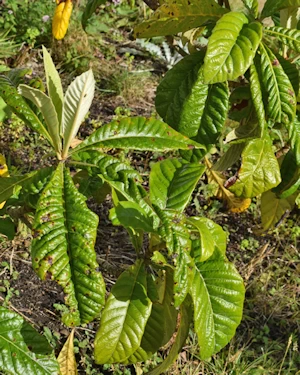
Loquat
A.k.a. Japanes medlar or Japanese plum. It is native to S China, but has been grown in Japan for over 1,000 years. A large, evergreen shrub or small tree, with a rounded crown, short trunk, and woolly new twigs. The tree can grow to 10 m but is often smaller. Loquats are unusual among fruit trees in that the flowers appear in the autumn or early winter, and the fruits are ripe at any time from early spring to early summer. The flowers have a sweet, heady aroma. Oval, rounded or pear-shaped fruits grow in clusters, with a smooth or downy, yellow or orange, sometimes red-blushed skin.
 October 2024
 October 2024
 October 2024
Dalrympleana
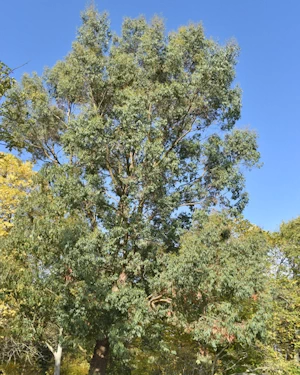
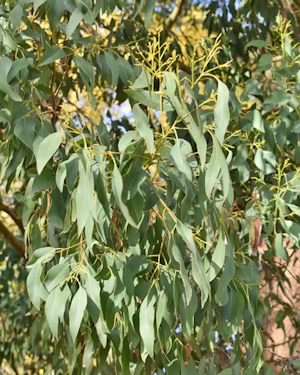
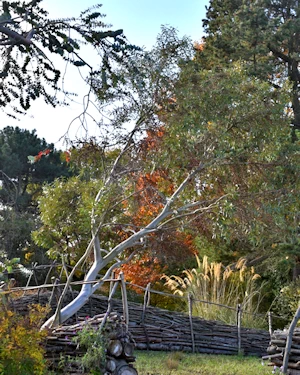
Mountain gum
A.k.a. white gum and broad-leaved ribbon gum, growing to 40m, a native of SE Australia. It has smooth bark, lance-shaped adult leaves, flower buds in groups of three or seven, white flowers and cup-shaped, bell-shaped or hemispherical fruit. The flower buds are arranged in groups of three or seven in leaf axils on a peduncle 3–12 mm long, the individual buds sessile or on a pedicel up to 3 mm long. Mature buds are oval, green to yellow, with a conical to rounded . White flowers occurs between March and June. The fruit is a woody cup-shaped, bell-shaped or hemispherical capsule 3–8 mm long.
 October 2024
 October 2024
moorei
Narrow-leaved sally
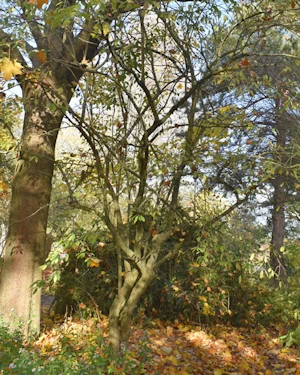
A a species of mallee that typically grows to a height of 6–10 m, native to New South Wales. It has smooth bark, linear to narrow lance-shaped or curved adult leaves, flower buds in groups of between seven and fifteen, white flowers and cup-shaped or shortened spherical fruit.
Eucalyptus moorei is a mallee (20–33 ft) and forms a lignotuber. Adult leaves are alternate, linear to narrow lance-shaped or curved, the same glossy green on both sides, 3 - 9 cm. The flower buds are arranged in clusters of between 7 and 15 in leaf axils on an unbranched peduncle. Mature buds are top-shaped, with a conical to horn-shaped . White flowers appear between February and May. The fruit is a woody cup-shaped or shortened spherical capsule.
 October 2024
 October 2024
 October 2024
Hamiltonianus lanceifolia
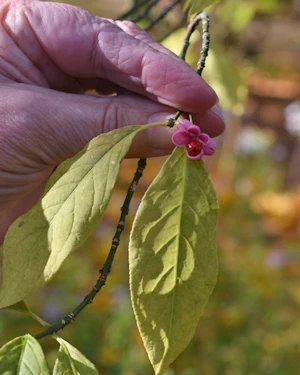
Hamilton's spindle tree
A.k.a. Himalayan spindle, and Siebold's spindle. It is native to Asia, where it is distributed in Afghanistan, Russia, China, Japan, Korea, India, Nepal, Pakistan, Bhutan, Thailand, and Myanmar. In the wild, it may grow to be a shrub of 3 m or a tree up to 20 m. The The inflorescence is a cluster of several white flowers, each nearly a centimeter wide. The brown, yellowish, or reddish fruit capsule splits into four sections holding brown seeds with orange arils.
 October 2024
 October 2024
 October 2024
atropurpurea
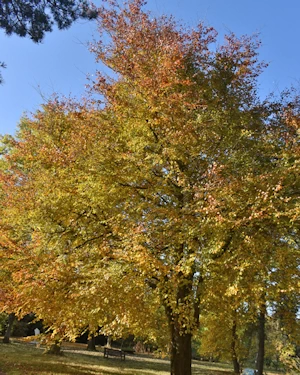
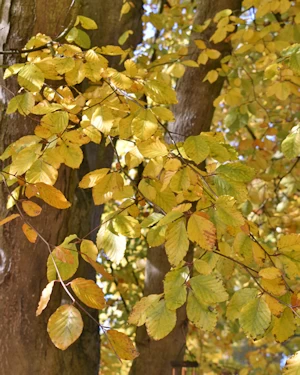
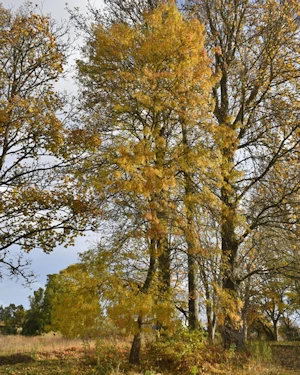
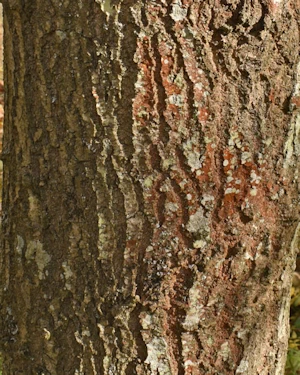
Copper Beech
Native across Europe, growing to a height of more than 40 m and develop a huge domed crown. The reddish brown, torpedo-shaped leaf buds form on short stalks and have a distinctive criss-cross pattern. Beech is . In April and May the tassel-like male catkins hang from long stalks at the end of twigs, while female flowers grow in pairs, surrounded by a cup. Beech woodland is shady and characterised by a dense carpet of fallen leaves and mast husks which prevent most woodland plants from growing. Only specialist shade-tolerant plants can survive beneath a beech canopy.
 October 2024
 October 2024
 October 2024
oxycarpa
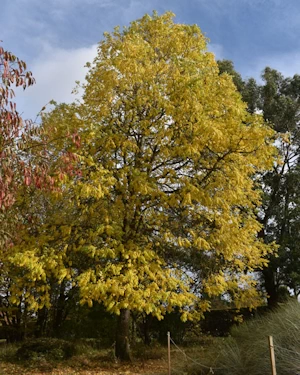
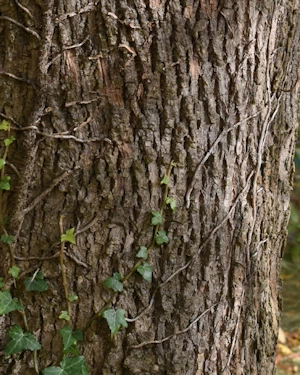
Raywood ash
A.k.a. Claret Ash or Raywood Ash. A fast-growing, medium to large deciduous cultivar growing to 15–20 m, with narrow, glossy leaves in summer and brilliant purple and red-wine autumn foliage. Narrow and upright when young, broadening to a full, rounded canopy with age. The flowers are produced in inflorescences which can be male, hermaphrodite or mixed male and hermaphrodite. Flowering occurs in early spring. The fruit when fully formed is a samara 3–4 cm long, the seed 1.5–2 cm long with a pale brown wing.
 October 2024
 October 2024
 October 2024
Oregon ash
a medium-sized deciduous tree that can grow to 20–25 m, native to W North America. It is common for the leaves and bark to show signs of disease and brown rot on otherwise healthy plants. Unlike bigleaf maples, ash twigs have woolly hairs. In mid to late spring, the tree produces small insignificant flowers. It is . The fruit, produced by female trees, is a cluster of samaras, 3–5 cm long that includes wings similar to maple trees.
 October 2024
 October 2024
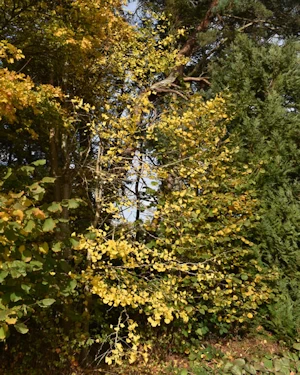
A long-lived dioecious tree with unique fan-shaped leaves, capable of clonal reproduction, and known for its striking yellow autumn foliage. Specimens have been measured in excess of 1,600 years, and the largest living trees are estimated to exceed 3,500 years. Ginkgos are large trees, normally reaching a height of 20–35 m. Ginkgo biloba is , with male plants producing small pollen cones with . Female plants do not produce cones. Two ovules are formed at the end of a stalk, and after wind pollination, one or both develop into fruit-like structures containing seeds. The outer layer of the fruit (the ) is attractive in appearance, but contains butyric acid and smells foul like rancid butter or vomit when fallen. As a consequence, most trees in cultivation are male clones.
 October 2024
Arnold Promise
Witch hazel 'Arnold Promise'
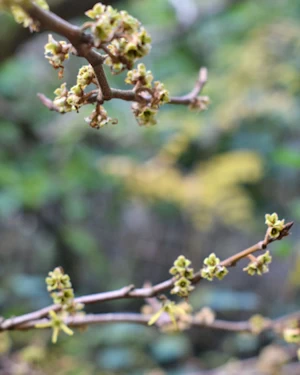
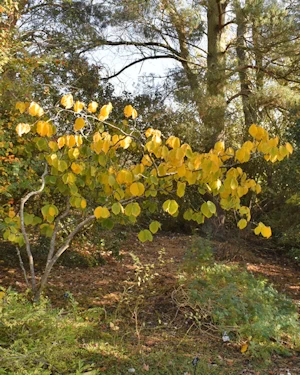
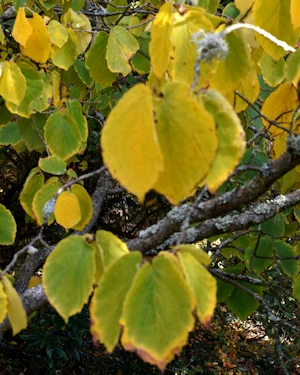
A vigorous, large spreading shrub, with an upright, fan-shaped vase form. Large, long-blooming four-petalled yellow flowers curl and uncurl in response to the weather, borne feely from December to March. They have a pleasant, 'tart' fragrance. In autumn, leaves turn yellow, orange to red hues.
 October 2024
 October 2024
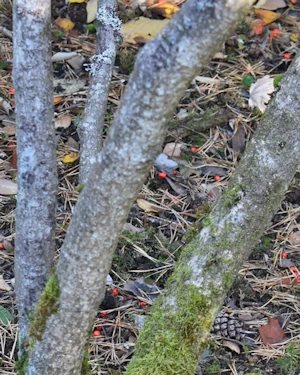 October 2024
Chinese hazel
.
A deciduous large shrub or small tree growing to 8 m, native to C and E China. Yellow flowers, often with a red base, have four ribbon-shaped petals 15 mm long, growing in clusters, flowering is in late winter to early spring on bare branches. The fruit is a hard woody capsule 12 mm long, which splits explosively at the apex at maturity one year after pollination, ejecting the two shiny black seeds.
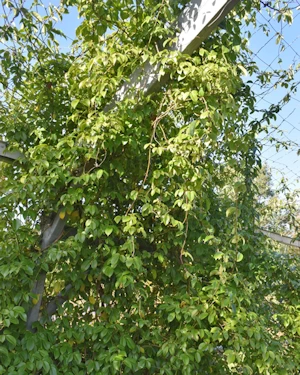 October 2024
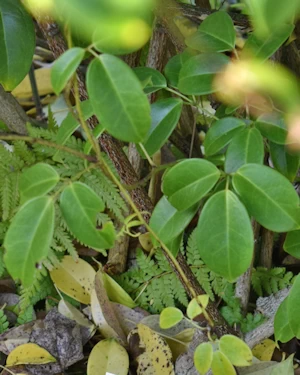 October 2024
Sausage vine
A vigorous, astonishingly hardy, evergreen climber with dark green, leathery leaves and short, elongated, violet coloured 'sausage' fruits, which are edible (though bitter). It is native to C China where it grows in scrubby thickets and mountain slopes. It has extremely fragrant flowers which can vary from white through pale green to pale purple, and appear in clusters in spring and early summer.
 October 2024
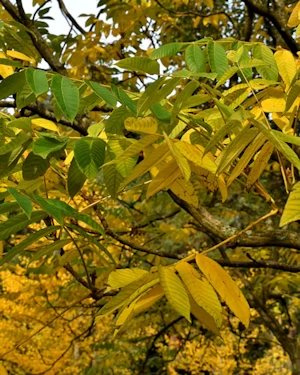 October 2024
 October 2024
cordiformis
Japanese walnut
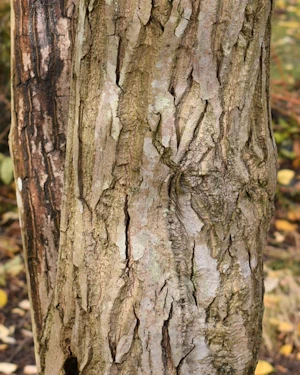
The species is a deciduous tree growing to 20 m, native to Japan. The male flowers are inconspicuous yellow-green catkins produced in spring at the same time as the new leaves appear. The female flowers have pink/red pistils. The fruit is a spherical nut surrounded by a green husk before maturity, produced in bunches of 4–10. This cultivar, the heartnut, is a cultivar distinguished by its heart-shaped fruit (in cross-section), which is very hard to crack. It is sweet without a bitter aftertaste often intrinsic with black and Persian walnuts.
 October 2024
 October 2024
Hornibrookii
Juniper
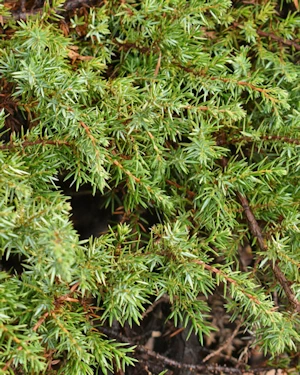
A noticeboard was by the juniper plants: Common juniper is the most widely distributed conifer in the world. Occuring right across the northern hemisphere, it grows in a vast range of habitats from the sea level to 2400m altitude. A wide range of different forms can be observed, from the trees of 18m in height to carpeting shrubs reaching just 18 cm in height. As a result, many subspecies have been described - in Scotland you are likely to see subsp. communis or subsp. nana. Globally, this plant has a Red List assessment of least concern. However, within the UK, over time populations have been reduced by , overgrazing, and removal of scrub habitat. In some places, there is very little regeneration - Juniper seed requires bare soil to germinate and the young plants are vunerable to grazing. Juniper is also threatened by a pathogen called Phytopthora austocedri which was first described in 2007 and first confirmed in the UK in 2011. The origin of this pathogen remains unclear, but it is a serious problem, causing die-back and death in a number of natural populations.
 October 2024
 October 2024
Chinese honeysuckle
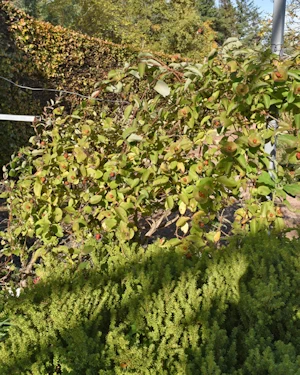
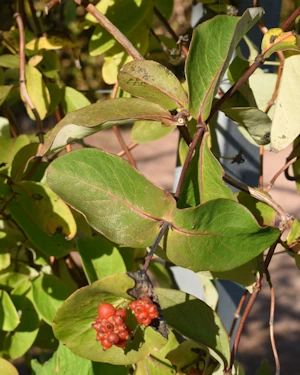
A deciduous climbing shrub growing to 6 m, native to Central China, where it inhabits forest, scrub and rocky crevices.It has grey-green leaves and trumpet-shaped, pure rich yellow flowers in late summer and autumn. Unlike many honeysuckles it is unscented.
 October 2024
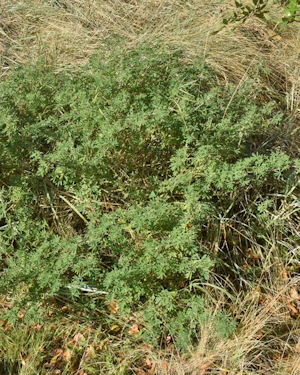
Rōhutu
A.k.a. tutuhi (Maori), a tall bushy shrub which can reach up to 6 m, native to New Zealand, usually found in lowland forest. It has a smooth trunk, beige hidden by pieces of greyish bark.The branchlets are numerous, erect and slightly pubescent. The leaves are much smaller than those of other trees of the same genus. They are thick, heart-shaped, opposite or , glabrous when adult (and pubescent before), and 5 to 10 mm long and wide. They are rather fragile and brittle.
 October 2024
 October 2024
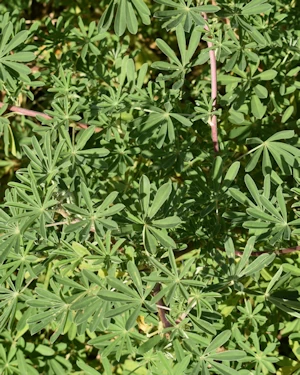
Tree lupin
A.k.a. yellow bush lupin, an evergreen shrub growing to 2 m, indigenous to California. In spring it bears many , 30 cm long, of fragrant, soft yellow, pea-like flowers. It has become an invasive species in many areas.
 October 2024
 October 2024
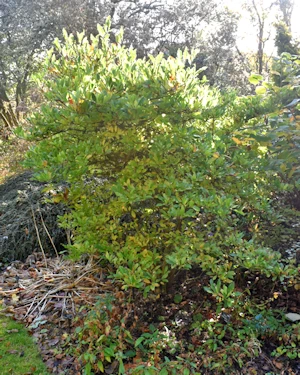
water lily
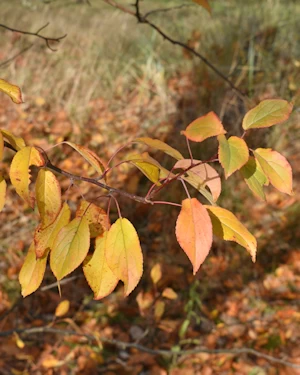
Star magnolia
A slow-growing deciduous shrub or small tree growing to 2.5 m, native to Japan. It bears large, showy white or pink flowers in early spring, before its leaves open. Flower colour varies from white to rich pink. The flowers are star-shaped, with at least 12 thin, delicate petal-like tepals, some cultivars (such as water lily) having more than 30. Fruits are reddish-green, knobby, aggregate, about 5 cm long.
 October 2024
 October 2024
 October 2024
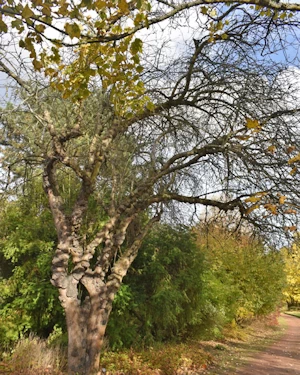
Chinese crabapple
A.k.a. Asiatic apple or Chinese flowering apple. It has white or pink flowers, depending on the variety. The fruit is yellow and about 2 cm in diameter. A native of China, where it is popular as an ornamental tree.
 October 2024
 October 2024
 October 2024
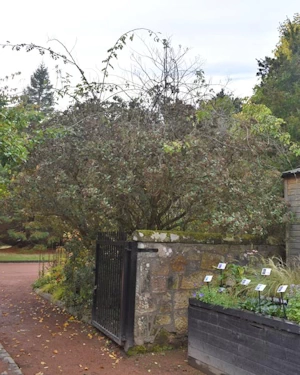
Dawn redwood
A vigorous, fast-growing deciduous conifer with fibrous, orange-brown bark, making a large, narrowly conical tree to 25m tall. The globose pollen cones are 5–6 mm long, produced on long spikes in early spring, but only on trees growing in regions with hot summers.
Older trees may form wide buttresses on the lower trunk, and distinctive "armpits" under each branch. The bark is vertically fissured and tends to exfoliate in ribbon-like strips.
 October 2024
 October 2024
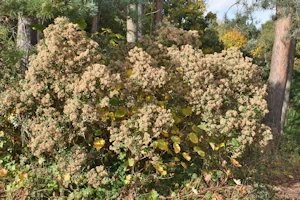
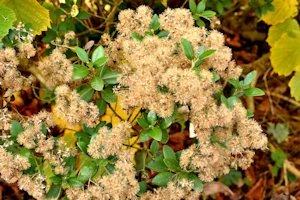
avicennifolia x paniculata
Mountain akeake hybrid
A hybrid. The first parent is a.k.a. Daisy bush, and is a small, bushy shrub or tree that grows up to 6 m, native to new Zealand. It has thin, papery bark and angular branchlets covered in white tomentum. Flowers are clustered and daisy-like with white rays and purple central disks. They emerge between November and February and have a sweet scent. They develop into fluffy seeds. The second parent is a small evergreen tree known as akeraho, again native to New Zealand, hasmany similar characteristics.
 October 2024
 October 2024
New Zealand daisy bush
A natural hybrid resulting from a cross between o. avicenniifolia and o. moschata, both native to New Zealand. A dense, bushy shrub with smooth, oval, evergreen leaves; dark green and glossy above, felted white below. Dense sprays of star-shaped, white flowers appear in mid to late summer.
 October 2024
 October 2024
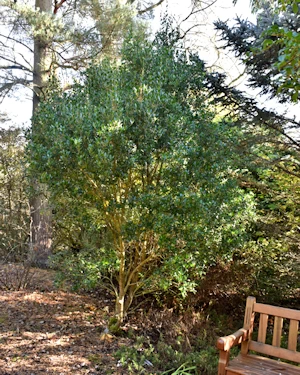
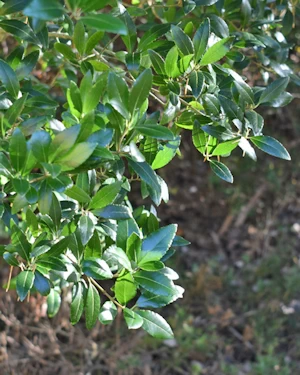
Osmanthus
A.k.a phillyrea decora, and dunce cap.A rounded, dense, medium-sized evergreen shrub to a height of 3m, native to Caucasia. It has dark green, leathery oval-shaped leaves. In mid spring, numerous small clusters of highly scented, tubular white flowers appear. These are followed by small, oval, purplish-black that ripen in autumn.
 October 2024
 October 2024
 October 2024
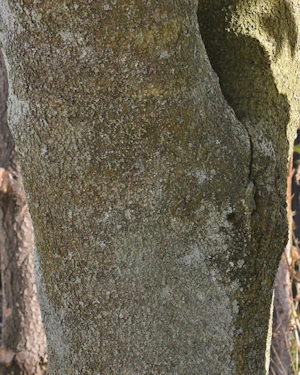
Goat willow
An evergreen shrub or small tree growing to 12 m, native to Yunnan and Sichuan in the far SW of China. In winter and spring, small clusters of creamy-white flowers in the leaf axils produce an intense fragrance. These are followed by egg-shaped fruit, dark purple with a white bloom.
 October 2024
 October 2024
microphylla
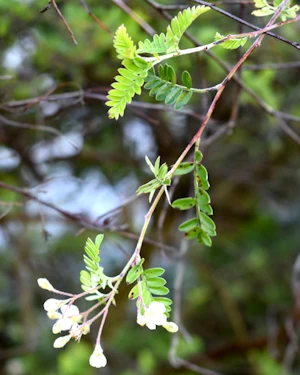
Chinese emperor plum
An evergreen shrub growing to 2.5 m in the open, considerably more against a wall; a native of Yunnan and other parts of W. China. It has long, slender, flexible branchlets covered with short grey hairs. Leaves are pinnate, composed of eight and a half to fifteen and a half pairs of obovate leaflets. The fruits are edible and can be eaten raw or used to make jellies and jams. The fruits have a sweet flavor. It is grown in gardens as an ornamental plant. It is also used in bonsai.
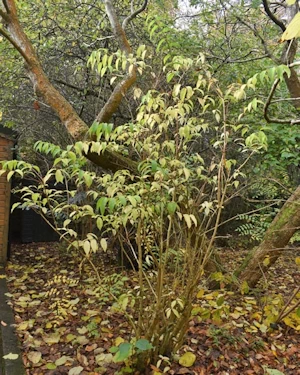 October 2024
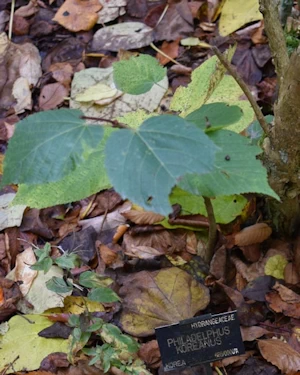 October 2024
Korean mock orange
A medium to large, multi-stemmed, deciduous shrub native to Korea. .It produces abundant, single, bowl-shaped, pure white flowers in late spring to early summer, typically in terminal clusters. A key feature is the strong, sweet, citrus-like fragrance, similar to orange blossoms,
The bark is dark brown, smooth, and shiny, often exfoliating in thin strips with age.
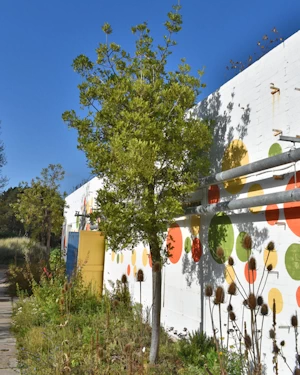 October 2024
 October 2024
Celery pine
A.k.a. tānekaha pine, is a medium-sized forest tree growing to 25 m, native to New Zealand. The leaves are sparse, tiny, scale-like, 2–3 mm long, and only green (photosynthetic) for a short time, soon turning brown. Photosynthesis is performed by phylloclades, which are highly modified, leaf-like short shoots, arranged alternately, 10–15 on a shoot. The seed cones are berry-like, with a fleshy white aril surrounding but not fully enclosing the single seed. Like the kauri, tānekaha shed their lower branches, producing smooth straight trunks and knot-free timber which is sought after for its strength.
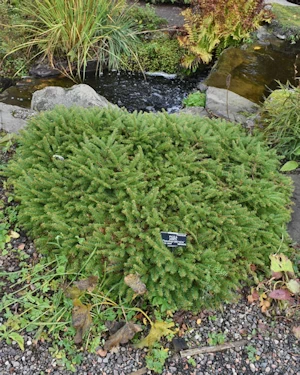 October 2024
pseudoprostrata
Dwarf Norway spruce
A wide-spreading, low-growing dwarf cultivar of the common Norway Spruce, characterized by its dense, wild-looking branches that stay close to the ground. A slow-growing evergreen conifer known for its broad, flat habit, unlike its towering, pyramidal parent species. It has the dark glossy green needles typical of Norway spruce.
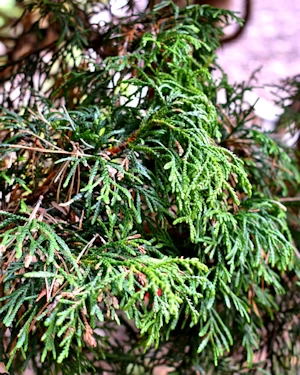 October 2024
 October 2024
Serbian spruce
A.k.a. Pančić spruce, after the Serbian botanist Josif Pančić. A medium-sized evergreen coniferous tree growing to 20 m, native to W. Serbia, E Bosnia and Herzegovina. The two pictured here are the standard, upright conical version, and the drooping cultivar. The cones are 4–7 cm (2–3 in) long, fusiform, dark purple when young, maturing to dark brown, with stiff scales. Grown widely as an ornamental, it is also used as Christmas trees, timber and paper production, particularly in N.northern Europe, though its slow growth makes it less important than Sitka spruce or Norway spruce. [Wikipedia]
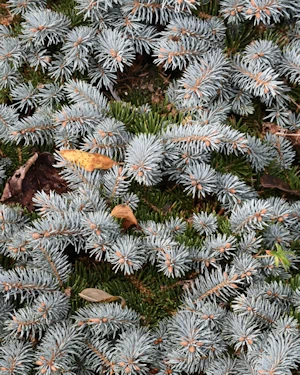 October 2024
Blue spruce
A large conifer reaching 50 m in the wild, more often 18 m in cultivation. It has scaly grey-brown bark with a cinnamon-red undertone on its trunk. On older trees the bark becomes deeply furrowed and scaly. The narrow, needle-like, evergreen leaves are quite sharply pointed and may be dull green, blue, or pale white. , develop throughout the crown, but are more common in the upper half. Purple-brown seed cones form at the top of the tree in May/June and release their mature seeds in the autumn of the same year, turning light brown as they mature.
 October 2024
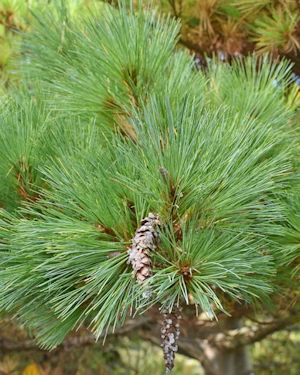 October 2024
Eastern White Pine
A.k.a. Weymouth pine, northern white pine, white pine and soft pine, a large pine native to E North America. The seed cones are slender, 8–16 cm long and have scales with a rounded apex and slightly reflexed tip, often resinous. Branches are spaced every 45 cm on the trunk with 5-6 branches like spokes on a wagon wheel.
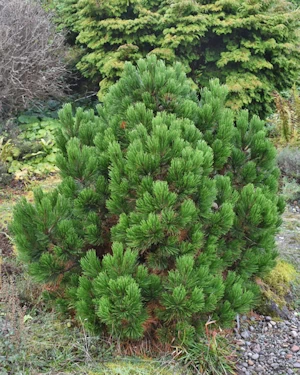 October 2024
 October 2024
Schmidt
Bosnian pine 'Schmidt'
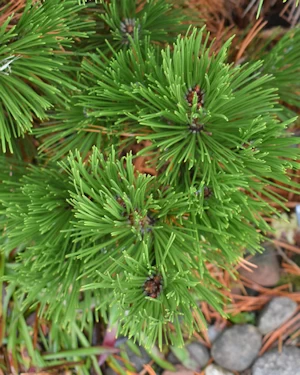
A.k.a. Pinus heldreichii. A very slow-growing conifer forming a broadly ovoid dwarf shrub with rigid, deep green needles. The species has distinctive bark that becomes grey-brown and deeply grooved into scale-like plates as it ages, often described as snakeskin crocodile-skin texture. While the dwarf cultivar may not develop this mature bark quality due to its small size, it will still produce small cones that emerge a striking blue-purple color before ripening to a pale brown.
 October 2024
 October 2024
Dwarf mountain pine
.
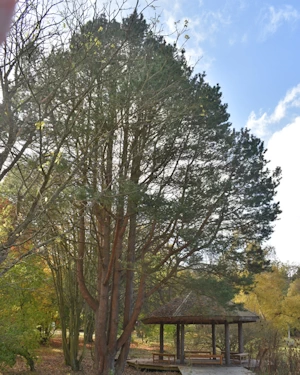
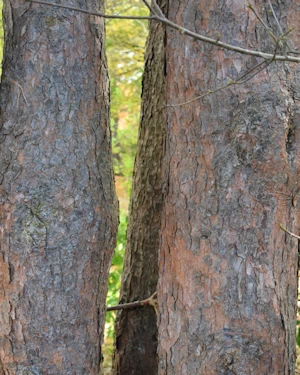
A.k.a. mountain pine, scrub mountain pine, Swiss mountain pine, bog pine, creeping pine, or mugo pine. A small, slow-growing, evergreen, often multi stemmed, tree, native to S and E Alps and the Balkan peninsula, capable of reaching 3–6 m. It has matt-textured, thin-scaled nut-brown symmetrical cones.
 October 2024
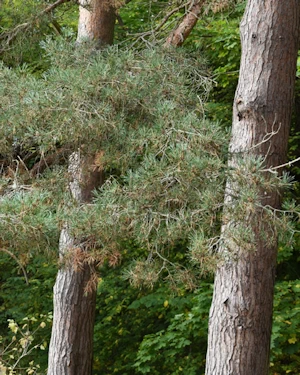 October 2024
Scots pine
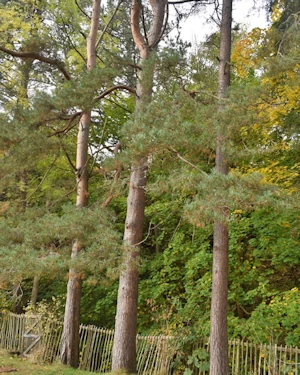
An evergreen conifer native to northern Europe. Mature trees grow to 35m and can live for up to 700 years. The needle-like leaves are blue-green and slightly twisted, and grow in pairs on short side shoots. Scots pine is Male flowers comprise clusters of yellow anthers at the base of shoots. Female flowers are small, red-purple and globular, and grow at the tips of new shoots. [Woodland Trust]
 October 2024
 October 2024
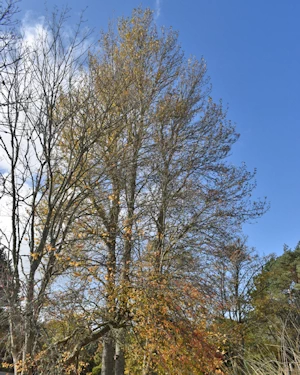
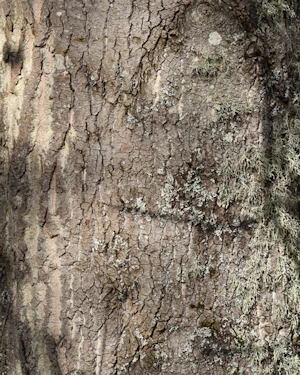 October 2024
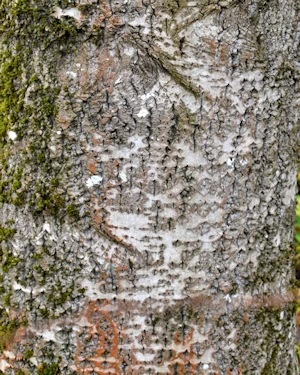
Balsam Spire poplar
A fast-growing, columnar hybrid with a narrow, upright habit. It produces sweet, balsam-like scent from the sweet resinous sap found in sticky buds in spring, with reddish twigs and textured bark.
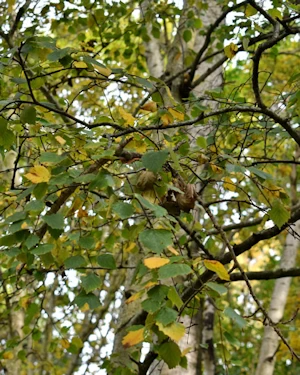 October 2024
 October 2024
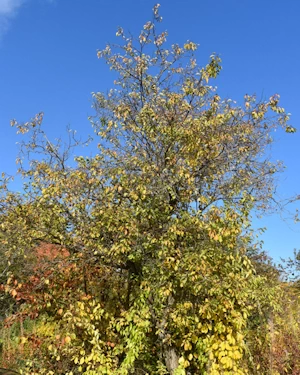
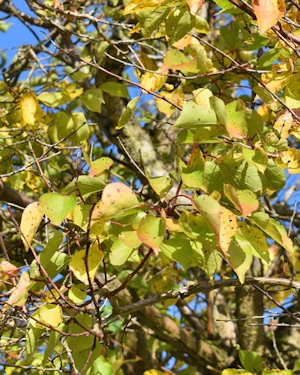
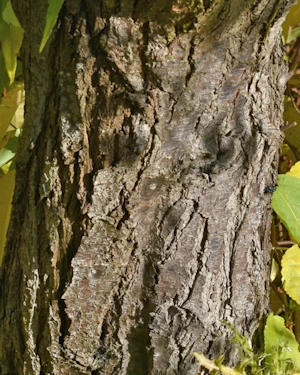
Aspen
Aspen leaves tremble, even in the slightest breeze. This has given rise to many of its common names, including its Gaelic form, critheann)which means 'quivering one'. Old beliefs suggest that it had been cursed by the devil and so could never rest. The tree often occurs in groups derived from a 'suckering' root system The timber is of poor quality, but has been used for matches and basic crates.
 October 2024
 October 2024
 October 2024
Apricot
A.k.a. Armenian plum. The apricot spread to Europe from W Asia via Armenia, though its origin is likely China. A small tree, 8–12 m tall and a dense, spreading canopy. The flowers have five white to pinkish petals, produced singly or in pairs in early spring before the leaves. The fruit is a drupe similar to a small peach, its surface can be smooth or velvety with very short hairs. The flesh (mesocarp) is succulent and its taste can range from sweet to tart. The single seed is enclosed in a hard shell, often called a stone, with a grainy, smooth texture except for three ridges running down one side.
 October 2024
 October 2024
 October 2024
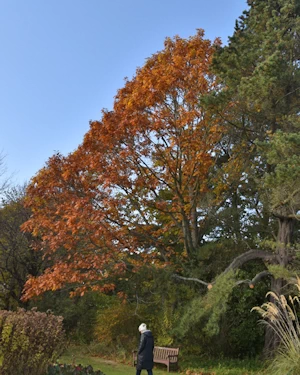
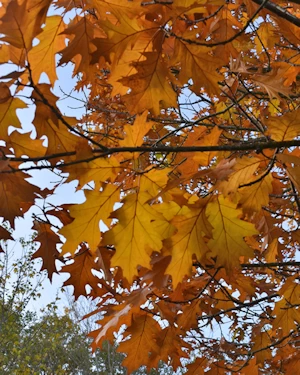
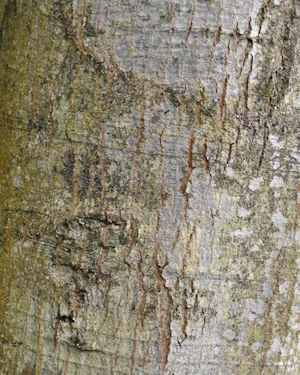
Red oak
A deciduous tree native to N America and S Canada. It can grow 30 to 40m, with a trunk up to 2m in diameter, quite straight and not too spreading in habit. The acorns take two years to develop on the tree. It is considered invasive in Europe, and is a neophyte in Britain.
 October 2024
 October 2024
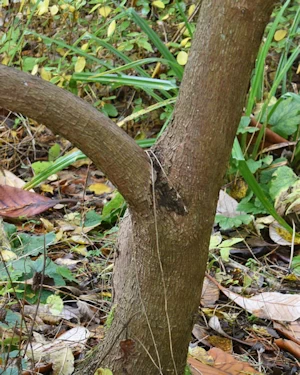 October 2024
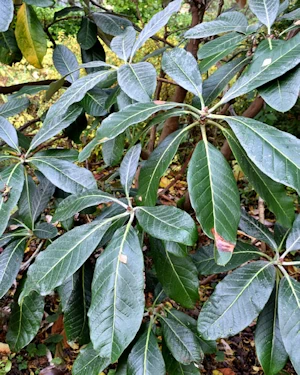
macabeanum
McCabe's rhododendron
A very large evergreen shrub or small tree growing to 12 m with glossy dark green leathery leaves that are greyish-white beneath, up to 30 cm in length. Flowers are bell-shaped, pale to deep yellow with a purple blotch, in large, dense rounded trusses, early to mid spring.
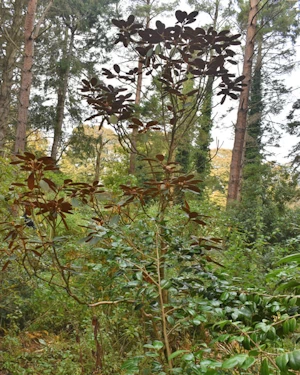 October 2024
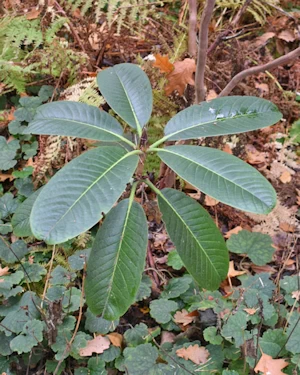 October 2024
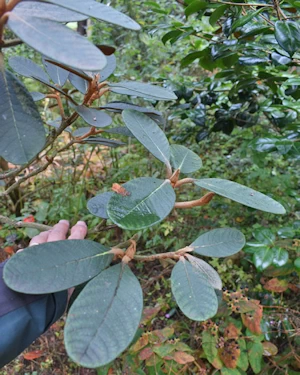 October 2024
mallotum
Rhododendron mallotum
A noticeboard comments: This plant occurs only in a small area on the border between China and Myanmar. It grows in thickets, forests and rock gullies, above 3000m altitude. The furry coating on the underside of the leaves is known as indumentum, and starts white on very new leaves, soon turning a wonderful coppery brown. The flowers are a deep red and appear in spring. It was classified as endangered by the most recent Red List assessment in 2011, which means it is at high risk of extinction in the wild. It occurs naturally in only a small geographical area, and is threatened by development, including major new roads. Growing threatened plants in a garden setting (also known as ex situ) provides some insurance in case anything happens to the remaining plants in the wild. Botanical gardens around the world work together via networks like Botanic Gardens Conservation International (BGCI), to maximise the value and diversity of their collections.
 October 2024
 October 2024
veitchianum
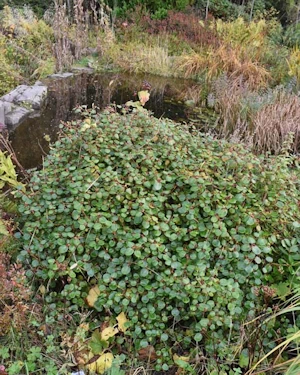
Rhododendron veitchianum
An evergreen shrub growing to 2–3 m, often , native to Thailand, Myanmar and Laos. The large trumpet-shaped flowers are 5–6.5 cm in diameter, white, often with a yellow blotch at the base, with 10 stamens (characteristic of rhododendrons), and appear in terminal trusses of up to 5.
 October 2024
 October 2024
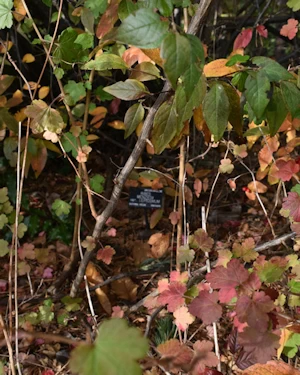
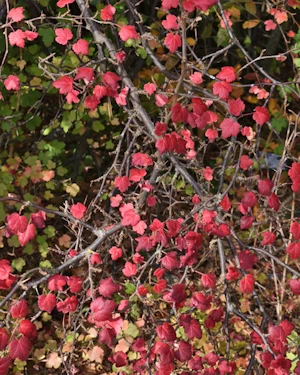
williamsianum
Williams Rhododendron
A compact, spreading small evergreen shrub, 1-1.5 m tall, native to SW China, with neat rounded or heart-shaped leaves, bronze when young and glaucous beneath. Bell-shaped, soft rose-pink flowers, 5 cm wide, are borne in small trusses in mid spring. [RHS]
 October 2024
 October 2024
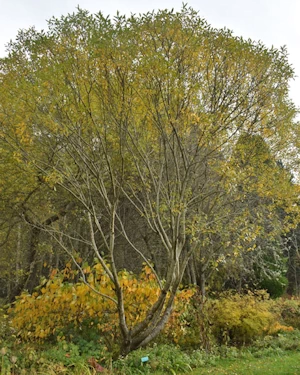
leptosmum
Canyon gooseberry
A deciduous spiny shrub up to 2 m high, native to W North America from central California to Oregon. Young shoots are downy and covered with long, slender bristles. The flowers are red-purple with a short, bell-shaped base, the sepals 1 cm. long; petals are white, sometimes rosy tinted. Fruits are globose, covered with glandular bristles, the remains of the flower persisting at the top.
 October 2024
 October 2024
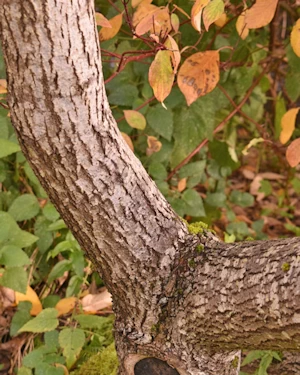 October 2024
A large shrub or small tree growing to 14 m, usually in wet, boggy ground. The dioecious flowers are catkins, produced in late spring after the leaves; the male catkins are yellow, 2 – 5 cm long, the female catkins greenish, 1.5 – 3 cm long; they are pollinated by bees. The fruit is a small capsule containing numerous minute seeds embedded in white down which aids wind dispersal. [Wikipedia]
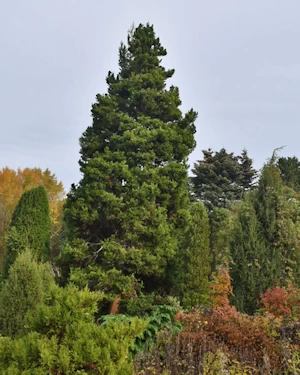 October 2024
 October 2024
giganteum
Giant redwood
Arguably the world's most impressive tree. It is the largest tree by volume and can live for more than 3000 years. Publication of its discovery in the Sierra Nevada, California, in 1852 caused a sensation. The first seed to reach Europe arrived in Scotland in August 1853 with John Matthew, narrowly beating a consignment for Veitch Nurseries in Exeter. The main use of this tree is as a grand specimen, but some experimental forestry has been conducted in Britain.
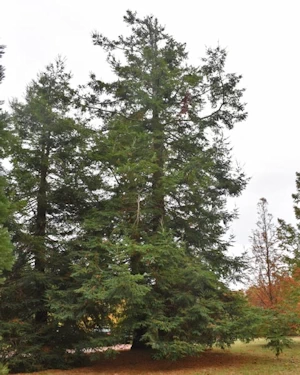 October 2024
 October 2024
Coast redwood
The sole living species of the genus Sequoia, capable of living 1,200 – 2,200 years or more. This species includes the tallest living trees on Earth, reaching up to 115 m. The bark can be very thick, up to 35 cm, quite soft and fibrous, with a bright red-brown color when freshly exposed (hence the name redwood). The species is . Seed cones are ovoid, up to 32 mm long. Seeds are released when the cone scales dry and open at maturity.
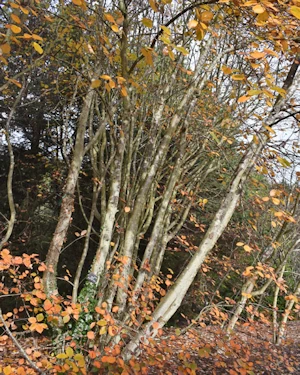 October 2024
 October 2024
 October 2024
English whitebeam
A.k.a. anglica, a small tree or shrub, often with multiple stems, native to Ireland and the United Kingdom. It is usually found growing on cliffs, quarries and rocky hillsides. It probably arose as a natural hybrid cross between Aria porrigentiformis and Sorbus aucuparia. Flowers are white, small (1 cm across), with creamy filaments and anthers, and two or three styles. Fruits are more or less globose, about 1 cm wide.
 October 2024
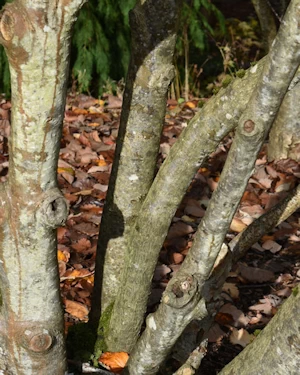 October 2024
Arran whitebeam
One of the rarest and most endangered trees in the world. It is a hybrid of rowan and rock whitebeam only found naturally on the Isle of Arran in Scotland. It is a small, slender, broadleaf tree, reaching a height of 7.5m in favourable, sheltered conditions, but more commonly only reaching 2m because of the harsh weather conditions and over-grazing. The leaves share some of the characteristics of s. aucuparia and (s.rupicola), the original parent species. Arran whitebeam has lobes but not separate leaflets.
 October 2024
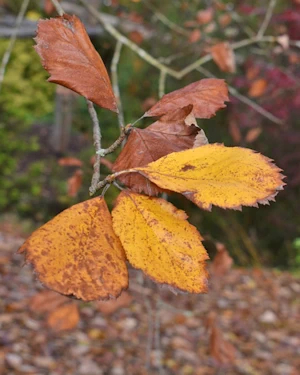 October 2024
 October 2024
Bristol whitebeam
A.k.a. bristoliensis. A shrub or small tree growing to about 10 m. Flowers are 2 - 5 cm wide, white, appearing in May or early June. Fruits are broadly ellipsoid, bright reddish orange and glossy.
 October 2024
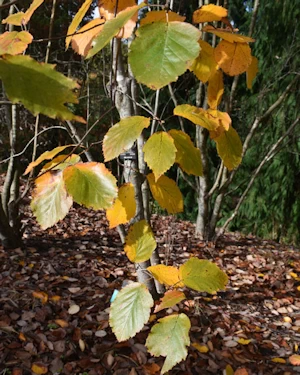 October 2024
 October 2024
Devon whitebeam
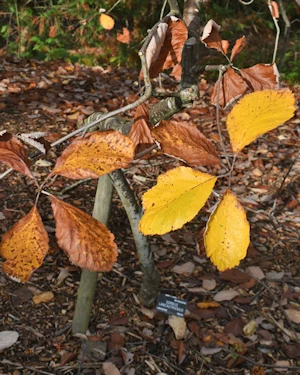
A.k.a. . The flowers are creamy-white clusters (umbels) blooming in late spring.These turn into rounded, orange-brown berries that ripen to a russet-red, becoming soft and edible (medlar-like) in autumn.
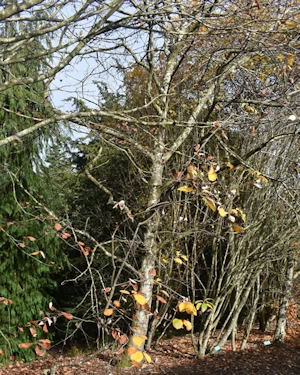 October 2024
 October 2024
Lancashire whitebeam
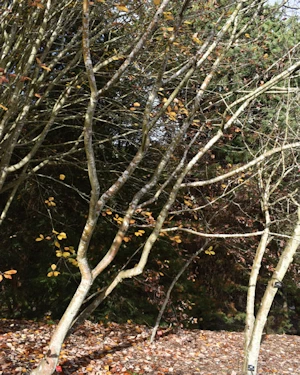
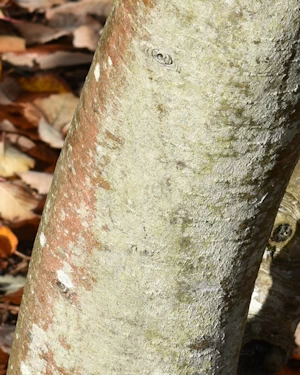
A.k.a. aria lancastriensis, and Lancastrian mountain ash, it grows only in a small area north of Morecambe Bay in Lancashire and Cumbria. A deciduous shrub or small tree growing to 6 m. Creamy white blossom in spring is followed by bright orange-red berries.
 October 2024
 October 2024
Lesser whitebeam
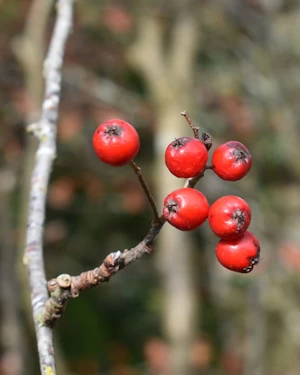
A.k.a. Hedlundia minima, and least whitebeam, a deciduous shrub in the rose family Rosaceae. It belongs to the genus Hedlundia, which includes species that have arisen from a hybridisation between members of the genus Sorbus (rowans) and members of genus Aria (whitebeams). It is an microspecies endemic to Wales. Probably a hybrid between the rock whitebeam (A. rupicola) and the rowan (S. aucuparia). It is a slender, deciduous shrub which can reach 3 m. The leaves are 6–8 centimetres long and are fairly narrow and oval in shape, acutely pointed at the tip and base. Flowers are produced in May and June and their white petals are 4 mm long. The red berries are 6–8 mm diameter.
 October 2024
 October 2024
 October 2024
Arran service-tree
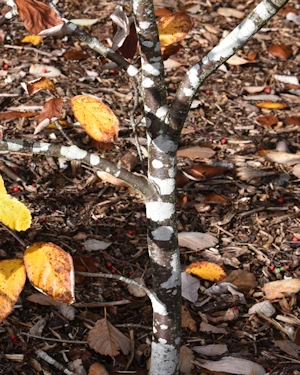
A.k.a. and Arran cut-leaved whitebeam, a rare tree endemic to the Isle of Arran in Scotland, threatened by habitat loss. It is thought to be a naturally occurring hybrid between H. arranensis and Sorbus aucuparia. Hedlundia arranensis is itself a hybrid between Aria rupicola and sorbus aucuparia. and hybridisation are common in some groups of sorbus species. There are at least two of these trees in the Garden, one labelled Hedlundia pseudofennica, the other sorbus pseudofennica.
 October 2024
 October 2024
 October 2024
Rock whitebeam
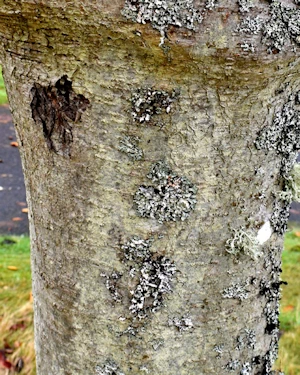
This deciduous tree or woody shrub clings to areas of rocky woodland and fissures in limestone cliffs. A parent species of the rarer Arran whitebeam, the rock whitebeam is becoming increasingly hard to find. It has upright stems and oval, serrated mid-green leaves. It can reach 10m high. Flowers are white, 12–16mm diameter and grow in loose clusters in June to July, similar to those of rowan but larger. These are followed by deep red berries, 12–15 mm in diameter, broader than long, with numerous scattered over the surface. The berries fruit from September to November.
 October 2024
 October 2024
 October 2024
Sargent's rowan
A small to medium-sized deciduous tree growing to 16 m, native to SW China, where it grows at altitudes of over 2000 m.
It is (20–52 ft) tall, with a trunk up to 50 cm (20 in) in diameter, and a rounded crown. The flowers are 5–7 mm in diameter, with five white petals and 20 yellowish-white stamens, produced in very large in late spring to early summer. The fruit is a small , bright orange-red to red, maturing in early autumn; it is juicy, and readily eaten by thrushes, which disperse the seeds.
 October 2024
 October 2024
Snowberry
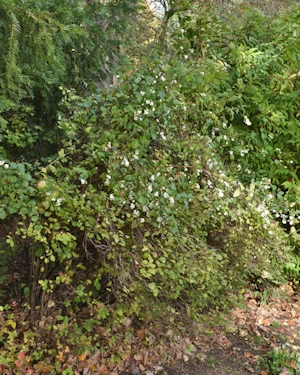
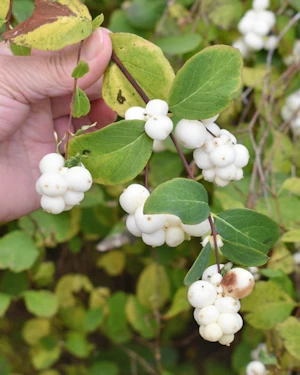
An erect, deciduous shrub, reaching 1–2 m high, producing a stiff, branching main stem and several smaller shoots from a rhizome. It can be invasive, spreading and colonizing an area to form a dense thicket. The inflorescence is a raceme of up to 16 flowers. Each flower has a small, five-toothed calyx of sepals. The bell-shaped, rounded corolla is bright pink in colour. It has pointed lobes at the mouth and the inside is filled with white hairs. The fruit is a fleshy white berry-like .The plant sometimes reproduces via seed but it is primarily vegetative, reproducing by sprouting from its spreading rhizome.
 October 2024
 October 2024
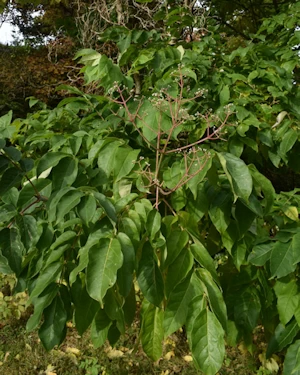
Bee-bee tree
A.k.a. Korean evodia,a native to Korea and SW China. A small tree reaching 20 m, and having pinnate leaves with 7-11 leaflets. Scented white flowers of 3-4mm are borne in which are highly attractive to bees, hence the common name bee tree. Small red seed pods, each with a distinct hooked beak, are produced in late summer. When ripe these will split to reveal two glossy black seeds, which are a favourite with birds [Cambridge Botanic Garden].
 October 2024
 October 2024
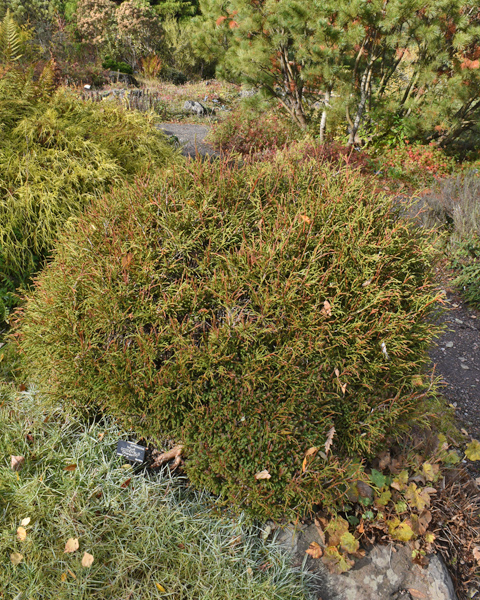
Ohlendorffii
Ohlendorff's American Arborvitae
A slow-growing, dwarf evergreen conifer, with dense, mounding form, irregular upright habit, and unique thread-like, juvenile foliage that is chocolate-green, turning reddish in winter. Capable of growing to 3 m if not pruned.
 October 2024
 October 2024
 October 2024
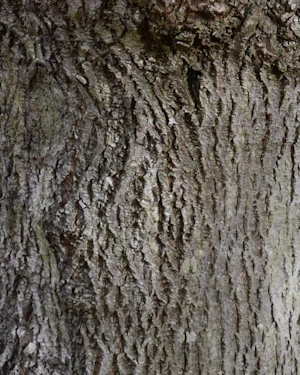
Large leaved lime
A narrowly domed tree possibly reaching 40 m, though more typically 25 m. The small, fragrant, yellowish-white flowers are arranged in drooping, clusters in groups of 3 to 4. Their whitish-green, leaf-like bracts have an oblong-obovate shape. The fruit is a round greenish-grey nutlet, with a woody shell.
 October 2024
 October 2024
 October 2024
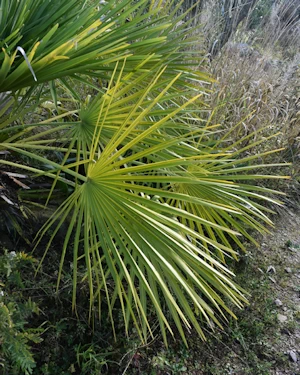
Windmill palm
Also called the Chusan palm, native to subtropical and temperate mountain forests of China, Japan, Myanmar and India where it typically grows to 12-20m. One of the hardiest of the palms, cultivated for its coarse but strong leaf sheath fibre, used for making rope, sacks, and other coarse cloth where strength is important.
 October 2024
 October 2024
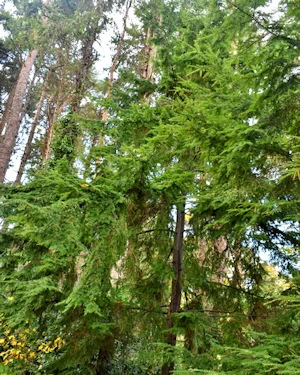
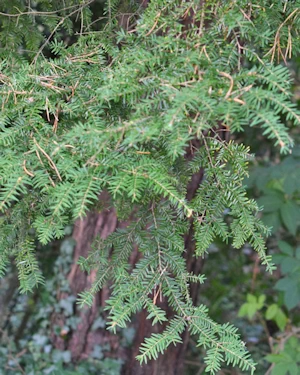
Western hemlock
A noticeboard by the tree says: Western Hemlock is native to the western parts of the USA and Canada. If it often a dominant species, forming extensive forests, but it also occurs with Douglas Fir (Pseudotsuga menziesii) and Sitka Spruce (Picea sitchensis) – both well known conifer species which are cornerstones of UK forestry. Western Hemlock is widely used for timber and for paper pulp.
This stately tree can reach 60m in height. Needles grow on a short stalk, are of different lengths, and have rounded tips. The small cones help to distinguish it from Douglas Fir and Sitka Spruce.
The small trees growing here were not planted and have all seeded from an older tree. Western Hemlock can regenerate easily in shade, including under an existing canopy. The seed can germinate on existing substrates, such as leaf mould, needle duff, old stumps or fallen tree trunks. This can give it a competitive advantage over trees which need bare soil and also be beneficial for foresters. However, it can be problematic if it allows it to invade valuable natural habitats such as Scots pine forest or native broadleaf woodland. Western Hemlock is the state tree of Washington, USA.
 October 2024
 October 2024
 October 2024
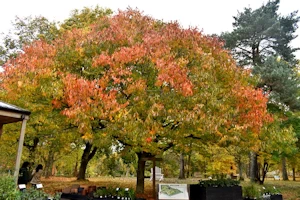
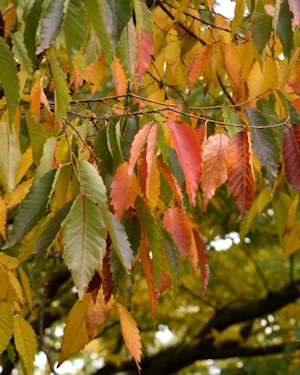
Japanese elm
A.k.a. keyaki (Japanese). A spreading, medium-sized deciduous tree growing to 30 m, native to Japan, Taiwan and E China. There are insignificant greenish flowers and fruits, which are small drupes only 3 mm wide.Zelkova is valued in Japan for the production of commercial timber. It is also the symbol of many Japanese cities. In Korea, a study showed that the largest percentage of trees over 500 years old were Zelkova, 10 of them registered as natural monuments.