Garden topiary - the potager
This page and its linked pages are in development. More pictures of this area over the years to follow.
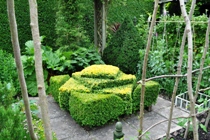
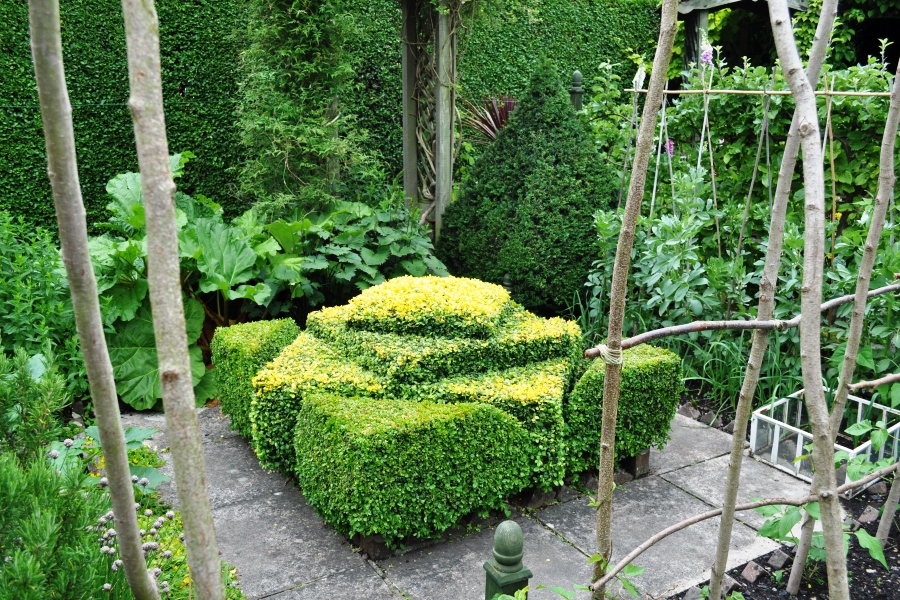
Box square in the centre of the vegetable plot.
Box in the potager
The potager
We do not grow a lot of vegetables, but do have a small square (about 5 x 5 yards) in which we usually grow rhubarb, mint, courgettes, beans, rosemary, sage, leeks and lettuce. In the centre of this potager is a clipped box topiary form. the centrepiece is ordinary buxus sempervirens, and the triangular corners are the smaller suffruticosa - 3 bushes to each corner. For some reason the centre grows with a yellow leaf, but this turns green as it ages. Some tight clipping is needed to keep the shape, particularly the corners which do not have a lot of strength in their stems.

Rubble and ash make a foundation for paving

Approaching its most mature stage as a vegetable plot.
Early layout in 1990s, matured in July 2010
Early views
Originally the square was laid out with foundations for a path using rubble and ashes. The path was bordered with paviours in dog-tooth fashion. Box was planted in the centre. This was perhaps in the late 1990s? By 2010 the box had matured into a square, with a diamond on top. Hazel poles were erected for runner beans each year. Trellis pyramids were in the four corners.
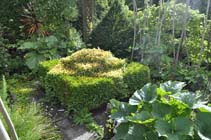
Box square under attack from box blight.
Box blight attack
Box blight
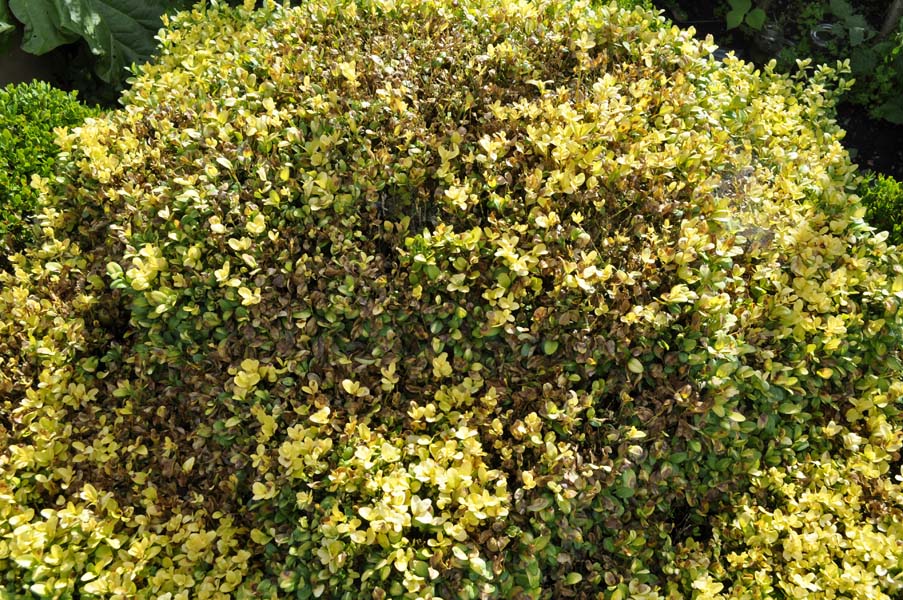
By 2017 box blight had made serious inroads into the topiary. Despite spraying with Bayer fungus fighter, and attempting to clip out affected areas, the summer saw all parts of the bushes badly affected, with the tell-tale brown leaves way back into the bush. The difficult decision was made to cut the bushes down - saying farewell to eighteen years of careful clipping and shaping.
Other box plants in the garden have patches of blight ranging from almost zero (a few browning leaves) to quite bad (defoliated and lots of brown patches). Some have recovered with cutting out the affected branches and spraying with Bayer fungus fighter. Each is being given every possible chance to recover before it is foresaken.
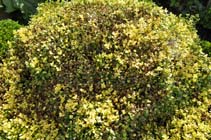
Box leaves suffering from blight
Blight attack
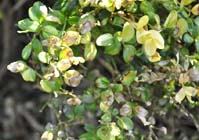
Box leaves suffering from blight attack
Affected leaves
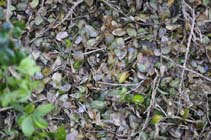
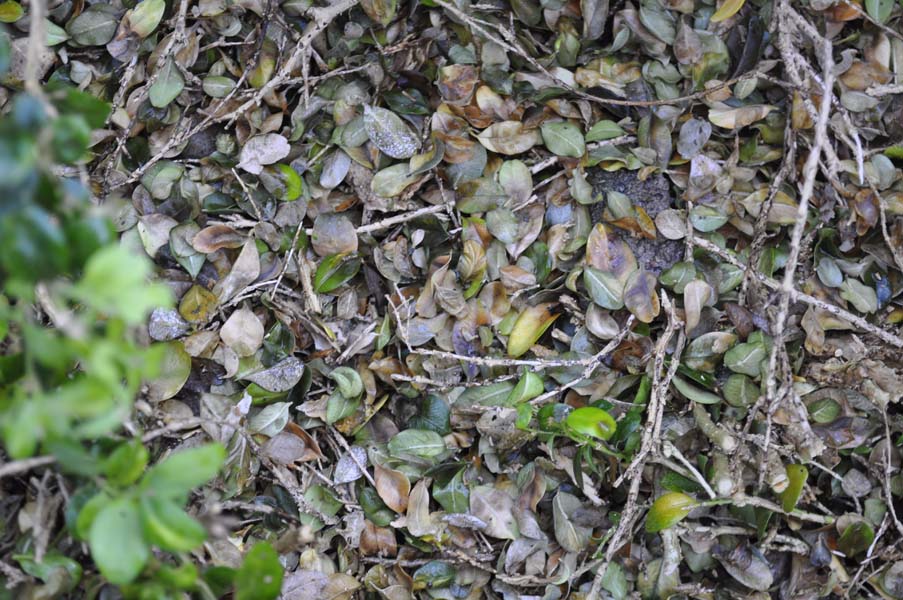
Box leaves suffering from blight turn brown and die back
Badly affected dead leaves
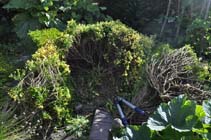
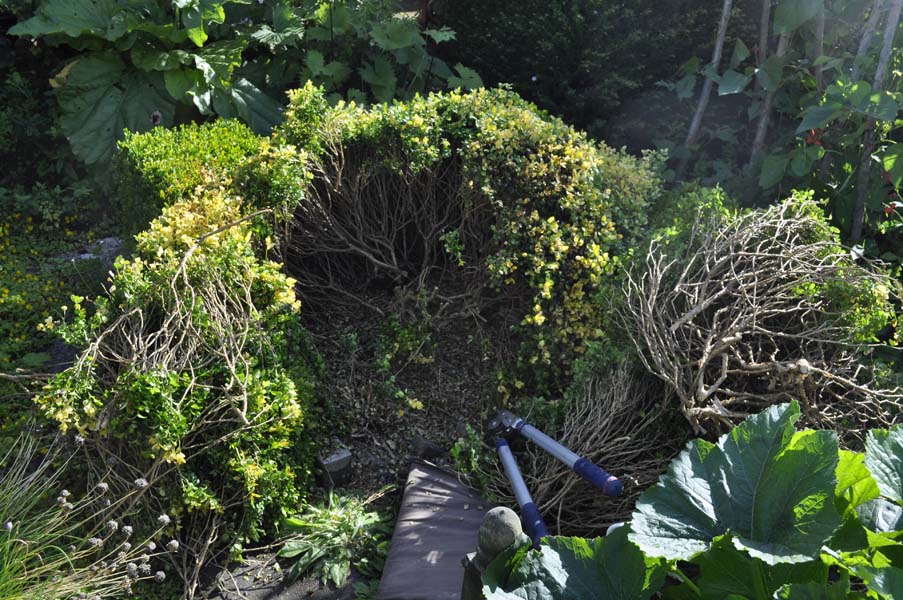
Box topiary cut back to the roots
Box cut ready for burning
Box square clipped down
The box was cut at the roots and piled up in situ ready for burning. It was covered with a tarpaulin whenever rain threatened, to allow it to dry out over three to four weeks. Once cut the full extent of the blight was clear, with brown leaves held in the centre of the bushes, and presumably holding the blight in there as well. Every effort was made to prevent any of these leaves blowing elsewhere, or being trodden around the garden on boots.
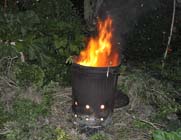
Box being burnt following blight attack
Burning box.
Incinerating the infected bushes
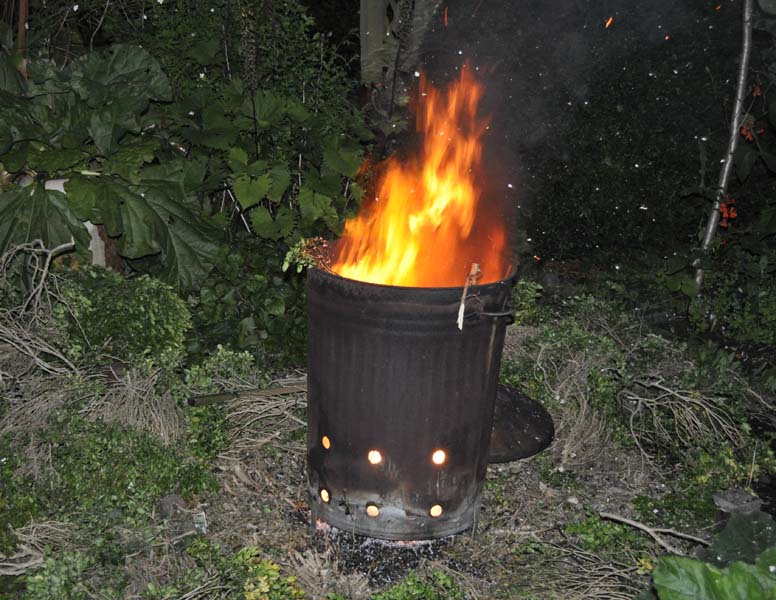
One night in July the incinerator was brought down to the square and all the box bushes were burnt with a powerful blaze. They were put in the bin a few strands at a time, and they certainly burnt well. After an hour or so this carefully clipped topiary was reduced to a few ashes. Very, very sad.
Rather than considering replainting any kind of topiary, it was decided that the paving in the area would be extended and this would become a seating area, probably surrounded by colourful annuals and herbs. There are two yew pyramids in the corners - possibly another two will be shaped in the other two corners. More on box blight

Sub base for paving laid out and levelled. Any rubble was used first, then a ton of Type 1 MOT bought in a dumpy bag and spread on top.

Sub base for paving laid out and levelled. Any rubble was used first, then a ton of Type 1 MOT bought in a dumpy bag and spread on top.
Hardcore base for paving the area.
Complete change: paved seating area
In 2018 Management decided she liked the outdoor sofa style furniture. The area was cleared, dug out, levelled and filled with MOT Type 1 subcore. Tamped down with a hand-tamper (a vibrator plate would be better but not available), then covered with thirty 2 x 2' plain concrete flags, mixing new with those that had previously formed a path in the area. The dog-tooth paver edging was lifted, repositioned and re-laid.

L shaped Hartmann table and sofa, plus buffets
Hartmann seating area.
Sofa and table installed
The paving slabs were laid, butt jointed on dabs of mortar, on a day which could have been drier for such a job, but it got done. An L-shaped corner sofa, table with glass top and 2 buffets made by Hartmann, were purchased and installed. A day's construction screwing it together and getting rid of the excessive plastic coverings. All plastic rattan style waterproof weave, though it does have a cover as well for bad weather. Some pots were installed in the corners with plants to soften the concrete.
The verdict? Looks good on a sunny day with everything uncovered and in use. Looks a bit monolithic over winter all covered up and grey.
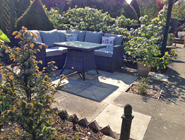
L shaped Hartmann table and sofa, plus buffets
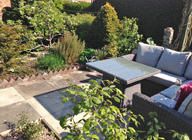
Paved rectangular seating area
The new seating area.
May 2020 Views
A couple of years on and the area is maturing, with a golden yew beginning to shape into a pyramid, and another yew planed in the third corner of the remaining bed. A witch hazel in a large pot is in the fourth corner. A cotoneaster is growing in a square left unpaved, which should provide a screen to the north side of the area eventually. The blossom on the espalier apple was at its best this year.
 Goat's beard before summerhouse building
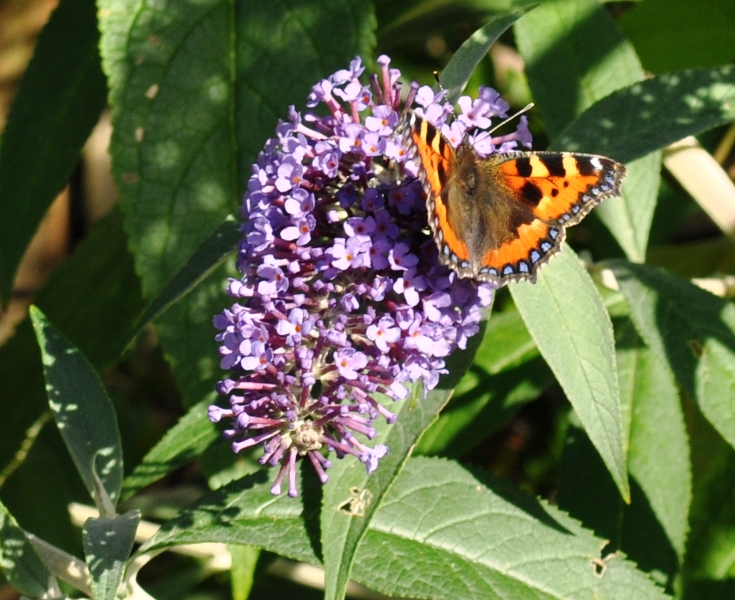 Tortoiseshell on the buddleia in late August
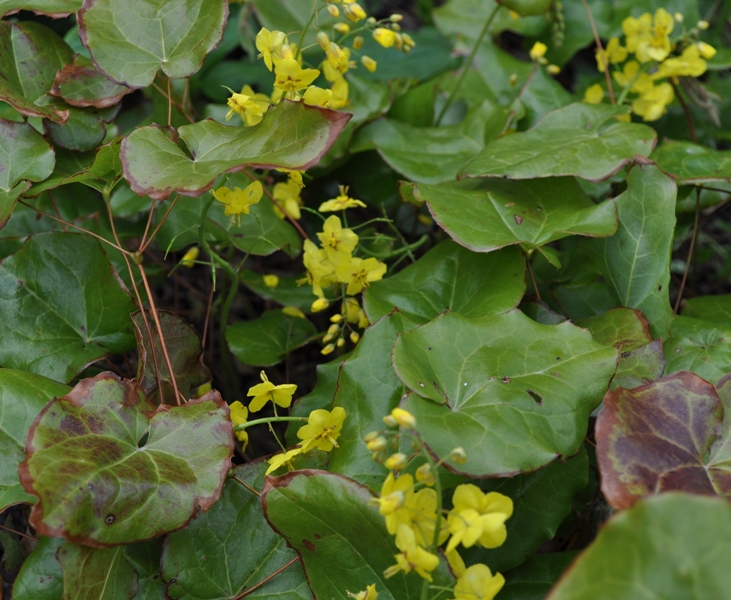 Epimedium in flower, April