×
![woodturning]()

Trees gallery - Beningbrough Hall
York, North Yorkshire
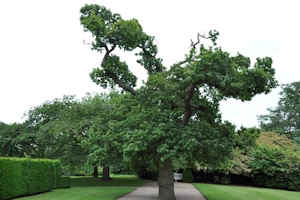 June 2017
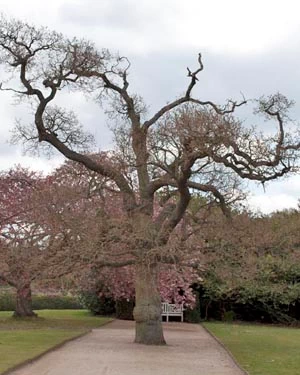 April 2021
Quercus robur "Variegata"
The Duke of Cambridge Oak
A nationally significant tree - the fourth largest variegated English oak in the country. This tree was planted in 1898 by the then Duke of Cambridge, the 79-year old grandson of George III. May 2018
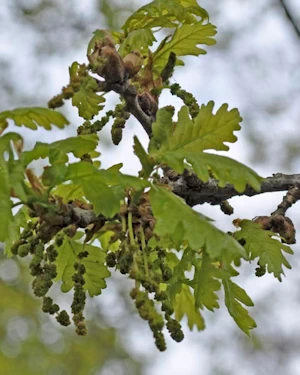 May 2018
 May 2018
Quercus robur
Oak
A tall oak in the American garden, with bright green young leaves and catkins. This could be the lightning oak, with a lightning strike scar down its side, but it may be that is another oak nearby. Another trip necessary to confirm.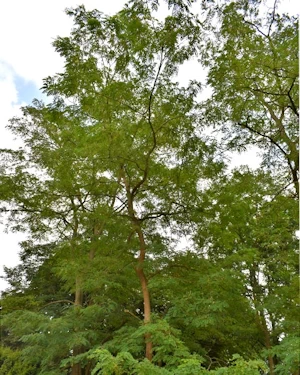 August 2024
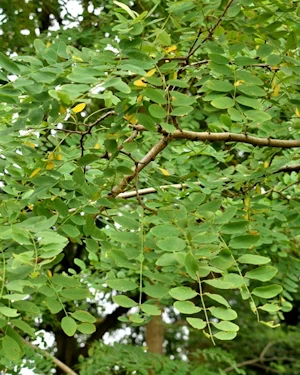 August 2024
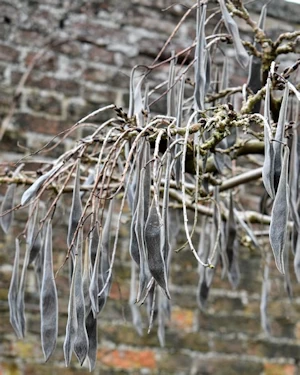
Robinia pseudoacacia Robinia after French herbalists Jean and Vespasian Robin who introduced the tree to Europe; pseudes - Greek, meaning false ; acacia, the leaf shape was initially mistaken for that of an acacia;
Black locust
A.k.a. false acacia, a fast-growing, spreading tree to 25 m tall with deeply furrowed rough bark and spines formed from stipulesa small leaflike appendage to a leaf, typically borne in pairs at the base of the leaf stalk. on twigs and suckers. Dense, drooping clusters of slightly scented white flowers, each 15-20 mm long and with a yellow blotch at the base of the standard petal, are borne in late spring and summer and are followed in autumn by hairless, linear to oblong pods containing 4-10 seeds. August 2024
Sambucus nigra Sambucus - from Greek sambuce or sambuca, referring to an ancient wind instrument or triangular harp, as the shrub's hollow twigs were historically used to make pipes; nigra is Latin for black,referring to the dark, purplish-black color of the mature berries.
Common elder
A.k.a. elderberry, black elder, European elder, bore-tree (Yorkshire dialect, pronounced 'botry'). A deciduous shrub or small tree growing to 6 m, rarely reaching 10 m. The bark, light grey when young, changes to a coarse gray outer bark with lengthwise furrowing, lenticels prominent. The leaves are arranged in opposite pairs, pinnate with five to seven (rarely nine) leaflets, the leaflets 5–12 cm long, with a serrated margin. The young stems are hollow. White flowers are borne in large, flat corymbs, followed by dark purple to black berries. Both the flowers and the berries have a long tradition of culinary use, primarily for cordial and wine.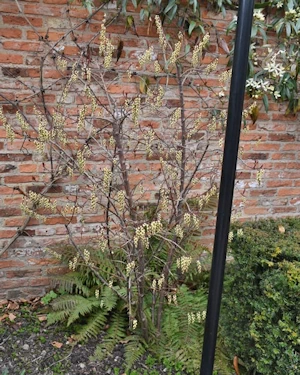 March 2025
 March 2025
Stachyurus chinensis from Greek stachys - ear of corn or spike; oura - tail, referring to the plant's cup-shaped pale yellow flower tassels that hang like a tail; chinensis - Chinese
Chinese stachyurus
Possibly s. praecox - the two species are very similar. S. chinensis is a spreading deciduous shrub or small tree growing to 3 - 4 m, native to China and Taiwan, with pendant racemes of 4-petalled flowers that appear on bare branches before the leaves emerge. August 2024
 August 2024
 August 2024
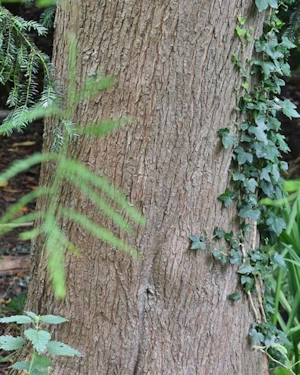
Taxodium distichumTaxodium from Greek, meaning yew-like, referring to the foliage; distichum from Greek dís (twice) and stíchos (row), referring to the leaves arranged in two distinct rows on the twigs.
Swamp cypress
A.k.a. Bald Cypress due to dropping its needles. A deciduous conifer native to the Gulf and S.E. coastal areas of the USA, introduced to Britain in 1640. It grows naturally in waterlogged areas, and is growing by the lake here..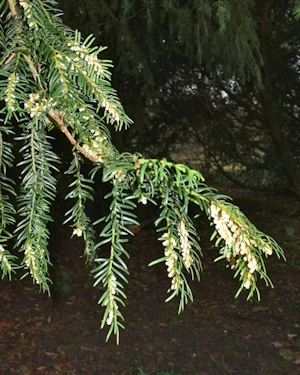 March 2025
Taxus baccata Taxus - from Greek 'toxus' or 'toxon'," meaning bow; or 'toxikon' meaning poisonous; baccata - Latin for 'bearing berries'.
Common Yew
Ancient, morbid, toxic. Yew is one of the longest-lived native species in Europe. This has made it a symbol of death and doom, but it provides food and shelter for woodland animals. Mature yew trees can grow to 20m. The yew is probably the most long-lived tree in northern Europe. It has evergreen needle-like leaves which grow in two rows along a twig. Underneath, the needles each have a raised central vein. Unlike many other conifers, the common yew does not actually bear its seeds in a cone. Instead, each seed is enclosed in a red, fleshy, berry-like structure known as an aril which is open at the tip. [Woodland Trust]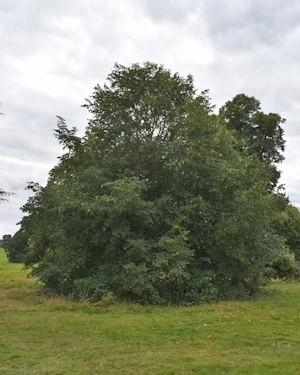 August 2024
 April 2021
 April 2021
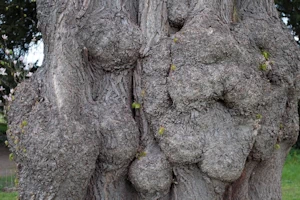
Tilia
Lime
This lime is covered in burrs it will make some beautiful woodturning one day, but hopefully not before it has lived a long and fascinating life. The clock is made from a lime burr. Another lime, no doubt one of many, grows out in the parkland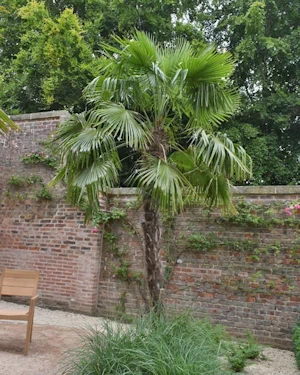 August 2024
Trachycarpus fortunei from Greek trachys, rough, and karpos, fruit, referring to the fibrous, rough trunk of the palm; fortunei, after Scottish horticulturist Robert Fortune (1812 - 1880).
Windmill palm
Also called the Chusan palm, native to subtropical and temperate mountain forests of China, Japan, Myanmar and India where it typically grows to 12-20m. One of the hardiest of the palms, cultivated for its coarse but strong leaf sheath fibre, used for making rope, sacks, and other coarse cloth where strength is important. March 2025
 March 2025