
Trees and Woodlands Gallery - Fungi
We frequently come across delightful patches of fungi when walking in woods and parklands. Every reference source I have looked at warns of the difficulty of exact identification of mushrooms and other fungi, and there is a large element of guesswork in most of the suggested names below, signified by a question mark next to the name. I have made little or no mention of edibility, as I have no experience of this: I just look and take photos. Identification comes from Collins' Fungi Guide,
and from 2025, Google AI (Google Lens). Photos are arranged in alphabetical order acording to botanical names.
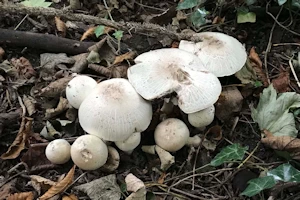 Thornton le Dale, October 2021
 Thorp Perrow, October 2022
Field mushroom ?
Agaricus campestris?
This is probably a species of agaricus, such as Field Mushroom (Agaricus campestris) or possibly Horse Mushroom (Agaricus arvensis). They have white or off-white caps, which may have a yellowish or brownish tint as they age. They grow in clusters on the ground, probably a field or woodland edge. They typically have gills that are pinkish when young and turn dark brown with age.
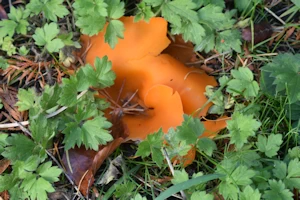 Thorp Perrow, October 2023
Orange peel fungus
Aleuria Aurantia - from Greek aleuria, flour, likely referring to the white, powdery underside of the fungus; aurantia, from Latin orange or golden.
This fungus is easily recognizable due to its bright orange, cup-shaped fruiting bodies, which often resemble pieces of discarded orange peel on the ground. It lacks a distinct stem and gills. It is a saprobic it gets nutrients from decaying organic matter fungus, commonly found on disturbed ground, such as forest edges, roadsides, and areas with clay-based soil.
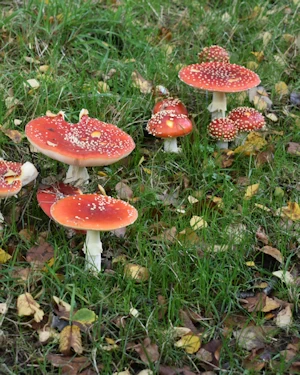 Yorkshire Arboretum, October 2022
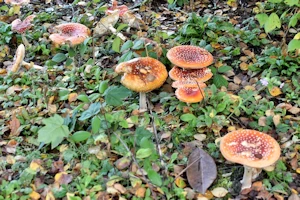 Himalayan Garden, October 2025
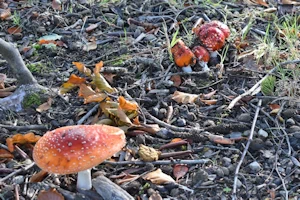 Himalayan Garden, October 2025
Fly agaric
Amanita muscaria
One of the most recognisable fungi, with a distinctive red cap and white spots. It is often found in woodlands and heathlands, typically growing near birch, pine, or spruce trees. It is poisonous mushroom, and contains psychoactive compounds that can cause effects similar to alcohol intoxication and hallucinations. Some animals, such as red squirrels and slugs, are known to eat it.
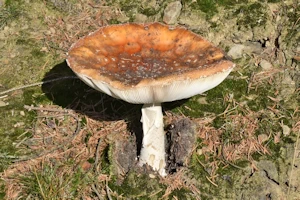 Himalayan Garden, October 2025
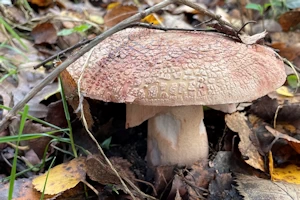 Dalby Forest, October 2025
The Blusher
Amanita rubescens
The mushroom has a brownish-orange cap with lighter, patchy areas. The cap can be convex when young and flatten with age. The stem is white and has a ring. The base of the stem is bulbous. It gets its name from the fact that its flesh, particularly the stem, "blushes" or stains pinkish-red when cut or bruised. It is often confused with the highly poisonous Panther Cap (Amanita pantherina), which has a different type of ring and volva A cup-shaped or sac-like remnant of the outer layer (universal veil) that enclosed a young mushroom.
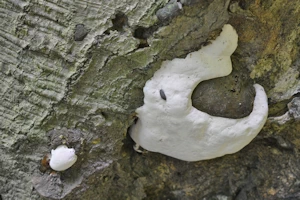 Burton Agnes, June 2022
Bitter bracket
Amoropostia stiptica
The mushroom is very bitter, due to chemical compounds like oligoporin D, which can trigger human taste receptors in very diluted, microgram quantities. Despite its unpalatable flavor, the mushroom is not toxic. It forms perennial, shelf-like or hoof-shaped fruiting bodies that are generally soft and whitish when fresh, and turn light ochre to brownish and woody as they age. The cap is finely felty or velvety, and fresh specimens often exude watery droplets.It typically grows on dead or decaying wood, particularly conifer and hardwood stumps, functioning as a brown-rot fungus, meaning it breaks down cellulose in wood
 Himalayan Garden, October 2025
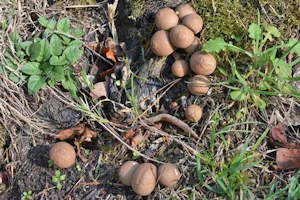
Stump puffball?
Apioperdon pyriforme?
A.k.a. Lycoperdon pyriforme., this is a saprobic growing on decaying wood fungus that grows often in large clumps. These puffballs are typically pear-shaped and can be yellowish to greyish-brown. The fungi in the image match this description. Stump puffballs are one of the few puffball species that grow directly on dead wood, which helps distinguish them from other puffballs that grow on soil.
 Himalayan Garden, October 2025
 Himalayan Garden, October 2025
 Himalayan Garden, October 2025
 Himalayan Garden, October 2025
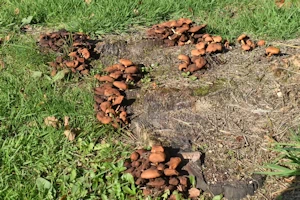
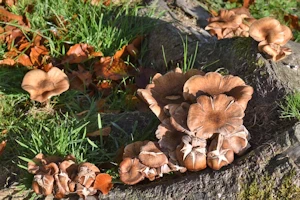
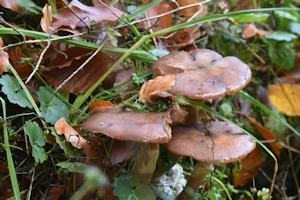
Honey fungus
Armillaria mellea?
This is a type of honey fungus, which includes a number of species, this one probably being Armillaria mellea. These mushrooms are characterized by their honey-brown color and their tendency to grow in dense clusters on or around decaying tree stumps and wood, with white to yellowish gills and fibrous stems. A similar species is (Desarmillaria tabescens (Ringless Honey Fungus), which does not have a ring on around its stem, unlike the former type. I didn't check the stem! Armillaria ostoyae is another possibility.
 Thorp Perrow, October 2023
Honey fungus
Armillaria gallica?
This is a type of honey fungus, probably armillaria gallica, possibly a. mellea. It has an ochre-brown to red-brown cap that is 4 to 10 cm wide and often has fine brown scales. Its key feature is a bulbous or swollen stem base, which distinguishes it from other honey fungus. It grows on woodland litter, dead stumps, and rotting wood of broad-leaf trees appearing in clusters, often with a short-lived, cobweb-like ring on the stem. The gills are initially white, becoming yellowish-brown with maturity.
 Castle Howard, October 2023
Giant funnel
Aspropaxillus giganteus
A.k.a. leucopaxillus giganteus, giant leucopax, giant clitocybe. It is a saprobic it grows on decaying organic manner species, the fruit body, or mushroom, can become quite large - the cap reaches diameters of up to 50 cm. It has a white or pale cream cap, and is funnel-shaped when mature, with the gills running down the length of the stem. It is typically found growing in groups or rings in grassy pastures, roadside hedges, or woodland clearings. It is considered by some to be a choice edible when young, and has been shown to contain a bioactive compound with antibiotic properties.
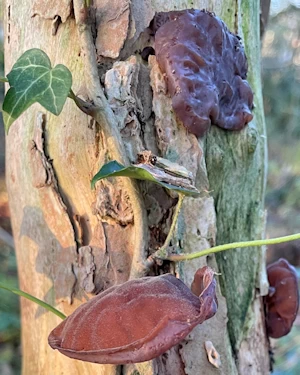 Thornton le Dale, November 2025
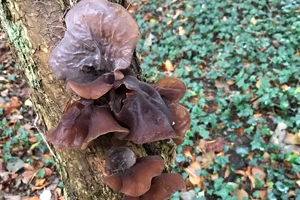 Thornton le Dale, October 2023
Jelly ear
Auricularia auricula-judae
Named for its ear-like shape and gelatinous texture. It is typically found on the decaying branches of broadleaf trees, especially elder and beech (this one was on an elder), and is most prolific during the winter months.
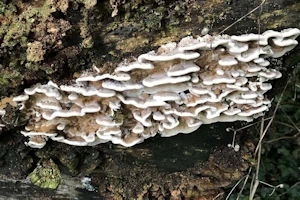 Thornton le Dale, October 2021
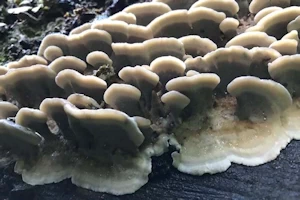 Thornton le Dale, October 2021
Bracket fungus
Bjerkandera adusta ?
A type of bracket fungus, likely either Smoky Bracket (Bjerkandera adusta) or Turkey Tail (Trametes versicolor). These two species are often confused with each other. Both grow in clusters on dead wood, on stumps and downed logs.
 Aros Park, Mull, September 2021
Yellow stagshorn
Calocera viscosa
.A saprotrophic an organism that feeds on dead or decaying organic matter jelly fungus known for its distinctive bright yellow to orange, branched, gelatinous, waxy form resembling antlers or coral. It feeds on dead organic matter, typically found growing on decaying conifer wood, such as stumps and buried roots. It can be found throughout the year, but it is most commonly seen in autumn.
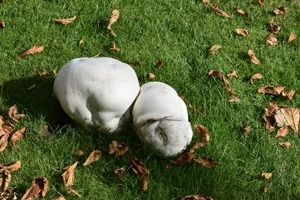 Sutton Park near York, September 2022
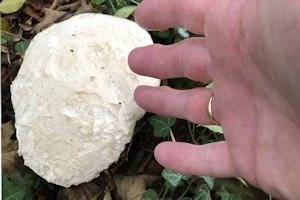 Sutton Park near York, September 2022
Giant puffball
Calvatia gigantea
Large, white to off-white, typically spherical or irregularly shaped. They lack a traditional stem and cap. When young, their surface can feel like velvet, becoming smoother as they mature. They can grow to be the size of a football or even larger, with some specimens exceeding a metre in diameter. They are often found in nutrient-rich habitats like grassy verges, fields, and woodland edges. They typically appear in the autumn months.
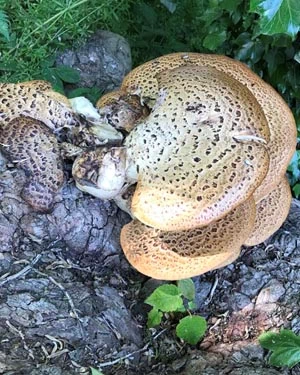 Thornton le Dale, June 2021
 Thornton le Dale, June 2021
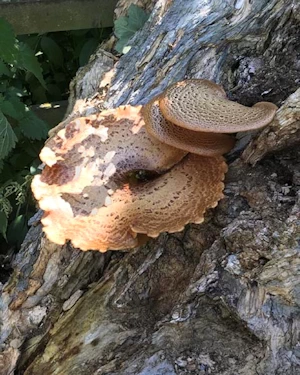 Thornton le Dale, June 2021
 Thornton le Dale, June 2021
 Thornton le Dale, June 2021
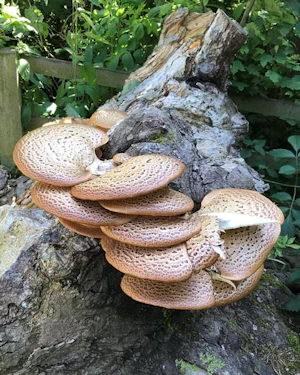
Dryad's saddle
Cerioporus squamosus
A.k.a. Pheasant's Back or Scaly Polypore. A large bracket fungus with a fan-shaped cap that can grow up to 60 cm across. The cap is typically brown to yellow and covered with dark scales. It is found on dead or dying hardwood trees and logs. It is often described as having a smell similar to watermelon or cucumber.
 Dalby Forest, October 2025
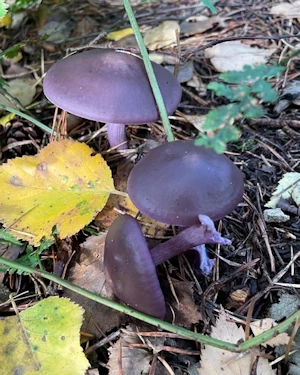
Wood blewit ?
Collybia nuda
Probably wood blewits, a.k.a. Lepista nuda, known for their distinctive blue-violet or lilac color on the cap, gills, and stalk, especially when young. The caps are typically stocky and can be 6 - 15 cm in diameter. They are saprotrophic they live on dead organic matter . They are commonly found in both coniferous and deciduous woodlands.
 Thornton le Dale, November 2022
 Thornton le Dale, November 2025
 Thornton le Dale, November 2025
 Thornton le Dale, November 2025
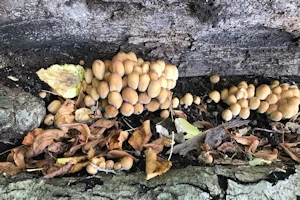
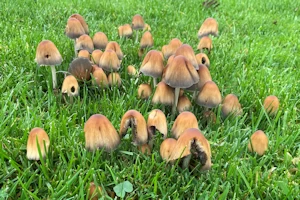
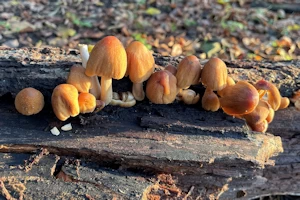
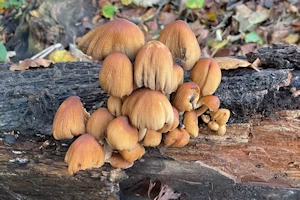
Inkcaps
Coprinellus sp.
Species from the genus Coprinellus, probably Fairy Inkcap (coprinellus disseminatus), possibly Glistening Inkcap (Coprinellus micaceus). They grow in dense clusters or tufts on decaying wood, stumps, or buried roots. The caps are typically small, bell-shaped or conical, and can be a pale tan or beige colour. Coprinellus micaceus is also known as the mica cap or glistening inky cap due to tiny, glistening particles on its cap when young. Coprinellus disseminatus is a.k.a. fairy bonnet. Both species are saprobic they grow on and decompose dead wood , and are commonly found in woodlands.
 Thornton le Dale, November 2025
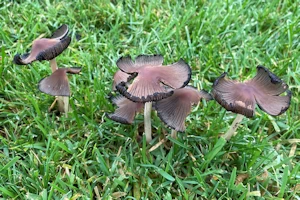
Common inkcap
Coprinopsis atramentaria
A.k.a. Coprinopsis atramentaria, commonly known as the common ink cap or alcohol inky cap, is a widely distributed mushroom known for its unique ability to liquefy into a black ink-like substance. The cap is initially bell-shaped and gray-brown, expanding to a flattened shape as it matures. The flesh is thin and has a mild taste. The gills are white at first but turn black as the mushroom matures, eventually liquefying. It commonly grows in clusters from late spring to autumn on decaying wood, particularly in urban and disturbed areas such as lawns and vacant lots. 2
 Castle Howard, October 2023
Shaggy inkcap
Coprinus comatus
A.k.a. lawyer's wig, or shaggy mane. The young fruit bodies first appear as white cylinders emerging from the ground, then the bell-shaped caps open out. The white caps are covered with scales, the origin of its common names. The gills beneath the cap are white, then pink, then turn black. This mushroom is unusual because it will turn black and dissolve itself in a matter of hours after being picked or depositing spores. The mushroom is often seen growing about lawns, gravel roads, and waste areas.
 Thorp Perrow, October 2023
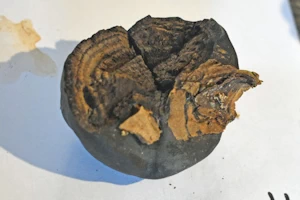
King Alfred's Cakes
Daldinia concentrica Daldinia: in honour of the Swiss monk Augusto Daldini (1817 - 1895); concentrica: This specific name refers to the visible, dark, concentric rings inside the fungus, which resemble tree rings and are formed by seasonal growth.
A dried mushroom collected on a fungus foray, this is a hard, black rounded ball, that grows on dead hardwood like ash and beech trees. When cut, it reveals concentric rings of silver and black, similar to a tree's growth rings. A.k.a. cramp balls, and coal fungus, as they are excellent for bushcraft, being long-burning and can be used to transport embers, smouldering like charcoal briquettes.
Home |
Latest additions |
Tree list |
Gardening |
Woodland |
Contact |
Oldfern woodturning
Links: oldfern Facebook page |
Ryedale Woodturners |
Ancient Tree Inventory |
Tree Register |
Woodland Trust |
The Wood Database
Woodlands.co.uk |
International Wood Collectors Society |
Tree and flower identification guide
Plant Atlas 2020 (BSBI)
Trees and shrubs online
The Conifer Society (American)
North East Fungus Study Group