
Trees and Woodlands Gallery - Fungi
We frequently come across delightful patches of fungi when walking in woods and parklands. Every reference source I have looked at warns of the difficulty of exact identification of mushrooms and other fungi, and there is a large element of guesswork in most of the suggested names below, signified by a question mark next to the name. I have made little or no mention of edibility, as I have no experience of this: I just look and take photos. Identification comes from Collins' Fungi Guide, and from 2025, Google AI (Google Lens). Photos are arranged in alphabetical order acording to botanical names.
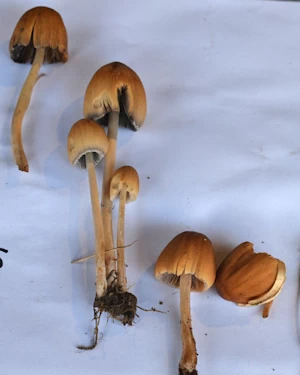 Thorp Perrow, October 2022
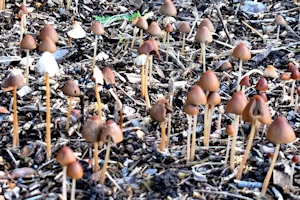 Dundee, November 2025
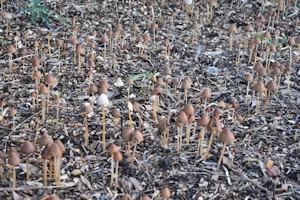 Dundee, November 2025
Liberty cap
Psilocybe semilanceata ? Psilocybe: from Ancient Greek psilos (ψιλός), meaning bare or naked, and kubē (κύβη) meaning head; semilanceata:Latin meaning half spear-shaped
This large patch of mushrooms fall into the "little brown mushrooms" (LBM) category applied to many small, brownish mushrooms that can be difficult to identify. They are probably liberty caps, known for distinctive conical or bell-shaped caps with a small nipple-like point at the top. The cap is typically yellowish-brown to dark brown when moist and fades to a lighter color as it dries. They are commonly found in grasslands, meadows, and pastures, often growing in clusters on decaying plant matter or wood chips, as seen in the image. Another possibility could be Panaeolus cinctulus.
 Dundee, November 2025
Coral fungus
Ramaria botrytis
A type of coral fungus from the genus Ramaria, probably Clustered Coral. They are often found in woodlands, growing on the ground, dead wood, stumps, or branches.
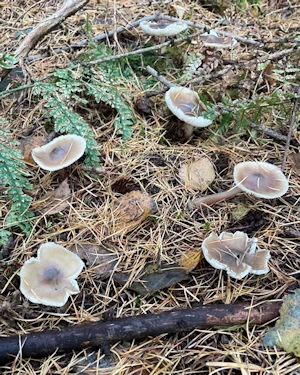 Thornton le Dale, October 2021
Buttercaps
Rhodocollybia butyracea ?
A.k.a. Greasy Toughshank. The cap is typically brown, often darker in the center and paler at the edges. It can have a greasy or buttery feel, especially when damp. This species is common in woodlands, particularly in coniferous forests, and grows in leaf litter or mossy areas. It is widespread throughout the UK, Europe, and parts of the USA.
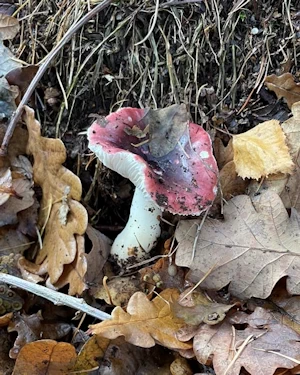 Dalby Forest, October 2025
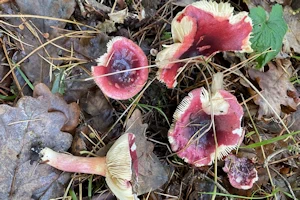 Dalby Forest, October 2025
The Sickener ?
Russula emetica ?
This is a type of brittlegill from the genus Russula, possibly the Emetic Russula. The cap is red, convex to flat, and can have a diameter of up to 8.5 cm. The cuticle can be peeled off almost to the centre. The gills are white to pale cream and closely spaced. The stem is smooth, white, and can be up to 10.5 cm long. It is found in coniferous woodlands and often grows among leaf litter. Many red-capped Russula species look similar and can be difficult to distinguish. For example, this could be Primrose Brittlegill, Russula sardonia, which is found in coniferous woodlands and has a reddish-purple cap.
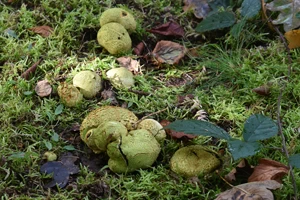 Yorkshire arboretum, November 2023
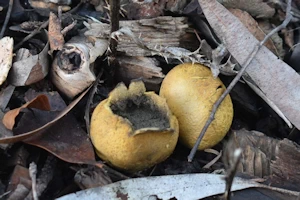 Dundee Botanic, November 2025
 Dundee Botanic, November 2025
 Castle Kennedy, September 2025
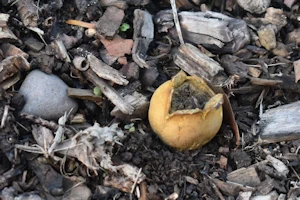
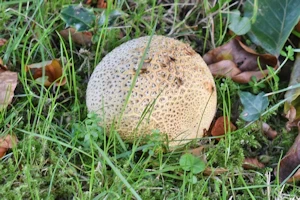
Common Earthballs
Scleroderma citrinum?
A.k.a. Pigskin Poison Puffballs, a round, warty fungus that can resemble a potato. It typically has a dirty yellow to brown color and no stem. This species is common in woodlands, on heathland, and sometimes in short grass. It is a ectomycorrhizal forming a symbiotic relationship with the roots of certain trees fungus, meaning . It is often mistaken for edible puffballs, but where the puffball has a single opening on top through which the spores are dispersed, the earthball just breaks up to release the spores. Also earthballs have much firmer flesh and a dark gleba interior much earlier in development than puffballs. It is the most common species of earthball fungus in the UK and occurs widely in woods, heathland and in short grass from autumn to winter.
 Thornton le Dale, February 2026
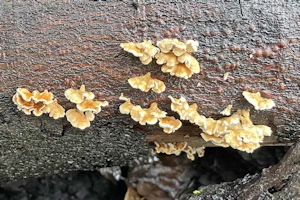
Hairy curtain crust
Stereum hirsutem
A rather impressive looking crust, often forming dense clusters of annual fruit bodies on various hardwoods. The dominant colour is yellow to rusty orange, there is no sign of red on its hairy skin. It is semi-circular to fan-shaped, and attaches to the substrate without having a stem. The upper surface (skin) is covered with short, stiff hairs (hirsute). It is concentrically zoned. Originally ochre to yellow, but can be brownish too. Margin is sharp, yellow, but it might fade with age. It is saprotrophicthe organism feeds on already dead organic materials.
 Dalby Forest, October 2025
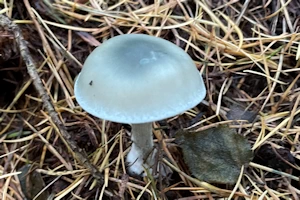
Blue roundhead?
Stropharia caerulea?
This is probably from the stropharia genus, probably a Blue Roundhead, but possibly Verdigris Agaric (Stropharia aeruginosa). Both of these mushrooms are known for their blue-green color and can be found growing in similar habitats. It could be an Aniseed Funnel (Clitocybe odora), which is also a blue-green mushroom. Sadly I didn't check for an aniseed or liquorice smell. The Verdigris Agaric is noted for its slimy, glutinous cap and fine white scales on the stem below the ring. The Blue Roundhead is a closely related species that can look similar but lacks the greasy or sticky cap coating of the Verdigris Agaric.
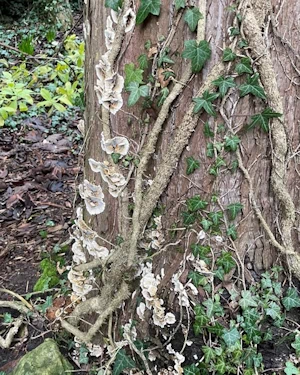 Thornton le Dale, February 2026
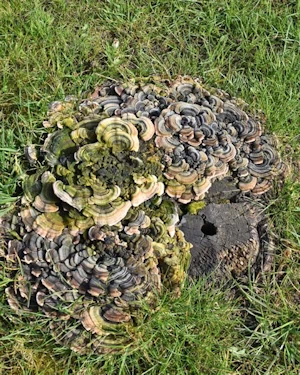 Scampston, March 2025
Turkey tail
Trametes versicolor trametes - from Latin, meaning one who is thin; versicolor - of several colours
A.k.a. Coriolus versicolor and Polyporus versicolor, this is a common polypore mushroom found throughout the world. The fruiting body is tongue-shaped, with no discernable stalk, and the tough flesh is 1–3 mm thick. The cap is flat, up to 10 cm across. It is often triangular or round, with zones of fine hairs coloured rust-brown or darker brown, sometimes with black zones. Underneath a layer of tomentum is a black layer, topping the whitish flesh. Older specimens can have zones with green algae growing on them.
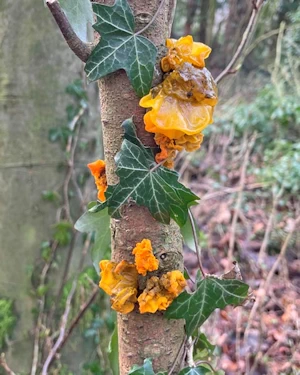 Thornton le Dale, February 2026
Witches' butter
Tremella mesenterica Tremella, from Latin meaning to tremble, referring to its jelly like structure; mesenterica from Ancient Greek mesos, middle, and enteron intestine, describing its folded, brain-like appearance.
A.k.a. yellow brain, golden jelly fungus and yellow trembler, a gelatinous, orange-yellow fruiting body, which can grow up to 7.5 cm diameter, with a convoluted or lobed surface that is greasy or slimy when damp. It is most frequently found on both dead but attached branches, as well as recently fallen branches. Within a few days after rain it dries into a thin film or shriveled mass, but is capable of reviving after subsequent rain.
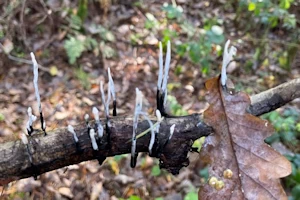 Dalby Forest, October 2021
Candlesnuff
Xylaria hypoxylon
A.k.a. Stag's Horn fungus. Characterized by its erect, stick-like fruiting bodies that grow up to 6cm tall. It has a black base and a distinctive white, powdery tip, which resembles a snuffed-out candle wick. Some of the fruiting bodies may also be forked. It is a common fungus in the UK and grows in groups on dead and rotting wood, particularly on the stumps and branches of broadleaved trees.
 Thornton le Dale, November 2023
Dead Man's Fingers
Xylaria polymorpha
This fungus is a saprobic it grows on decaying wood species, commonly found on rotting tree stumps and logs. It has distinctive black, club- or finger-shaped growths that often emerge in clusters, resembling human fingers. Young specimens can be a pale grey or bluish color, but they mature into a rough, black, and woody texture. It is a common species in woodlands across Europe.