
Trees and Woodlands Gallery - Fungi
We frequently come across delightful patches of fungi when walking in woods and parklands. Every reference source I have looked at warns of the difficulty of exact identification of mushrooms and other fungi, and there is a large element of guesswork in most of the suggested names below, signified by a question mark next to the name. I have made little or no mention of edibility, as I have no experience of this: I just look and take photos. Identification comes from Collins' Fungi Guide, and from 2025, Google AI (Google Lens). Photos are arranged in alphabetical order acording to botanical names.
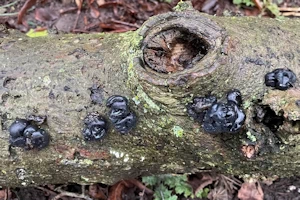 Thornton le Dale, February 2026
Warlock's butter
Exidia nigricans exidia from Greek meaning to exude or sweat,referring to its jelly-like, wet appearance; nigricans - blackish or becoming black, referring to the dark, tar-like, or blackish appearance of the fungus on wood.
A.k.a. black jelly-roll, Exidia nigricans, recently given the English name Warlock's Butter, is similar to (and very often confused with) Exidia glandulosa - commonly referred to as Witches' Butter or Black Witch's Butter, because of its butter-like consistency when wet and its sombre colour; however, Exidia nigricans has brain-like folds rather than being made up of irregular blocks with flattish facets. This jelly fungus can occur throughout the year; it appears on dead hardwood, particularly Beech, Ash and Hazel, but very rarely oaks.
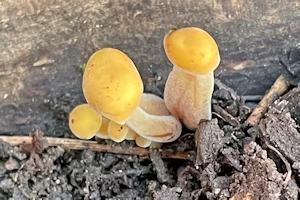 Thornton le Dale, 30 December 2025
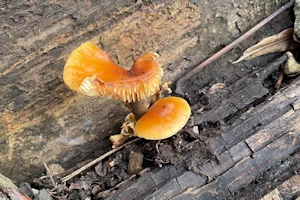 Thornton le Dale, 26 December 2025
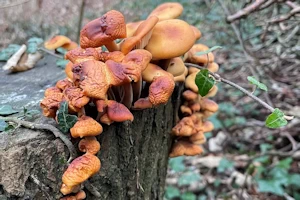 Thornton le Dale, 30 December 2025
Velvet shank
Flammulina Velutipes flammulina Latin meaning little flame; referring to the cap's bright orange colour; velutipes means velvet foot, describing the stem's characteristic fuzzy, velvety texture, making it the velvet shank.
When young these were identified (using AI) as Gymnopilus junonius Gymno, Greek meaning naked, pilus - cap, referring to its smooth cap, junonius after the Roman goddess Juno, suggesting splendour or beauty. , the spectacular rustgill. As they aged (2 weeks) they were identified as Flammulina Velutipes, the Velvet Shank, a.k.a. Winter Mushroom - which fits the date. The caps are a caramel to orange colour, which can be greasy or slimy in wet weather. The stem (stipe) is distinctively velvety and darkens from the base upward, giving it its common name. The first two photos are of growth on an old, large, fallen horse chestnut branch. The third is on a decaying stump in Thornton Dale Estate Woods.
 Antony, June 2014
 Mull, September 2021
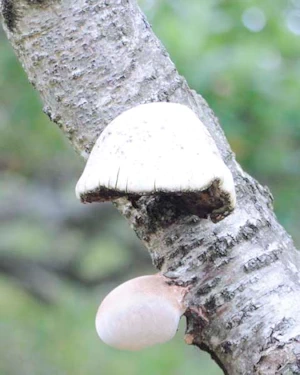 Mull, September 2021
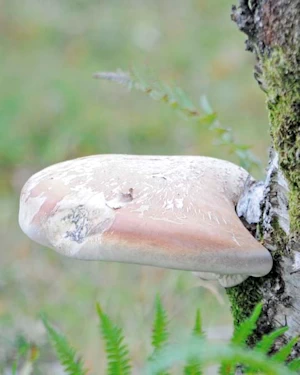 Mull, September 2021
Hoof fungus
Fomes fomentarius
A.k.a. tinder fungus, this is a bracket fungus a group of fungi that grow on trees or dead wood. They are shelf- or bracket-shaped and often grow in horizontal rows with a distinctive hoof-like or shelf-like shape with a hard, woody texture and is typically gray or brown. The fungus grows in layers, with new layers forming each year, which can give it a striped appearance. It is a wood-decaying fungus that grows on the trunks of deciduous trees, such as birch, beech, and sycamore. The name 'tinder fungus' comes from its historical use for starting fires, due to its porous inner tissue.
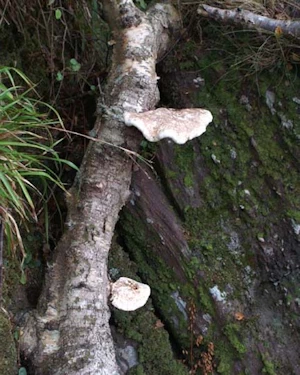 Brodick Castle, October 2007
Birch polypore ?
Fomitopsis betulina
A bracket fungus, a.k.a. a shelf or polypore fungus. Bracket fungi are common in the UK and grow on both living and dead trees. They cause decay and rot in the heartwood of trees, which can weaken the tree over time. Birch polypore is a type of bracket fungus that grows exclusively on birch trees. It is also known as Razorstrop fungus because its leathery surface was once used to sharpen knives and razors.
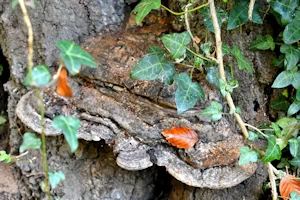 Thorp Perrow, October 2023
Artist's Conk
Ganoderma applanatum Ganoderma, from the Greek for bright (ganos) and skin (derma), and applanatum, Latin for flattened, describing the shiny appearance and its characteristically flat, bracket shape.
A.k.a. Artist's Bracket, a large, perennial, woody shelf fungus. It has a unique, smooth white underside that stains dark brown instantly when scratched, allowing it to be used as a natural canvas for drawing. It has a tough, flattened, fan-shaped or hoof-like fruiting body that can grow very large (up to 30 inches across). The top surface is dull, gray to brown, often covered in reddish-brown spores, and may have concentric rings or furrows. It lacks a traditional stem. The internal flesh is tough, corky, and woody. It is a saprophyte it lives on dead or decaying organic matter on dead wood or a parasite on living trees, causing white rot in a variety of hardwood trees (e.g., beech, poplar, maple, oak) and sometimes conifers.
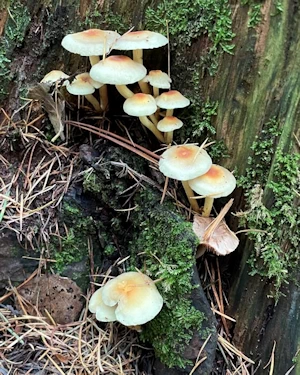 Dalby Forest, October 2021
 Himalayan Garden, October 2025
 Harlow Carr, January 2025
Sulphur tuft?
Hypholoma fasciculare?
This is probably a Sulphur Tuft, or a similar species like conifer tuft (Hypholoma capnoides) or Brick Tuft (Hypholoma lateritium). Certainly the photo taken at Harlow Carr has an information board next to it,pointing out it is saprotrophic only feeding on dead wood , and hence the gardener's friend, unlike honey fungus. They grow in dense clusters or "tufts" on dead wood, such as stumps, logs, and roots. The caps are typically a sulphur-yellow colour, often with a darker, tan or orange tone in the center. The gills are initially yellow and darken with age. The poisonous Sulphur Tuft has greenish gills, while the edible Conifer Tuft has pale grey gills. The Brick Tuft is generally larger and has a more reddish cap.
 Dalby Forest, October 2025
Bay bolete ?
Imleria badia ?
A.k.a. Boletus badius. The cap is typically a reddish-brown to chestnut-brown color and can be slightly sticky or wet when young or after rain. : The stem is usually a paler brown color, often with a fibrous texture, and lacks the prominent net-like pattern (reticulation) found on the stems of some other bolete species, such as the Porcini (Boletus edulis). It is commonly found in coniferous and mixed woodlands, often under pine or spruce trees, and grow during the summer and autumn.
 Scampston, October 2023
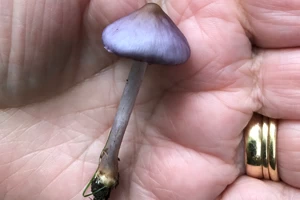
Lilac fibrecap?
Inocybe geophylla
Probably a lilac fibrecap, with its small, conical lilac cap and a silky, pale stem. It could be a webcap from the genus Cortinarius, known as spotted cort or viscid violet cort: this mushroom has a slimy, purple cap that can develop yellowish spots as it matures.
 Thorp Perrow, October 2022
Weeping widow?
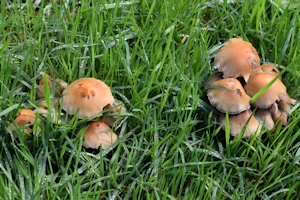
Lacrymaria lacrymabunda? Lacrima - Latin meaning tear, alluding to the black, tear-like droplets of spores that can form on the cap and gills of the mushroom; lacrymabunda - Latin meaning producing an abundance of tears or weeping. It reinforces the meaning of the genus name, emphasizing the distinctive "weeping" characteristic of the fungus.
Probably a cluster of Weeping Widow mushrooms. The cap is initially bell-shaped and becomes more broadly convex as it matures. It is covered in woolly fibres and can be reddish-brown with radial streaks of yellow and clay brown. It is a saprotrophic it feeds on decaying organic matter. It is commonly found in grasslands, on verges, and in woodland clearings.
 Thornton le Dale, June 2021
 Thornton le Dale, June 2021
 Thornton le Dale, June 2021
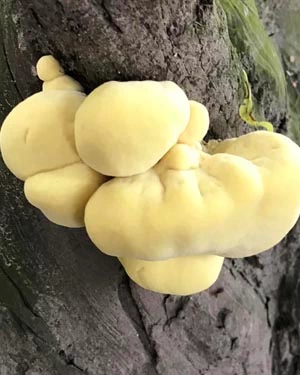
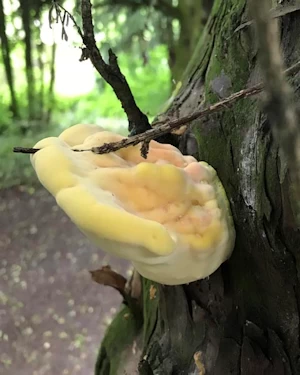
Chicken of the woods
Laetiporous sulphureus
A polypore polypores form large, woody, or fleshy fruiting bodies, often shaped like a shelf or bracket, with pores or tubes on the underside. , growing in shelf-like clusters on the trunks of both living and dead trees, typically a vibrant yellow to orange colour when young. The fruiting bodies can be up to 20 cm wide. This one was spotted growing on an old yew tree in "Squirrel Wood", near the pond in Thornton le Dale.
 Himalayan Garden, October 2025
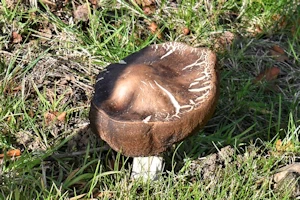
Brown birch bolete?
Leccinum scabrum?
A common mushroon with brown cap, though it can vary in shade - which starts hemspherical and flattens with age. The surface can be smooth and is sticky when wet. It has a white to greyish stem covered in small, dark, rough scales or scabers, which gives the mushroom its common name "scaber stalk". It is commonly found in association with birch trees..
 Dundee Botanic, November 2025
Red lead roundhead
Leratiomyces ceres
A.k.a. as stropharia aurantiaca, and chip cherry, often found growing in large clusters on woodchip mulch or sandy soil, especially under pine trees, known for its bright red to orange cap, which is typically convex to flat in shape as it ages. The cap is 2 to 6 cm in diameter and has thin flesh. It has a pale stem that is often flushed red at the base. It often has remnants of a white veil on the margin.
 Castle Howard, October 2023
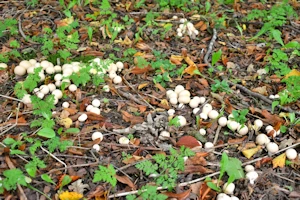
Common puffball
Lycoperdon perlatum - from Greek lúkos (wolf) and pérdomai (to break wind), creating the meaning wolf's flatulence, thought to describe the puffball releasing a cloud of spores when it is disturbed, similar to a puff of gas from a wolf. perlatum is Latin, meaning pearl-bearing, a reference to the common puffball's warty, pearl-like surface.
These are probably common puffballs, often found growing in groups on the ground in woodlands. They are typically white or off-white, with a rounded or pear-shaped body. The surface of the common puffball is covered in small, spiky warts that can be rubbed off, leaving a net-like pattern. The stump puffball tends to be a bit smoother and more pear-shaped, and it typically grows on decaying wood or buried roots, even if it appears to be on the ground. When young, the inside of a true puffball is solid and pure white. As the mushroom matures, the interior turns yellow, then brown, and becomes a powdery mass of spores. A small hole or pore eventually forms at the top to release these spores.
 Thornton le Dale, October 2021
Parasol mushrooms
Macrolepiota procera ?
A large, edible mushroom with a cap that starts rounded and flattens out with age, often having a snakeskin-like pattern on the stem. Alternatively this could be a a related species - shaggy parasol, Chlorophyllum rhacodes: its stem lacks the snakeskin pattern and its flesh stains red when cut, neither of which tests did I conduct.
 Thorp Perrow, October 2022
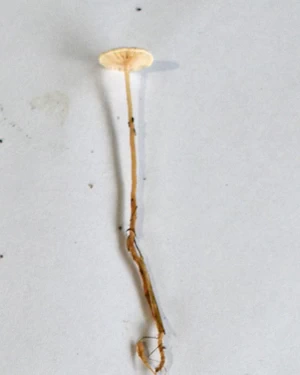
Pinwheel mushroom
Marasmius Rotula Marasmius, from Greek marasmos - drying out, referring to the ability of these mushrooms to recover if rehydrated after drying out; rotula - from Latin meaning little wheel, describing the mushroom's gills and collar, which resemble the spokes and rim of a wheel.
A small, delicate, whitish agaric fungus. It is characterized by its parachute-like cap and slender, tough stem. The cap is broadly convex, developing a navel-like central depression, and is pleated with a flat top and squarish sides. The gills are attached to a small collar encircling the stem, and the flesh is thin and white. The stem is dark brown towards the base, shiny, and wiry, with no ring. The spore print is white or whitish. It thrives in environments with deceased deciduous hardwood roots, fallen trunks, branches, and twigs, and is found in hardwood forests from spring to autumn.
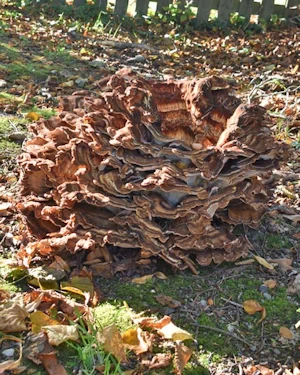 Castle Kennedy, September 2025
 Castle Kennedy, September 2025
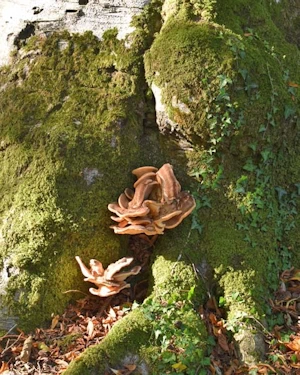 Castle Kennedy, September 2025
Giant polypore
Meripilus giganteus
A.k.a. Black-staining Polypore, this fungus forms large, layered, fan-shaped brackets that can grow to be quite massive (about 18 inches across here). The colour is typically brown, with a lighter underside. It is a parasitic fungus that grows at the base of trees, particularly beech trees, or on their stumps and roots: here it was gorwing on the stump of a large beech, awith other clumps a few feet away, probably on the roots. A key identifying feature is that its flesh will bruise or turn black when handled or damaged.
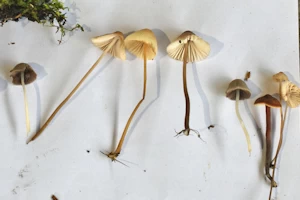 Thorp Perrow, October 2022
Clustered bonnet?
Mycena (inclinata?) Mycena, from μύκης" (mykes), Greek for mushroom; inclinata is from Latin, meaning sloping inwards or curved inwards, referring to how the mushrooms in a cluster often lean into one another.
These mushrooms are part of a large group of small, grey-brown bonnet mushrooms that are often difficult to identify without a microscope. They are probably from the Mycena genus (or possibly Psilocybe). They could be species such as the Snapping Bonnet (Mycena vitilis) or the Nitrous Bonnet (Mycena leptocephala). Snapping Bonnet gets its name from the stem, which breaks with a sharp snapping sound when pulled lengthwise. Mycena inclinata has a bell-shaped to conical cap with striations and a slender stem. It is typically found growing on decaying hardwood, such as oak stumps or fallen branches. It grows in clusters or bunched groups.
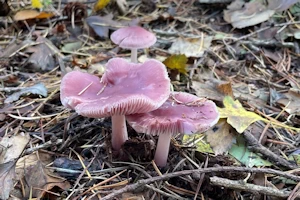 Thornton le Dale, October 2022
Rosy bonnet ?
Mycena rosea ?
This is probably a Rosy Bonnet or a closely related species such as the Lilac Bonnet (Mycena pura). It has a bell-shaped cap that can flatten with age, and its colour is typically a shade of rosy pink or lilac. The gills are also a pale pink hue. It is saprotrophic growing on decaying organic matter like leaf litter, twigs, and branches . They are commonly found in damp, shaded woodlands, often in mixed or coniferous forests.
 Thornton le Dale, 26 December 2025
Crystal brain
Myxarium nucleatum Myxarium from Greek myxa, mucous-like; nucleatum, little nut or kernel, describing the opaque, white, nut-like mineral (calcium oxalate) nodules within the translucent fungus.
The fruit bodies are watery white, pustular or lobed, and gelatinous with small, white, mineral inclusions visible to the naked eye. It is a common, wood-rotting species in Europe, typically growing on dead attached or fallen branches of broadleaf trees (as here, growing on a fallen horse chestnut branch).
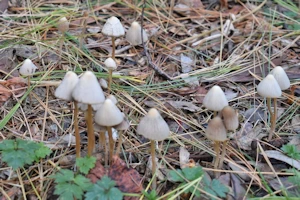 Dundee, November 2025
Mottlegill
Panaeolus papilionaceus??
These could be a type of mottlegill, though this is far from certain: they could be from the mycena genus. They have a conical to bell-shaped cap that is pale brown or grey-brown, and a slender, fragile stem. This appearance is consistent with several species within the Panaeolus genus, which are commonly known as mottlegills. They are growing on a forest floor, a common habitat for many small fungi, including some types of mottlegill. The name mottlegill refers to the mottled pattern on the gills.
 Thorp Perrow, October 2022
Tawny funnel
Paralepista flaccida Para, Latin, meaning beside or near, and Lepista, a related genus, meaning wine pitcher or goblet, referring to the concave shape of the mushroom's cap when mature; flaccida, Latin, meaning slack, flabby, or limp., referring to the texture which is not tough or rigid.
This species is a common and widespread fungus found in woodlands across the Northern Hemisphere. It is known to form fairy rings. The cap is typically pinkish, orange, or cinnamon-brown and slightly funnel-shaped with decurrent the fungal gill extends downward along the stem or stalk gills.
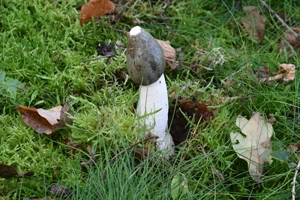 Yorkshire Arboretum, November 2023
Common stinkhorn
Phallus impudicus
Recognizable by its phallic shape and a foul odour, the mushroom emerges from an egg-shaped base, which is often partially buried in the ground. The cap is covered in a sticky, olive-brown slime called gleba the spore-bearing inner mass of certain fungi, from the Latin word for clod of earth , which attracts flies to help disperse its spores. The stinkhorn is found in woodlands and gardens, often associated with rotting wood.
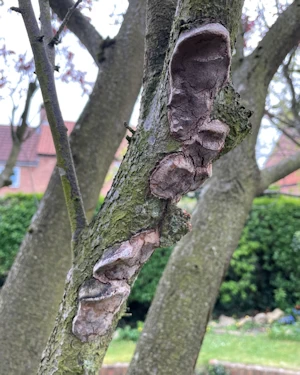 Thornton le Dale, April 2026
Cushion bracket fungus
Phellinus pomaceus
Tough and woody. Resupinate inverted or upside-down, fungi that twists during development to face downward or lie flat against a surface. on the underside of the stem / branch and forming brackets when elsewhere. Young fruit bodies develop from a mycelial, begin orange and mature to become purple-brown on the upper surface – sometimes with green banding. New growth rings mature fruiting bodies with a gold-orange. The pore layer is off-white. Can turn a mouldy blue when parasitised. Almost exclusively on prunus varieties. []TMA-fungi]
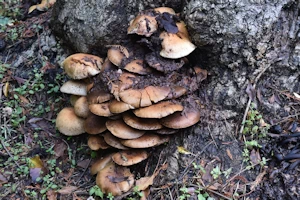 Thorp Perrow, October 2022
Shaggy scalycap
Pholiota squarrosa Pholiota: from Ancient Greek pholis, meaning scale, referring to the scaly appearance of the mushroom's cap and stem; squarrosa: from Latin meaning scaly, rough or shaggy.
This is possibly pholiota, but could be a honey fungus (armillaria). The mushrooms have yellow-ochre or straw-yellow caps covered in prominent, upturned brown scales. The stems are also covered with scales. This is consistent with the common name shaggy scalycap. It is typically found growing in large groups at the base of living deciduous or coniferous trees, as here.
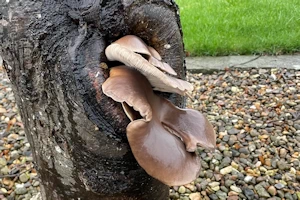 Thornton le Dale, February 2026
Grey oyster mushroom
Pleurotus ostreatus Pleurotus: from Ancient Greek πλευρόν (pleurón - rib/side) and oûs (ear), referencing how the cap attaches laterally to the wood, rather than centrally; ostreatus from Latin ostrea (oyster/bivalve), referring to the shape of the mushroom cap, which resembles an oyster shell.
A.k.a. pearl oyster mushroom or hiratake. It has a broad fan or oyster-shaped cap, and 2–30 cm wide. Colour ranges from white to grey or brown; the margin is inrolled when young, smooth and often somewhat lobed or wavy. The flesh is white, firm, and varies in thickness due to stipe the stem supprting the cap of a mushroom arrangement. The stipe, if present, is up to 4 cm long and thick, off-centre and attaching laterally to wood. The gills are whitish, sometimes becoming yellowish, and decurrentextending down the stem beyond the point of attachment if a stalk is present. The spore print is white to lilac-grey, and best viewed on a dark background. The musroom has the bittersweet aroma of benzaldehyde or bitter almonds. [Wikipedia]
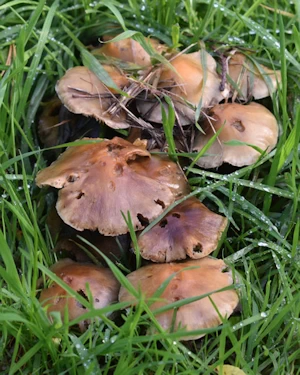 Thorp Perrow, October 2022
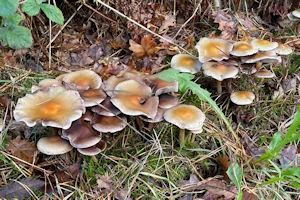 Dalby forest, November 2025
Wavy cap ?
Psilocybe cyanescens ? Psilocybe: from Ancient Greek psilos (ψιλός), meaning bare or naked, and kubē (κύβη) meaning head; cyanescens:Latin meaning 'becoming blue', which refers to the blue bruising that occurs on the mushroom when it is handled or damaged.
This is probably from the genus Psilocybe, probably a wavy cap, but possibly Psilocybe allenii. A.k.a. blueleg brownie. These mushrooms are known to contain the psychoactive compounds psilocybin and psilocin. They are often found growing on woodchip mulch and can be found in autumn and winter.