
Trees gallery - Isles of Scilly - shelter belts
The Isles of Scilly have a mild climate, but are battered by strong winds laden with salt. To grow crops or flowers, or exotic plants as in the Abbey Gardens on Tresco, the wind needs to be filtered and kept away from the gardens and growing fields. Fast growing, salt tolerant trees are needed, and these were imported in the 19th century and planted in shelter belts formed of tall trees and shrubs (over 4.5m) planted in three or four staggered rows on the islands, most notably on Tresco to provide shelter for the collection of exotic plants grown in the Abbey Gardens.
In the main other native trees such as oaks are too slow growing for a good shelter belt. Other native trees like sycamores frequently have their leaves burnt off by late spring gales and salt spray - I saw very few on the islands. They also grow in odd shapes as a result of trying to escape persistent wind damage. The other strong contender for the best windbreak tree in coastal or windswept locations is quercus ilex, the evergreen oak. Ilex drop their old leaves in early summer, just as the new growth emerges, but, in winter, their leaves remain unsinged by even the most severe gale. Again the attraction is that they cut out wind from top to bottom and, unlike cupressus macrocarpa, the branches only start to split out in very old age For a conifer which provides more wind protection from top to bottom, Cupressus macrocarpa is also fast growing and resilient. (Information from Burncoose Nurseries)


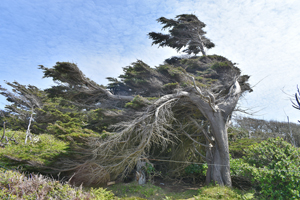
Cupressus macrocarpa
Monterey cypress
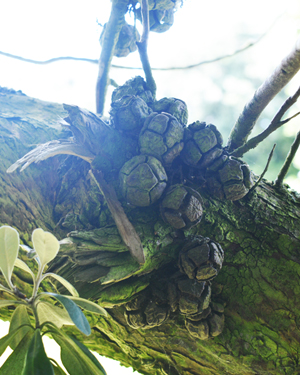
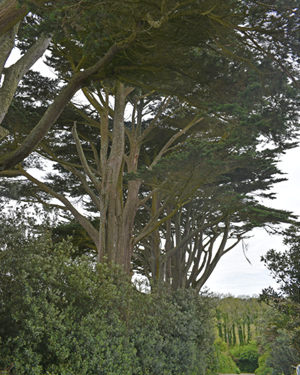
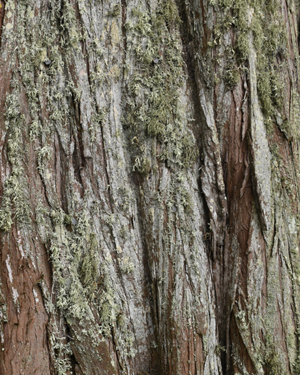
For a conifer mostly evergreen trees and shrubs having usually needle-shaped or scalelike leaves and bearing true cones or fleshy cones (arils, galbulus) which provides more wind protection from top to bottom than the Monterey pine, the Monterey Cypress, Cupressus macrocarpa is also fast growing and resilient. Branches tends to split out from low down the trunk. A native of California, it was introduced to Britain in 1838. It is one of the parents of the ubiquitous Leylandii, cupressus x leylandii (the other parent being the nootka cypress, callitropsis nootkatensis)
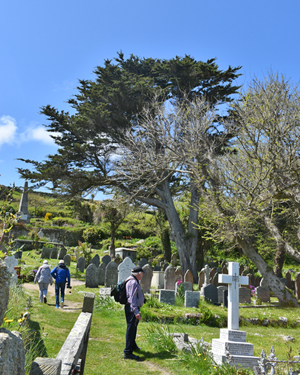
The Monterey cypress can be a sacrificial planting, and can suffer damage in the coastal winds. It has resilience however, as shown by this battered but thriving specimen high on the hill at The Garrison, St Mary's. Its one-sided growth may be more due to a result of a companion tree growing alongside it, now lost, than solely to the effects of the wind.

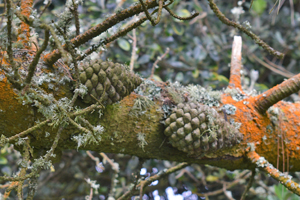
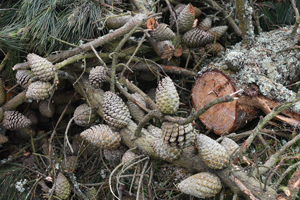
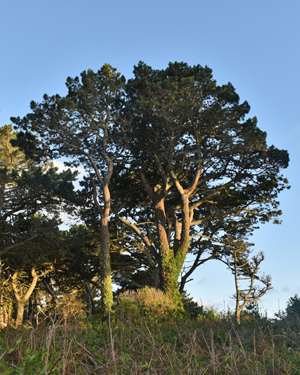
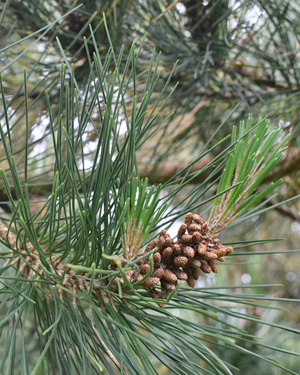
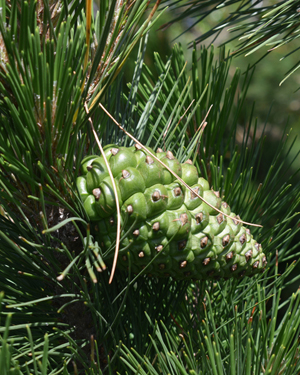
Pinus radiata
Monterey Pine, radiata pine
Native to the coasts of Mexico and California, introduced to Scilly in the 19th century, Monterey pine is a fast growing tree - 3 to 6 feet per year! It can withstand salt sprays and wind. They live only up to 100 years in the high rainfall Cornish climate but are the backbone of Tresco’s outer defences and are planted in protective belts on the other islands. There are escapes as well.