×
![woodturning]()

Trees Gallery - Brodsworth Hall
Near Doncaster

 August 2024
 August 2024
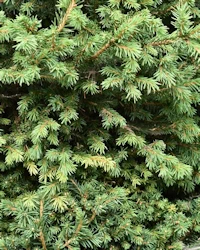
Abies balsamea abies - from L. abeo - to rise, to go up; balsamea - from Latin balsamum, meaning balm or resinous ointment Hudsonia - probably refers to Hudson Bay in Canada, where this dwarf variety is foundHudsonia
Hudson fir
A.k.a. dwarf balsam fir. A slow-growing dwarf evergreen conifer, with a compact bun-shaped habit to 1 m tall, 1.5 m broad, taking 20 years to reach this size. It has a pleasant, balsamic fragrance. It does not produce cones.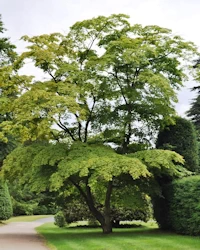 October 2020
 August 2024
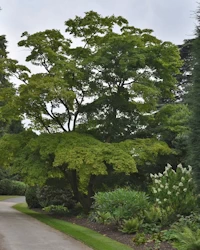
Acer palmatum acer - from the Latin for maple; palmatum, palm-like, referring to the 5 lobed hand shaped leaves
Japanese maple
A large maple tree growing in the grounds of Brodsworth Hall. Variety unkonwn (to me). August 2024
 August 2024
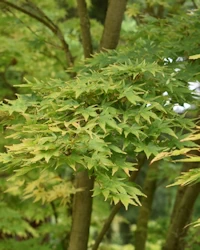
Acer palmatum acer - from the Latin for maple; palmatum, palm-like, referring to the 5 lobed hand shaped leaves osakazuki- Osaka refers to the Japanese city of Osaka, and zuki can mean either I love or cup.osakazuki
Japanese maple
This a. palmatum is probably osakazuki given its deeply cut 7-lobed leaves. A large deciduous shrub of rounded habit, reaching 4 - 8 m. Flowers and fruits are small and red, with samaras almost horizontally paired. The bark is smooth and grey-brown. ,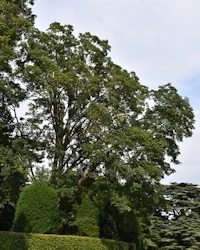 August 2024
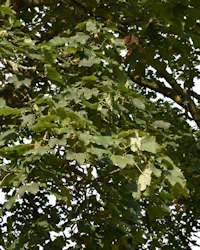 August 2024
Acer pseudoplatanus acer - maple; pseudoplatanus - false plane, referring to a superficial similarity of leaves and bark to those of plane trees (genus platanus)
Sycamore
Not native to Britain, but they have been here for many years and are well established across the country. These broadleaf trees can grow to 35m and live for 400 years. Twigs are pink-brown and hairless. Small, green-yellow flowers hang in spikes, or 'racemes'. After pollination by wind and insects, female flowers develop into distinctive winged fruits known as samaras..pulp. August 2024
 August 2024
Araucaria araucana araucaria - after a region of Chile; araucana - the native tribe who used the tree's seeds for food.
Monkey puzzle
A.k.a. monkey tail tree, pewen, pehuen pine or piñonero, an evergreen tree growing to 30 - 40 m, native to C and S Chile and W Argentina. It is on the IUCN list as endangered in its native region due to logging, forest fires, and grazing. It is usually dioecious male and female cones on separate trees . The male (pollen) cones are oblong and cucumber-shaped. It is wind pollinated. The bark can be up to 15 cm thick, possibly an adaptation to resist wildfires.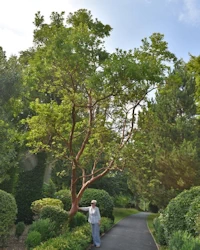 August 2024
 August 2024
 August 2024
Arbutus andrachnoides arbutus - Greek for strawberry tree; andrachnoides - from Greek andrákhnē (ἀνδράχνη), meaning wild strawberry
Hybrid strawberry tree
A. andrachne, commonly called the Greek strawberry tree, is an evergreen shrub or small tree growing to 12 m. a. andrachoides is a cross between a. andrachne and a. unedo. The flowers bloom in spring and are white or yellowish green. Its fruits ripen in autumn, and when left to dry in a cool place, are eaten as sweet, chewy candy.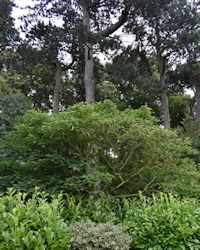 August 2024
 August 2024
Broussonetia papyriferaBroussonetia, after French naturalist Pierre Marie Auguste Broussonet; papyrifera, from the Latin papyrus (referring to paper) and ferre (meaning "to bear"), in reference to the tree's bark being used to make paper and tapa
Paper mulberry
A deciduous shrub or tree usually growing 10 - 20 mm native to Asia. It is dioecious it has male and female flowers on separate plants . Catkins are up to 8 cm long with fuzzy male flowers. The pistillate inflorescence is a spherical head up to about 2 cm wide with greenish female flowers trailing long styles. The fruit is a spherical cluster wide containing many red or orange fruits. Each individual protruding fruit in the cluster is a drupe. It is cultivated for paper and cloth production from its bark. August 2024
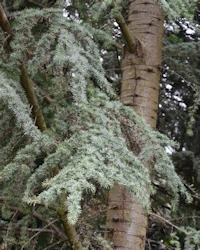 August 2024
Cedrus atlantica cedrus - from Greek kedros, cedar; atlantica - from Latin, 'from the Atlas Mountains'; glauca, blue. glauca
Atlas cedar
A large coniferous evergreen tree, 30 to 35 m, with a trunk diameter of 1.5 to 2 m. A native of the Rif and Atlas Mountains of Morocco and Algeria. It is very similar to the other true cedars; some authorities consider it a subspecies of c. libani; others rank it as a distinct species. This glaucous variety has a blue tinge to the needles. August 2024
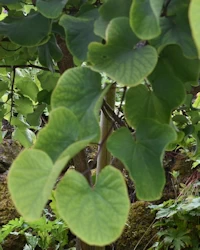 August 2024
Cercis siliquastrum cercis - from Greek kerkis, shuttle, referencing the tree's flat seed pods, siliqua - from Latin, pod; astrum meaning similar, so overall similar to a shuttle-shaped pod.
Judas tree
A small tree up to 12m, native to S Europe and W Asia. The deep pink flowers are produced on year-old or older growth, including the trunk, in spring. They have five free petals and fused sepals, a flower shape typical of much of the pea family (Fabaceae). The leaves appear shortly after the first flowers emerge. These are cordate with a blunt apex and occasionally have a shallow notch at the tip. The tree produces long flat pods that hang vertically. The flowers are edible and reportedly have a sweet and tart taste August 2024
 August 2024
Chamaecyparis Chamaecyparis: - dwarf cypress; lawsoniana - after Scottish nurseryman Charles Lawson aurea - golden, referring to the yellow foliage lawsoniana aurea
Lawson's cypress
A large evergreen tree growing to 50 m with trunk up to 2 m in diameter. The bark is silver-brown, vertically furrowed, and up to 25 cm thick at the base. The seed cones are globose, 7 - 14 mm in diameter, green at first, maturing brown in autumn. Trees can live up to about 600 years of age. This is a golden variety.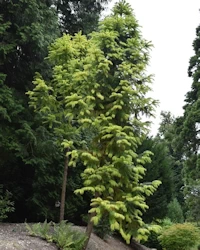 August 2024
 August 2024
Cunninghamia cunninghamia after Allan Cunningham, a botanist who explored Australia in the early 19th century lanceolata - Latin for lance-shaped, referring to the sharply pointed, flat needles.lanceolata
.Chinese fir
Despite its common name, this is a member of the cypress family. Native to China. A large tree, growing up to 45m in its native territory. Much used for construction timber, with soft but durable, scented wood. Also used in Chinese medicine to ease pain and rheumatism.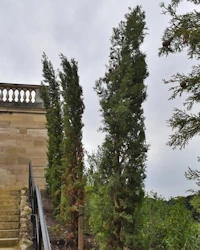 August 2024
 August 2024
Cupressus sempervirens Cupressus - from Greek kuparissos, which refers to a mythological youth who was transformed into a cypress tree. semper - always; virens - green, referring to the tree being evergreen.
Italian cypress
A.k.a. Mediterranean cyoress, Tuscan cypress, or Persian cypress, a medium-sized coniferous evergreen tree native to the eastern Mediterranean region and Iran. It is well-adapted to growing there due to its ability to survive in both acidic and alkaline soils and withstand drought. A sacred tree in Iran, where it is ametaphor for "the graceful figure of the beloved". It is very long-lived, with some trees reported to be over 1,000 years old. August 2024
Dicksonia antarctica Dicksonia - after Scottish nurseryman James Dickson (1738-1822) antarctica - Latin term meaning 'southern' referring to the fern's origin in the southern hemisphere rather than Antarctica itself.
Woolly tree fern
A.k.a. man fern or soft tree fern. Native to S Australia. It can grow to 15 m, but more typically 5m. It has an erect rhizome forming a trunk, which is very hairy at the base and the crown. The 'trunk' of this fern is merely the decaying remains of earlier growth of the plant and forms a medium through which the roots grow. The large, dark green, roughly-textured fronds spread in a canopy of 2 - 6m across. Reproduction is primarily from spores, but it can also be grown from plantlets occurring around the base of the rhizome. August 2024
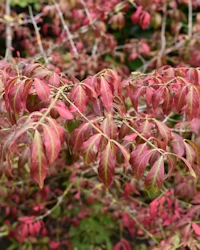 August 2024
Euonymous alatus euonymous - Latin meaning 'good name', alatus, 'winged', referring to the distinctive corky ridges that protrude from its branches like wings;
Burning bush
A.k.a. winged spindle, a native of C and N China, Japan, and Korea. It is prized for its bright red autumn colour - hence the common name - and also for its bright orange or pink fruits. The leaves were surprisingly red on this specimen when we visited in August. Its other name, winged spindle, comes from the corky wings along the stems. August 2024
Fagus sylvatica Fagus - Latin for beech; sylvatica -from Latin silvanus, of the forest purpurea
Copper beech
A.k.a. purple beech, a cultivated form of beech, though natural occurences do occur. It grows to more than 40m. The bark is smooth, thin and grey, often with slight horizontal etchings. It is monoecious both male and female flowers grow on the same tree . In spring tassel-like male catkins hang from long stalks at the end of twigs; female flowers grow in pairs, surrounded by a cup.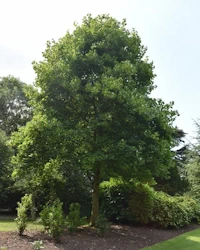 August 2024
 August 2024
 August 2024