×
![woodturning]()

Trees Gallery - Brodsworth Hall
Near Doncaster
 August 2024
 August 2024
Mespilus germanica - from Greek Mesos - half; pilos - ball; Latin germanica - German, but the plant's native range is SW Asia and SE Europe. Probably from its cultivation and popularity in Roman times when it was cultivated in Germany and the rest of Europe.
Medlar
A large shrub or small tree, cultivated since Roman times for its peculiar fruit, which is usually eaten after bletting a process of softening fleshy fruits beyond ripening - with medlars leaving them in sawdust for several weeks It may be eaten raw and in a range of cooked dishes. The wild form is a thorny shrub to 4m. In the cultivated forms, the thorns are usually reduced or absent. The wood has a fine texture, very hard, with a white, slightly pink-tinted sapwood and is brownish core. The annual rings are clearly visible. August 2024
 August 2024
 August 2024
 August 2024
Paulownia tomentosa Paulownia - in honour of Anna Pavlovna (1795–1865), Russian Princess & Queen: She was the daughter of Czar Paul I of Russia and the Grand Duchess of Russia, and later became the Queen Consort of the Netherlands from 1840 to 1849. tomentosa - from Latin meaning 'covered in hairs', referring to the hairy undersides of the tree's large, heart-shaped leaves.
Empress tree
A.k.a. the foxglove tree (reflecting the purple flower shapes) or princess tree (named after Queen Anna Pavlovna of the Netherlands).The common name reflects the purple flower shapes. It is rapid growing, to 25m, and can be invasive - a neophyte in the UK. Fragrant flowers, large and violet-blue in colour are produced before the leaves in early spring, on panicles 10–30 cm long, with a tubular purple corolla 4–6 centimetres long resembling a foxglove flower. August 2024
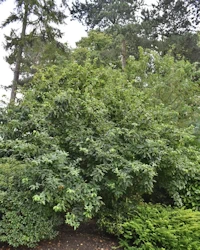
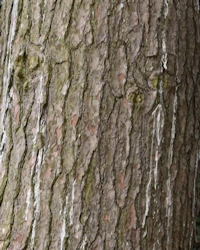
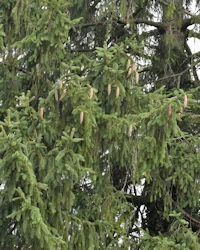 August 2024
Picea abies picea- from Latin pix - pitch, meaning pitch pine, abies - from the Latin for fir tree, referring to the tree's original classification or similarity to a fir
Norway spruce
A fast-growing evergreen conifer which can reach 40m and live for up to 1,000 years. They are tall and straight and of a triangular appearance, with a pointed crown. The young bark is a coppery grey-brown and appears smooth, but is rough with papery scales. Mature trees have dark purple-brown bark, with cracks and small plates. Twigs are orange-brown, grooved and hairless. Male flowers consist of clusters of stamens, which turn from red to yellow in spring when laden with pollen. Female flowers are red, upright and oval, and tend to form at the top of the tree. Once pollinated by wind, female flowers turn green and enlarge to become red-brown cones with diamond-shaped, rounded scales. Seeds are released in spring. [Woodland Trust] August 2024
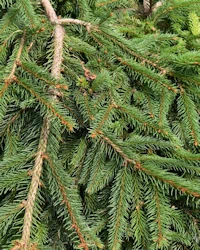 August 2024
Picea abies picea- from Latin pix - pitch, meaning pitch pine, abies - from the Latin for fir tree, referring to the tree's original classification or similarity to a fir; inversa is Latin for inverted or upside down, and describes the tree's characteristic drooping, cascading branches. inversa
Weeping Norway spruce
A large, coniferous shrub, a fast growing cultivar with distinctive weeping form. The main and secondary branches of this cultivar are quite pendulous and adpressed to the upright trunk. Here it is being growing in a rockery to cascade down over the rocks.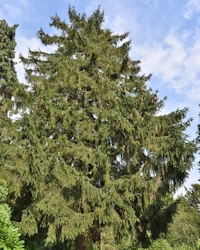 August 2024
 August 2024
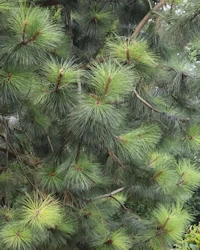
Picea breweriana picea- from Latin pix - pitch, meaning pitch pine, breweriana - honours William Henry Brewer (1828-1910), American botanist and professor of agriculture at Yale.
Brewer's spruce
A.k.a. Brewer's weeping spruce, or weeping spruce, a slow-growing large evergreen conifer growing to 20–40 m with a trunk diameter of up to 1.5 m, native to W North America, where it is one of the rarest on the continent. The pendulous foliage only develops when the tree grows to about 1.5–2 m tall; young trees smaller than this are open-crowned with sparse, level branchlets. The cones are longer than most other North American spruces, pendulous, cylindrical, 8–15 centimetres long. Immature cones are dark purple, maturing red-brown 5–7 months after pollination.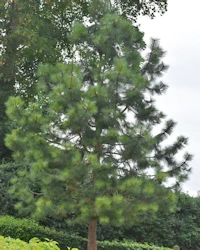 August 2024
 August 2024
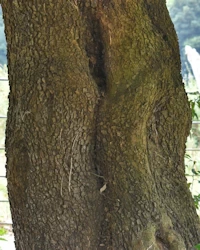
Pinus ponderosa pinus - from Latin for pine tree; ponderosus Latin for heavy - so this is a 'heavy pine'.
Ponderosa pine
A.k.a. bull pine, blackjack pine, western yellow-pine, or filipinus pine, a very large coniferous tree native to mountainous regions of W. North America. It is the most widely distributed pine species in North America. The bark helps distinguish it from other species: mature individuals have yellow to orange-red bark in broad plates with black crevices. Younger trees have blackish-brown bark, (blackjacks). Egg-shaped cones are 8–13 cm long, initially purple but becoming more brown and spherical as they dry. August 2024
 August 2024
 August 2024
Prunus laurocerasus prunus - Latin for plum or cherry; laurus - laurel; cerasus - cherry;
Cherry laurel refers to the similarity of foliage and appearance to bay laurel (Laurus nobilis, the true laurel)
A.k.a. common laurel, an evergreen shrub or small to medium tree, growing to 5 to 15 m, native to regions bordering the Black Sea in SW Asia and SE Europe. The fruit is a small cherry 1–2 cm broad, turning black when ripe in early autumn. It is considered an invasive species in Britain, where it forms dense thickets in woodlands and on hillsides.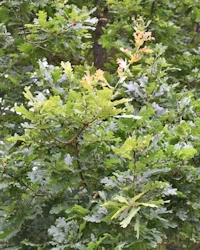 August 2024
 August 2024
 August 2024
 August 2024
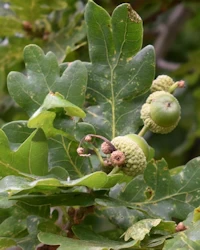
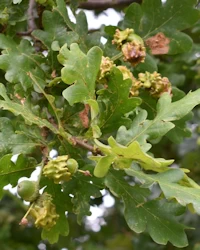
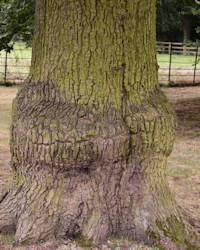
Quercus robur quercus - Latin name for oak, derived from the Proto-Indo-European root kwerkwu; robur - Latin for robust or strong, referencing the tree's sturdiness.
Common oak
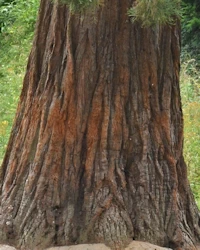
A.k.a. English oak or pedunculate oak, native to mixed woodland areas from the British Isles to the Caucasus, and has been widely planted in North America since the 1600s. It is a large, majestic, deciduous tree of the white oak group that typically grows in cultivation to 30 m with a broad-spreading, rounded crown. Small monoecious separate male and female catkins appear on the same tree yellow-green flowers appear in spring as the leaves emerge. Fruits are oval acorns 2.5 cm long, on long stalks (peduncles).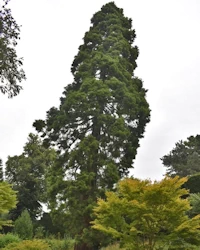 August 2024
 August 2024
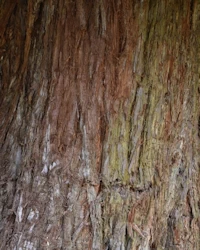
Sequoiadendron Sequoia - probably relating to the cherokee tribe; dendron - tree; giganteum - giant. giganteum
Giant redwood
A.k.a. as Wellingtonia in the UK, to commemorate the Duke of Wellington. It is the largest tree by volume and can live for more than 3000 years. Publication of its discovery in the Sierra Nevada, California, in 1852 caused a sensation. The first seed to reach Europe arrived in Scotland in August 1853 with John Matthew, narrowly beating a consignment for Veitch Nurseries in Exeter. The main use of this tree is as a grand specimen, but some experimental forestry has been conducted in Britain.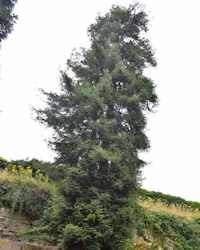 August 2024
 August 2024
 August 2024
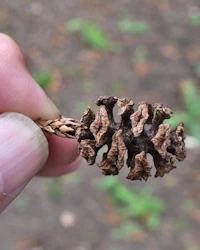 August 2024
Sequoia Sequoia - probably relating to the cherokee tribe sempervirens semper virens - always green.
Coast redwood
The sole living species of the genus Sequoia, capable of living 1,200 – 2,200 years or more. This species includes the tallest living trees on Earth, reaching up to 115 m. The bark can be very thick, up to 35 cm, quite soft and fibrous, with a bright red-brown color when freshly exposed (hence the name redwood). The species is monoecious pollen and seed cones on the same plant . Seed cones are ovoid, up to 32 mm long. Seeds are released when the cone scales dry and open at maturity. August 2024
Taxus baccata Taxus - from Greek 'toxus' or 'toxon', meaning bow; or 'toxikon' meaning poisonous; baccata - Latin for 'bearing berries'; standishii - in honour of John Standish (1814-1875), a significant figure in the nursery trade and founder of Sunningdale Nurseries in England.
Fastigiate golden yew
A dense, columnar, slow-growing medium-sized evergreen shrub with erect branches of bright, golden-yellow needle-like foliage, most vibrant in full sun. Yellow flowers appear in spring, followed by red berries in the autumn.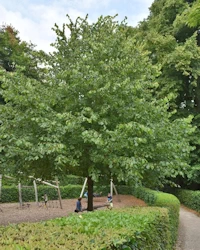 August 2024
 August 2024
Tilia cordata tilia - Latin name for the lime tree cordata, meaning heart shaped, referring to the leaves.
Small leaved lime
Always difficult to tell which of three species of lime is here, but this could be t. cordata. Native to Britain, called pry in the SE, but the rarest of the three most common limes, now considered an indicator of ancient woodland. It is commonly planted as an ornamental, particularly in lime avenues on the entrances to large estates. It is possible to tell true species apart by the underside of the leaf. Common lime (T. x europaea) has tufts of white hairs between the vein joints, whereas these are rusty red in small-leaved lime. Large-leaved lime (T. platyphyllos) has hairs all over the underside. Common lime is a hybrid and is rare in the wild in the UK. Lime wood is soft and light, white-yellow and finely textured. It is easy to work and used in turnery, carving and furniture-making. The tree can grow to 40 m, with a trunk up to 1 m diameter.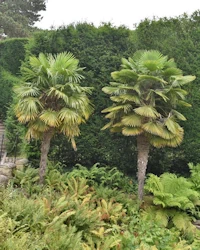 August 2024
 August 2024