×
![woodturning]()

Trees gallery - in and around Thornton le Dale
Ryedale, North Yorkshire
 May 2024
 May 2024
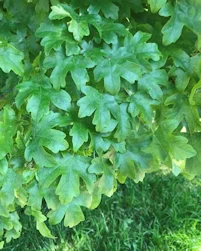
Acer campestre
Field maple
Our native maple, commonly planted on roadsides and in car parks, as here, due its resistance to air pollution. Capable of reaching 20m, and living up to 350 years. Usually monoecious male and female reproductive parts are on the same plant , the yellow-green flowers appear as the leaves open, in erect clusters; they are insect-pollinated. The fruit is a samara a winged achene, a type of fruit in which a flattened wing of fibrous, papery tissue develops from the ovary wall with wings aligned at 180°.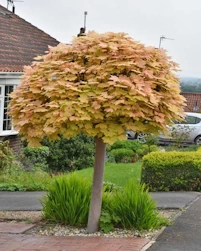 May 2024
 May 2024
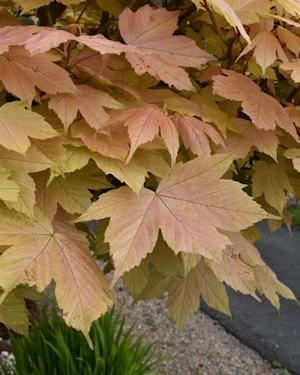
Acer pseudoplatanus 'Brilliantissimum'
Shrimp leaved sycamore
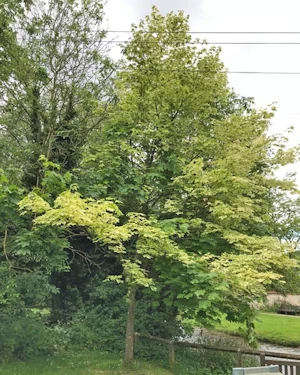
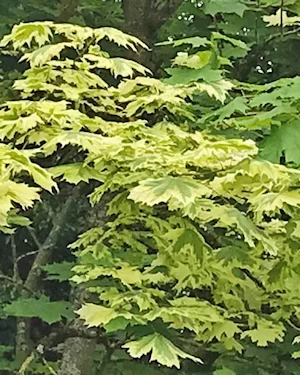
A popular cultivar of the common sycamore, grown for its modest size (to 4m in 20 years), and its salmon pink spring leaves. It displays greenish yellow flowers in spring and winged red fruit in the autumn.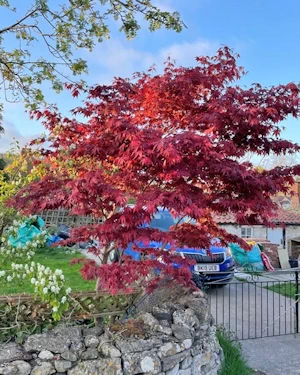 April 2025
 April 2025
Acer palmatum acer - from the Latin for maple; palmatum, palm-like, referring to the 5-lobed hand-shaped leaves;
Japanese maple
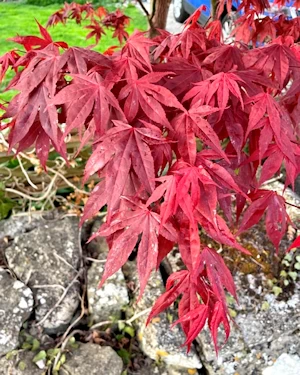
One of many varieties of Japanese maple, possibly a. palmatum Bloodgood, which holds its deep red-purple foliage well into summer. June 2024
 June 2024
 June 2024
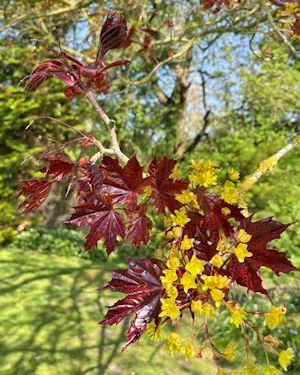
Acer platanoides acer - from Latin for maple; platanoides - resembling the plane tree (platanus). Drummondii after Thomas Drummond (1790 - 1855) Drummondii
Variegated Norway maple
A maple cultivar with creamy white edged variegated leaves, turning orange in autumn. Masses of bright yellow flowers in spring. Named after Scottish botanist Thomas Drummond (1790 - 1855).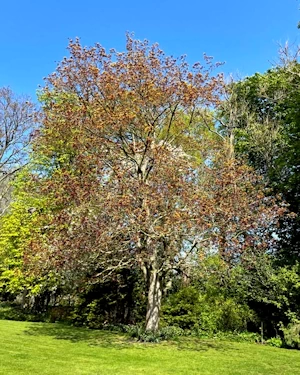 April 2025
 April 2025
 April 2025
Acer platanoides Crimson King acer - from Latin for maple; platanoides - resembling the plane tree (platanus); Crimson King is the name of a purple cultivar raised in Belgium in the 1930s.
Norway maple
A deciduous tree growing to 30 m, native to E and C Europe and W Asia. The bark is grey-brown and shallowly grooved. Unlike many other maples, mature trees do not tend to develop a shaggy bark. Flowers are in corymbs a flower cluster whose lower stalks are proportionally longer so that the flowers form a flat or slightly convex head. of 15–30 together, yellow-green with five sepals and five petals; flowering occurs in early spring before the new leaves emerge. The fruit is a double samara with two winged seeds. May 2020
Acer pseudoplatanus acer - maple; pseudoplatanus - false plane, referring to a superficial similarity of leaves and bark to those of plane trees (genus platanus)
Common sycamore
During daily walks around the village in the coronavirus lockdown, we took note of some of the trees around the village. This is a stand of 5 sycamore trees, growing tightly packed together in High Fields, to the north west of the village, isolated from other woodland.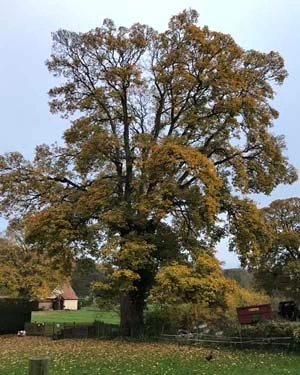 November 2021
 November 2021
Acer pseudoplatanus acer - maple; pseudoplatanus - false plane, referring to a superficial similarity of leaves and bark to those of plane trees (genus platanus)
Common sycamore
A fine large sycamore, next to the Bowling Club, by Burgess Mill. Very common, considered a weed by some, as it is not native to this country and spreads readily. Its timber is perfect for pyrography and for turning wet (unseasoned) in preparation for fine piercing.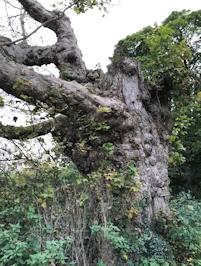 October 2021
 October 2021
Acer pseudoplatanus acer - maple; pseudoplatanus - false plane, referring to a superficial similarity of leaves and bark to those of plane trees (genus platanus)
Common sycamore
Another tree on the Ancient Tree Register, number 1720. Classed as a veteran tree with a girth of 5.19m. It suffered the loss of a large branch in 2019, but is still growing. Situated on the path between the car park and the sports field.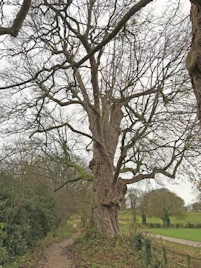 December 2021
Acer pseudoplatanus acer - maple; pseudoplatanus - false plane, referring to a superficial similarity of leaves and bark to those of plane trees (genus platanus)
Common sycamore
Yet another tree on the Ancient Tree Register, number 228. Classed as a veteran tree, with a girth of 5.54 m . It looks like limbs have been lopped off over time, probably necessary to prevent their weight causing them to split and break away.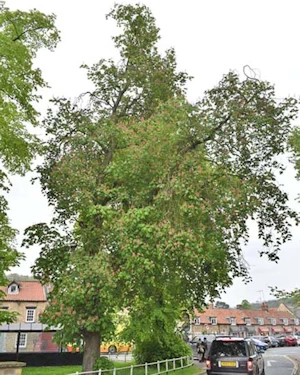 May 2024
Aesculus x carnea
Red horse chestnut
A medium-sized tree, an artificial hybrid between A. pavia (red buckeye) and A. hippocastanum (horse-chestnut). Its origin uncertain, probably appearing in Germany before 1820. It inherits the red flower color from A. pavia. Its showy flowers are borne in plumes on branch ends in spring, producing leathery fruit capsules in autumn. Usually smaller in stature than its more prolific parent, growing to 12m.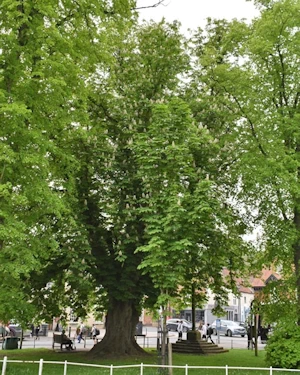 May 2024
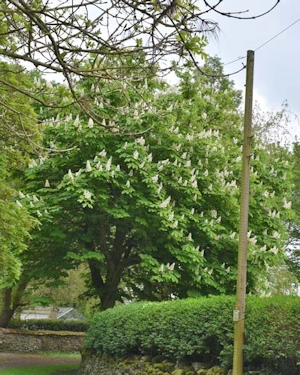 May 2024
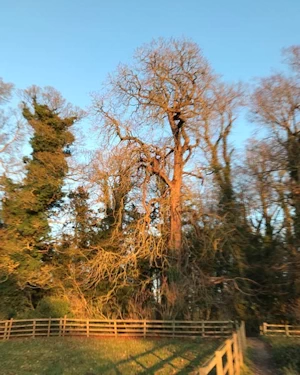 December 2021
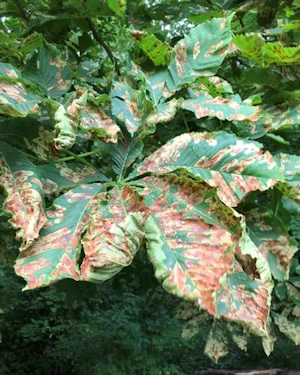 October 2022
Aesculus hippocastanum
Horse chestnut
A large horse chestnut dominates the village green (more of a traffic island these days) in Thornton le Dale, a plentiful source of conkers in September. There are numerous other examples around the village, particularly in the Thornton Estate Woods at the south of the village. Many suffer from leaf mining moth attacks as the season progresses.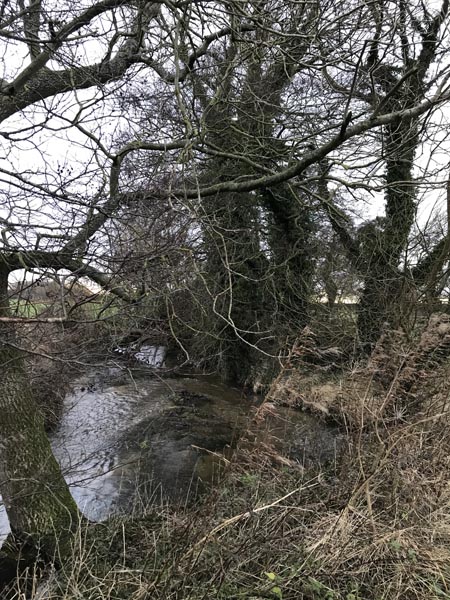 January 2022
Alnus glutinosa
Alder
Yet another tree on the Ancient Tree Register, number 31726. Classed as a veteran tree, with a girth of 3.6m. Not easily accessible, down a footpath on a bend in Thornton Beck on the south side of the village. April 2025
 April 2025
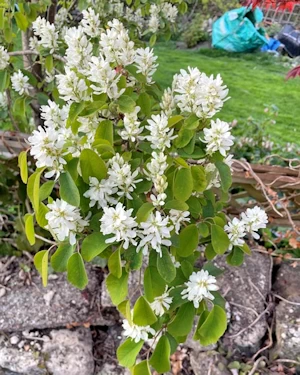
Amelanchier alnifoliaAmelanchier - likely derived from the French which itself comes from Celtic roots; alnifolia Latin, meaning having leaves similar to an alder tree.
Serviceberry
A.k.a. saskatoon berry, western shadbush, or western juneberry, a shrub native to North America. It is a deciduous shrub or small tree that most often grows to 1–8 metres. Its growth form spans from suckering and forming colonies to clumped. As with all species in the genus Amelanchier, the flowers are white, with five separate petals and five sepals. They appear on short racemes of 3–20, somewhat crowded together, blooming from April to July. The fruit is a small purple pomea fruit consisting of a fleshy enlarged receptacle and a tough central core containing the seeds, e.g. an apple, pear, quince, rowan. , with a waxy bloom.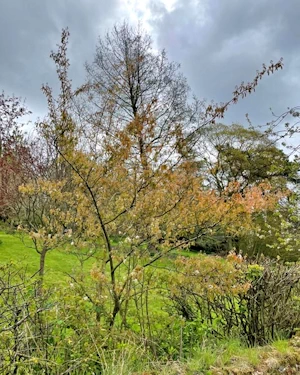 April 2025
 April 2025
Amelanchier Amelanchier - likely derived from the French which itself comes from Celtic roots; canadensis referring to its native range of Canada. canadensis
Canadian Serviceberry
A.k.a. thicket serviceberry, shad-blow, shadbush, bilberry, juneberry, chuckle-berry, sugarplum, currant-tree. A deciduous multi-stemmed shrub or small tree growing to 8 m. The The flowers are produced in early spring in loose racemes 4–6 cm long at the ends of the branches; each raceme has four to ten flowers. The flower has five white petals and 20 stamens. The fruit is a pomea fruit consisting of a fleshy enlarged receptacle and a tough central core containing the seeds, e.g. an apple, pear, quince, rowan. , dark purple when ripe; it is edible and sweet.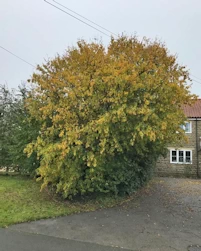 October 2023
 October 2023
Carpinus betulus
Hornbeam
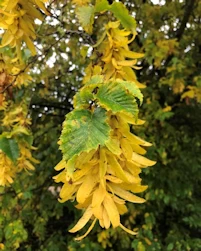
A hornbeam spotted at the entrance to a garden on Westgate. Pictured in late October, when the clusters of three-lobed bracts, together with the turning leaves, make for a colourful spectacle.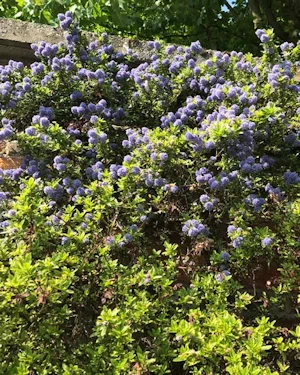 May 2024
 May 2024
Ceanothus from Greek keanōthos, a thistle, though the plant does not resemble a thistle
Californian lilac
A ceanothus growing by the north wall (of The Hall's old walled garden) in the car park at Thornton le Dale. A.k.a. buckbrush, soap bush, or just ceanothus, it is native to North America. There are many varieties, mostly shrubs growing to 3m; I am not sure which this is.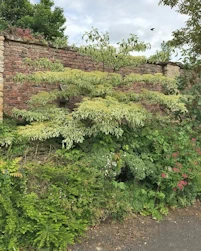 May 2024
 June 2024
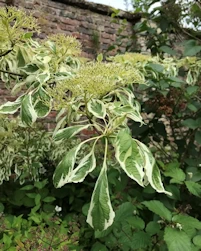
Cornus controversa from Latin - Cornum - horn, probably referring to the dense wood; controversa - in opposite directions, probably relating to the branches which spread out and cross each other variegata - variegated foliage
Wedding cake tree
A variety of dogwood native to China, Korea, the Himalayas and Japan. It is a deciduous tree growing to 15 m, (8 m for the variegated variety) with multiple tiered branches, which give the common name. Flat panicles of white flowers appear in summer, followed by globose black drupes fleshy fruit with thin skin and a central stone containing the seed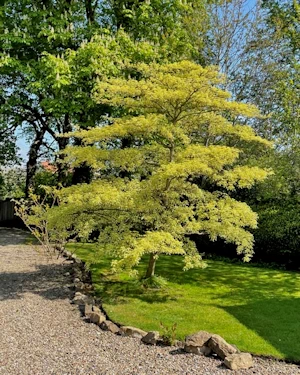 April 2025
 April 2025
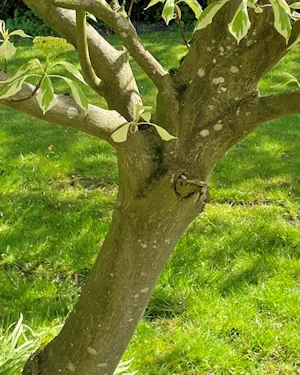 April 2025
Cornus controversa from Latin - Cornum - horn, probably referring to the dense wood; controversa - in opposite directions, probably relating to the branches which spread out and cross each other variegata - variegated foliage
Wedding cake tree
A variety of dogwood native to China, Korea, the Himalayas and Japan. It is a deciduous tree growing to 15 m, (8 m for the variegated variety) with multiple tiered branches, which give the common name. Flat panicles of white flowers appear in summer, followed by globose black drupes fleshy fruit with thin skin and a central stone containing the seed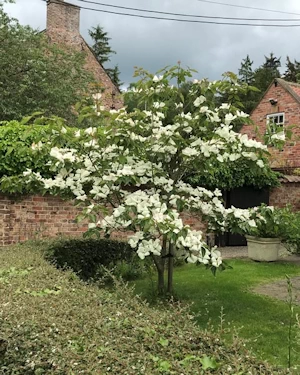 June 2024
 June 2024
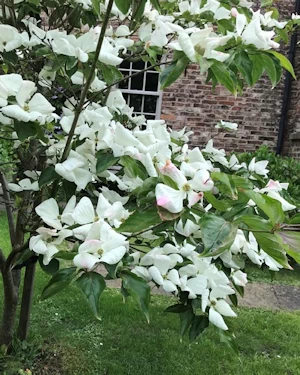
Cornus kousa Latin Cornus - horn, from the cornel tree, (not clear) kousa - the Japanese name for the tree
Kousa dogwood possibly from dagwood - dags being sharp skewers, which the dogwood could furnish (cf. dagger)
A.k.a. Chinese dogwood, Korean dogwood, or Japanese dogwood. A small deciduous tree growing 8–12 m, native to E Asia including Korea, China and Japan. Like other Cornus, C. kousa has opposite, simple leaves, 4–10 cm long. The fruit is a globose red compound berry 2–3 cm in diameter. It is edible, with a sweet and creamy flavour, and is sometimes used for making This is possibly c. kousa venus. June 2024
Crataegus laevigata from Greek krátos, meaning strength, referring to the tree's hard wood; laevigata is Latin and means smooth or slippery surface, which describes the leaves.
Midland hawthorn
A.k.a. English hawthorn, woodland hawthorn, or mayflower, a native of W and C Europe. It is a large shrub or small tree growing to 8 m, with a dense crown. The hermaphrodite flowers are produced in May, in corymbs a type of inflorescence in which the lower flowers have longer pedicels than the upper ones, creating a flat-topped appearance. of 6 to 12, each flower with five white or pale pink petals and two or sometimes three styles, each of which produces a seed (unlike c. monogyna which has 1). The fruit is a dark red pome, slightly broader than long.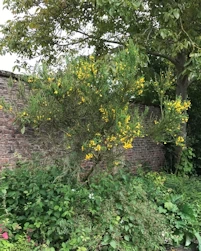 May 2024
 June 2024
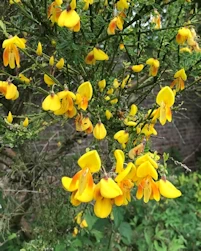
Cytisus scopariusfrom Greek - Kytisos - a type of clover, relating to the plant's leaf shape; scoparius - from Latin scopa - a broom or sweeping stick, relating to the long brush-like branches
Common broom
An upright, deciduous shrub about 1.5m tall, with slender green shoots bearing small bright green leaves composed of 3 leaflets, and clusters of pea-like bright butter-yellow flowers, appearing from the leaf axils in late spring.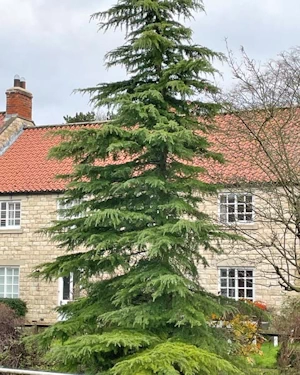 December 2025
 December 2025
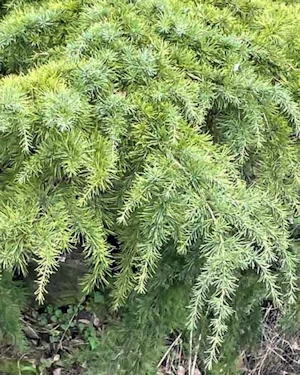
Cedrus deodara cedrus - from Greek kedros, cedar; deodara - from Sanskrit devadāru, a compound of deva (god) and dāru (wood or tree).
Deodar cedar
A large evergreen coniferous tree reaching 40–50 m, with a trunk up to 3 m in diameter. It has a conic crown with level branches and drooping branchlets. The female cones are barrel-shaped, and disintegrate when mature (in 12 months) to release the winged seeds. The male cones are 4–6 cm long, and shed their pollen in autumn.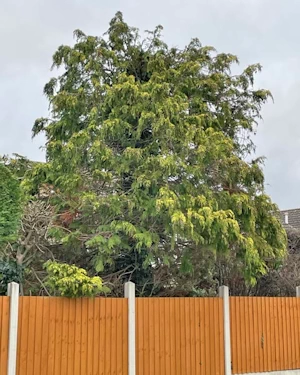 December 2025
Chamaecyparis Chamaecyparis: - dwarf cypress; lawsoniana - after Scottish nurseryman Charles Lawson lawsoniana
Lawson's cypress
A large evergreen tree growing to 50 m with trunk up to 2 m in diameter. The bark is silver-brown, vertically furrowed, and up to 25 cm thick at the base. The seed cones are globose, 7–14 mm in diameter, green at first, maturing brown in autumn. Trees can live up to about 600 years of age.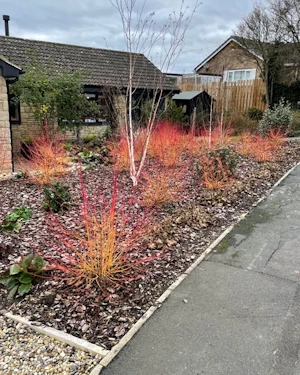 December 2025
 December 2025
Cornus sanguineaCornus - from Latin meaning horn, likely referring to the wood's density and strength; sanguinea - Latin for blood-red or bloody, describing the reddish colour of the twigs; Midwinter Fire - refers to the shrub’s intense, bright yellow-to-orange-red stem colour during the winter months.midwinter fire
Cornus Midwinter Fire
a popular, deciduous, shrub-like dogwood grown for its intense, fiery orange-red and yellow winter stem colour, reaching 1.5–2.5m. It thrives in moist, sunny spots, providing summer white flowers and autumn colour. Often pruned hard in early spring for maximum brightness.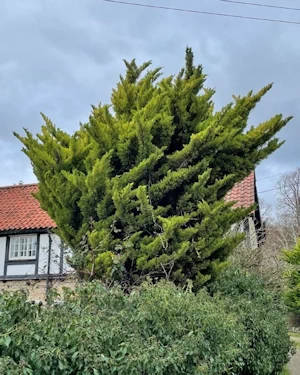 December 2025
 December 2025
Cupressus - Cupressus, cypress tree, ultimately from the Greek word for the tree, kypárissos; makros, large; karpos, fruit: Monterey cypress has relatively large cones macrocarpa
Monterey Cypress
A.k.a. hesperocyparis macrocarpa one of several species of cypress trees native to California. A medium-sized coniferous evergreen tree. The leaves are scale-like, produced on rounded (not flattened) shoots. This is a golden cultivar of the tree, probably Goldcrest.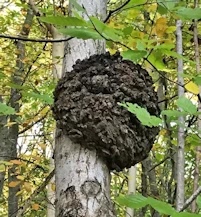 October 2021
Fagus sylvatica
Beech burr
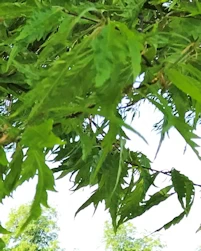
On the road from Thornton to Ellerburn, there is a large burr unnatural growth caused by the grain growing around a foreign object, a localised virus or fungus infection on a beech tree just off the roadside. Probably caused by some injury or stress to the tree in the past, causing a mass of twiggy growth to form on the side of the trunk.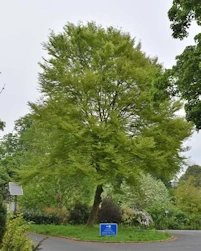 May 2024
 May 2024
Fagus sylvatica (laciniata?)
Cut leaf beech
One of many fine trees in the car park at Thornton le Dale. A cut leaf form of beech, either asplenifolia or laciniata (some authorities list the two as synonymous, but Trees and Shrubs Online makes a distinction). Smaller than the type, but still growing to 20m. May 2024
Fagus sylvatica Fagus - Latin for beech; sylvatica -from Latin silvanus, of the forest; atro - dark; purpurea - purple atropurpurea
Copper Beech
Native across Europe, growing to a height of more than 40 m and develop a huge domed crown. The reddish brown, torpedo-shaped leaf buds form on short stalks and have a distinctive criss-cross pattern. Beech is monoeciousboth male and female flowers grow on the same tree . In April and May the tassel-like male catkins hang from long stalks at the end of twigs, while female flowers grow in pairs, surrounded by a cup. Beech woodland is shady and characterised by a dense carpet of fallen leaves and mast husks which prevent most woodland plants from growing. Only specialist shade-tolerant plants can survive beneath a beech canopy.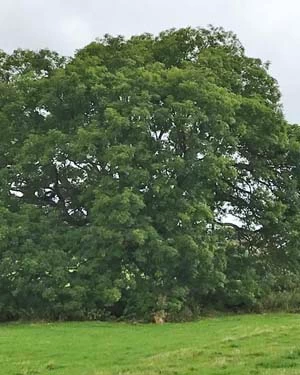 September 2022
 May 2024
Fraxinus excelsior
Common Ash
This is the larger of two large ash trees in Aunums Field, on the south west of the village, near what was the old Farmanby village. It seems to be fighting off ash dieback. December 2021
Hedera helix
Ivy
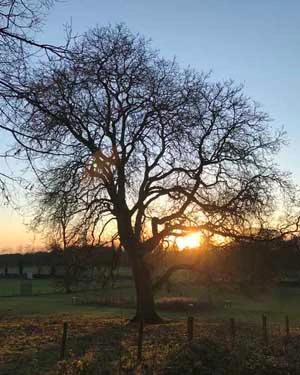
Ivy stems surrounding the trunk of a beech tree in the woods on Dog Kennel Lane. The finger-like hand in the middle, and the way the stems morph into each other adds a fascination to an otherwise mundane tree. August 2021
 December 2021
Juglans regia
Walnut
This large walnut probably formed part of The Hall parklands many years ago. A fine tree, just off the path alongside the old Ha-Ha, leading from the car park to Dog Kennel Lane. There are smaller versions a couple of hundred yards on either side, probably offspring. October 2021
Juglans regia
Common walnut
A relatively small walnut tree growing as the southern end of the lake. I like to think this could be an offspring from the large walnut a few hundred yards away, but perhaps it was just planted here.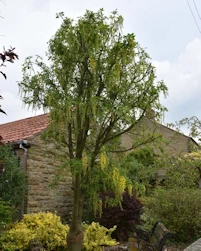 May 2024
 May 2024
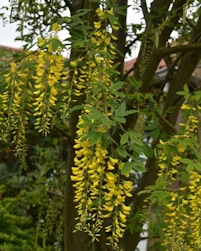
Laburnum Laburnum - the Latin name for the tree; anagyris - a similar genus, hence anagyroides is 'resembling anagyris' anagyroides
Golden chain tree
A deciduous small tree, native to the mountains of S Europe from France to the Balkans. All parts of the plant are poisonous, although mortality is very rare. The heart-wood may be used as a substitute for ebony or rosewood. It is very hard and a dark chocolate brown, with a butter-yellow sapwood. May 2024
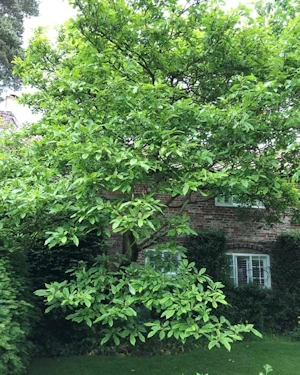
Liriodendron tulipifera from Greek Leirio - lily, referring to the lily-like flowers, and dendron tree; tulipifera - tulip like, referring to the leaves
Tulip tree
A little unusual to find this tall tree growing down Archway Lane in Thornton le Dale. I believe this is probably because the man who used to own the house and garden was Royston Valentine Roger, who started R V Roger nurseries in Pickering in 1913. The unusual 4-lobed leaves carpet the lane in autumn.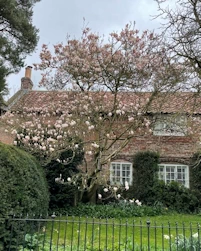 April 2025
 April 2025
 June 2024
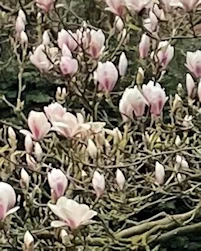
Magnolia (soulangeana?)
Saucer? magnolia
A large magnolia tree growing at Brook House, near the stream on Priestman's Lane. Possibly a saucer magnolia, but there are so many varieties of magnolia that withut a definite confirmation it would be hard to pinpoint what this one is. The pink tinge and early flowering fits the description. April 2025
 April 2025
Magnolia (stellata?)
Star magnolia
A small star magnolia growing outside a terrace house just across the road from me on Roxby Road. Masses of flowers for a short period - in full bloom here but already some petals are tinged with brown.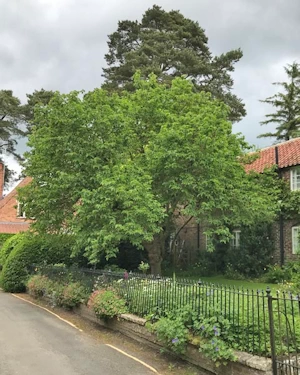 June 24
 June 24
 June 24
 June 24
Morus nigra Morus Latin for mulberry; nigra - Latin for black, referencing the dark purple or black color of the mulberry fruit.
Black mulberry
A deciduous tree growing to 12 m, originating in Mesopotamia and Persia, but cultivated across Europe and Asia. The richly flavoured fruit is a compound cluster of several small drupes that are dark purple, almost black when ripe, 2.5 cm in diameter.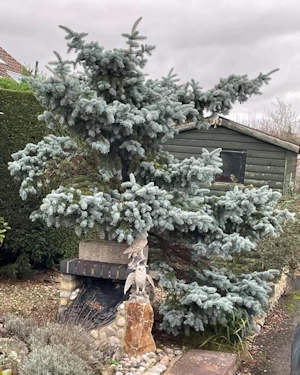 December 2025
 December 2025
Picea pungens Picea Latin pix meaning pitch or tar, referring to spruce resin; ; pungens Latin meaning sharply pointed, piercing, or prickly, escribes the tree's stiff, sharp, and often blue-tinged needles.
Blue spruce
A large conifer reaching 50 m in the wild, more often 18 m in cultivation. It has scaly grey-brown bark with a cinnamon-red undertone on its trunk. On older trees the bark becomes deeply furrowed and scaly. The narrow, needle-like, evergreen leaves are quite sharply pointed and may be dull green, blue, or pale white. Strobili pollen producing cones , develop throughout the crown, but are more common in the upper half. Purple-brown seed cones form at the top of the tree in May/June and release their mature seeds in the autumn of the same year, turning light brown as they mature.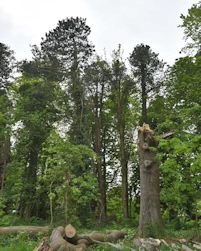 May 2024
Pinus sylvestrisPinus is Latin for pine; sylvestris from silva - woodland or forest
Scots pine
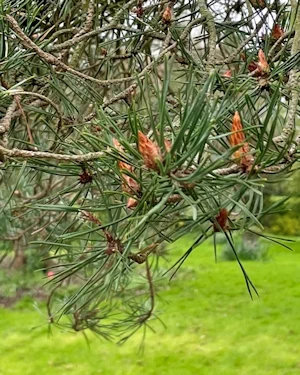
Tall Scots pine are mixed in with beech in a strip of woodland alongside the beck, opposite the playing fields. A large beech snapped and fell in a storm in 2023, giving a little more light to the Scots pine. A large, evergreen tree to 25m, with the upper trunk and branches orange-brown, developing a picturesque, irregular outline with maturity. Twisted grey-green needles are borne in pairs. Cones are 5cm in length. April 2025
 April 2025
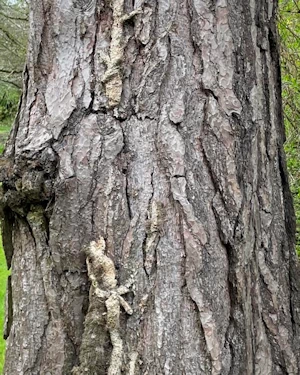 April 2025
Pinus sylvestris pinus- Latin for pine silva - woodland or forest, reflecting the tree's habitat.
Scots pine
An evergreen conifer native to northern Europe. Mature trees grow to 35m and can live for up to 700 years. The needle-like leaves are blue-green and slightly twisted, and grow in pairs on short side shoots. Scots pine is monoecious both male and female flowers grow on the same tree. Male flowers comprise clusters of yellow anthers at the base of shoots. Female flowers are small, red-purple and globular, and grow at the tips of new shoots. [Woodland Trust] April 2025
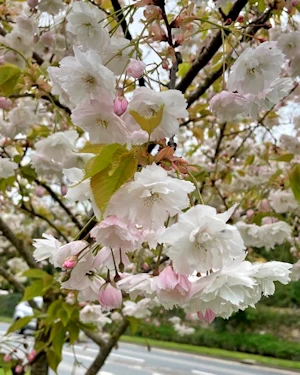 April 2025
Prunus serrulata prunus - Latin name for plum or cherry trees; serrulata meaning small saw or serrated, referring to its finely serrated leaf margins.
Japanese cherry
A.k.a. Oriental Cherry, or Hill Cherry. A small, deciduous tree, reaching up to 12 m with a spreading, vase-shaped canopy and smooth, chestnut-brown bark. Known for spectacular, dense, mid-spring blooms of white or pink flowers, it features ovate-lanceolate serrated leaves that are bronze when young, green in summer, and turn red/crimson in autumn.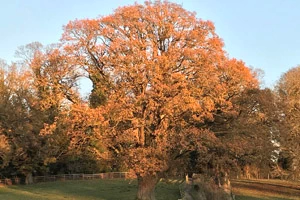 December 2021
Quercus robur
Pedunculate Oak
This fine oak is on the Ancient Tree Register, number 223770: Notable tree. It has a girth of 5.23m. It is in a sheep field next to the path that runs along the old Ha-Ha, leading from the car park to Dog Kennel Lane. Pedunculate refers to the "peduncles" that the acorns are borne on - long stalks - as opposed to sessile oak, where the acorns grow from the branch.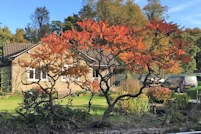 October 2024
Rhus typhina rhus - from the Greek for the sumac; typhina - from Latin, 'rough like antlers in velvet', referring to the hairy, velvety young twigs that resemble a stag's antlers.
Stag's horn sumach
A spreading stags horn sumac growing in a garden by the beck on Maltongate, in autumn colour. A large suckering deciduous shrub to 6m, the red-hairy stems with large pinnate leaves turning red and orange in autumn. Dioecious having male and female reproductive organs on separate plants , with yellow-green flower clusters, followed on female plants by dense crimson fruiting heads. [RHS]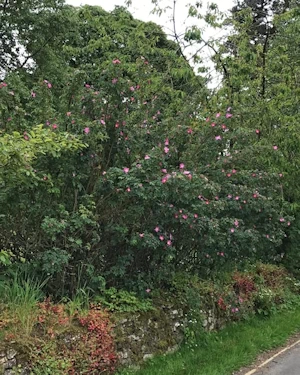 June 2024
 June 2024
Rosa glauca rosa - Latin for rose; glauca Latin glaucus for bluish-grey/glaucous, highlighting the distinctive, waxy, grey-blue to purple foliage.
Wild rose
Probably r. glauca, but could be another wild rose variety. The stems are reddish-violet and sparsely prickly. Small (4cm), single, deep rose-pink flowers with white centers appear in clusters during early to mid-summer. Bright red, spherical hips develop in late summer and last into winter. A hardy, upright, and arching shrub that typically grows to 1.5–2 meters in height. October 2021
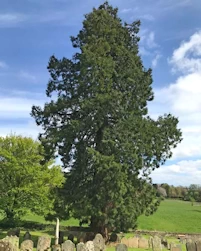 April 2024
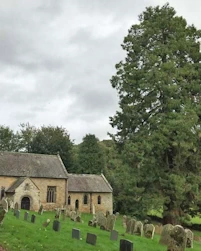 October 2021
Sequoia giganticum
Giant sequoia
Noted in the Ancient Tree Register, number 195651. Girth 5m, as a Notable Tree. In St Mary's churchyard, it is slowly swallowing an adjacent gravestone. October 2021
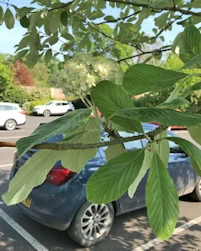 October 2021
Sorbus aria from Greek: sorbus - service tree, or red-fruited tree;aria - an old name for oak
Whitebeam refers to the white blossom and white underside of the leaves
A deciduous broadleaf tree that is compact and domed, growing to 15m. The bark and twigs are smooth and grey and the shoots are brick red in sunlight but greyish-green in shade. It is hermaphrodite each flower contains both male and female reproductive parts . Five-petalled flowers appear in clusters in May, and are pollinated by insects, followed by into scarlet berries which ripen in late summer. October 2021
Sorbus aucuparia from Latin: sorbus - service tree; avis, bird and capere catching , reportedly describing the use of the fruit as bait for fowling.
Rowan
A.k.a. mountain ash, a deciduous tree or shrub growing to 15m, native to Europe, Asia and N Africa. It is monoecious male and female flowers grow on the same tree , blossoming from May to June in dense corymbs of small yellowish white flowers and develops small red pomes as fruit that ripen from August to October, eaten by many bird species. The fruit and foliage have been used in the creation of dishes and beverages, as a folk medicine, and as fodder for livestock. Its tough and flexible wood has traditionally been used for woodworking. Yellowish grey, gleaming bark becomes grey-black with lengthwise cracks in advanced age, with lenticels in the bark elongated and coloured a bright ochre. The plant does not often grow older than 80 years.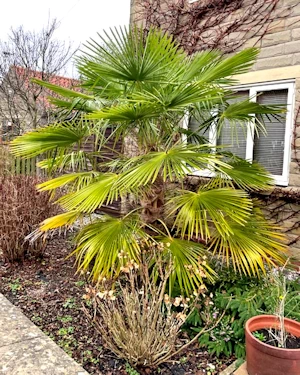 December 2025
 December 2025
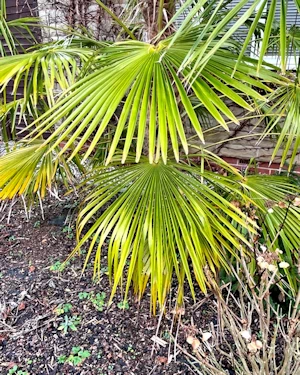
Trachycarpus fortunei from Greek trachys, rough, and karpos, fruit, referring to the fibrous, rough trunk of the palm; fortunei, after Scottish horticulturist Robert Fortune (1812 - 1880).
Windmill palm
Also called the Chusan palm, native to subtropical and temperate mountain forests of China, Japan, Myanmar and India where it typically grows to 12-20m. One of the hardiest of the palms, cultivated for its coarse but strong leaf sheath fibre, used for making rope, sacks, and other coarse cloth where strength is important.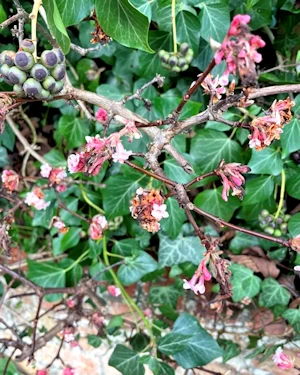 December 2025