×
![woodturning]()

Trees gallery - in and around Thornton le Dale
Ryedale, North Yorkshire
 December 2021
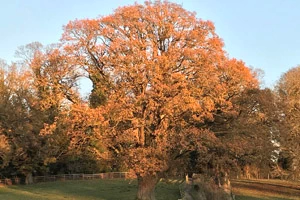
Quercus robur quercus - Latin name for oak, derived from the Proto-Indo-European root kwerkwu; robur - Latin for robust or strong, referencing the tree's sturdiness;
Pedunculate Oak
This fine oak is on the Ancient Tree Register, number 223770: Notable tree. It has a girth of 5.23m. It is in a sheep field next to the path that runs along the old Ha-Ha, leading from the car park to Dog Kennel Lane. Pedunculate refers to the "peduncles" that the acorns are borne on - long stalks - as opposed to sessile oak, where the acorns grow from the branch.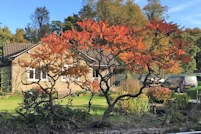 October 2024
Rhus typhina rhus - from the Greek for the sumac; typhina - from Latin, 'rough like antlers in velvet', referring to the hairy, velvety young twigs that resemble a stag's antlers.
Stag's horn sumach
A spreading stags horn sumac growing in a garden by the beck on Maltongate, in autumn colour. A large suckering deciduous shrub to 6m, the red-hairy stems with large pinnate leaves turning red and orange in autumn. Dioecious having male and female reproductive organs on separate plants , with yellow-green flower clusters, followed on female plants by dense crimson fruiting heads. [RHS]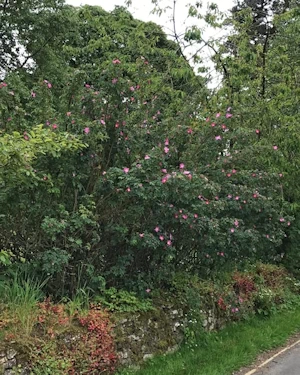 June 2024
 June 2024
Rosa glauca rosa - Latin for rose; glauca Latin glaucus for bluish-grey/glaucous, highlighting the distinctive, waxy, grey-blue to purple foliage.
Wild rose
Probably r. glauca, but could be another wild rose variety. The stems are reddish-violet and sparsely prickly. Small (4cm), single, deep rose-pink flowers with white centers appear in clusters during early to mid-summer. Bright red, spherical hips develop in late summer and last into winter. A hardy, upright, and arching shrub that typically grows to 1.5–2 meters in height.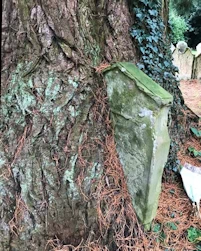 October 2021
 April 2024
 October 2021
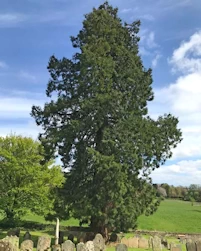
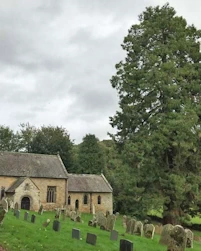
Sequoiadendron giganteum Sequoia - probably relating to the cherokee tribe, possibly from Latin sequoia, relating the sequence of seeds per cone; dendron - tree; giganteum - giant.
Giant sequoia
Noted in the Ancient Tree Register, number 195651. Girth 5m, as a Notable Tree. In St Mary's churchyard, it is slowly swallowing an adjacent gravestone.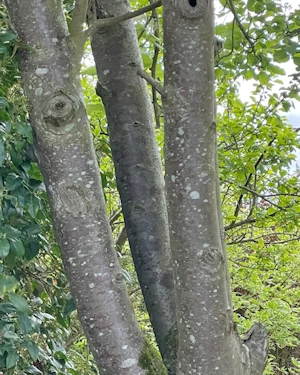
May 2026
Sorbus aria from Greek: sorbus - service tree, or red-fruited tree;aria - an old name for oak
Whitebeam refers to the white blossom and white underside of the leaves
A deciduous broadleaf tree that is compact and domed, growing to 15m. The bark and twigs are smooth and grey and the shoots are brick red in sunlight but greyish-green in shade. It is hermaphrodite each flower contains both male and female reproductive parts . Five-petalled flowers appear in clusters in May, and are pollinated by insects, followed by into scarlet berries which ripen in late summer. October 2021
Sorbus aucuparia from Latin: sorbus - service tree; avis, bird and capere catching , reportedly describing the use of the fruit as bait for fowling.
Rowan
A.k.a. mountain ash, a deciduous tree or shrub growing to 15m, native to Europe, Asia and N Africa. It is monoecious male and female flowers grow on the same tree , blossoming from May to June in dense corymbs of small yellowish white flowers and develops small red pomes as fruit that ripen from August to October, eaten by many bird species. The fruit and foliage have been used in the creation of dishes and beverages, as a folk medicine, and as fodder for livestock. Its tough and flexible wood has traditionally been used for woodworking. Yellowish grey, gleaming bark becomes grey-black with lengthwise cracks in advanced age, with lenticels in the bark elongated and coloured a bright ochre. The plant does not often grow older than 80 years.
April 2026
Tilia europaea tilia - Latin name for the lime tree europaea, - European.
Common lime?
Always difficult to tell which of the three main species of lime is here, but this is probably t. europaea, the European lime or linden: a hybrid of two native limes - small and large leaved. Selected for its ornamental properties, it is propagated by layering or root cuttings, so every common lime is genetically identical. The trees produced are very uniform and are popular for planting in avenues. Highly attractive to bees when in flower, common limes produce an abundance of shoots from the base of their trunks. Ironically, despite being a selected variety or cultivar, most gardeners cut off these sprouts to reveal clear, if scarred, bark. Beneath that bark limes produce a fibre called bast, once important for rope-making. Today limes still produce piano keys, sound boards for instruments and refreshing tea.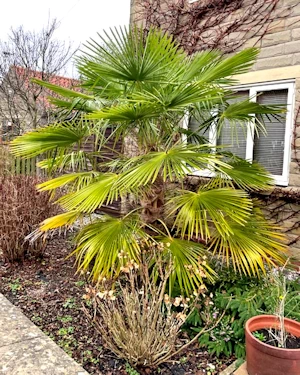 December 2025
 December 2025
 December 2025
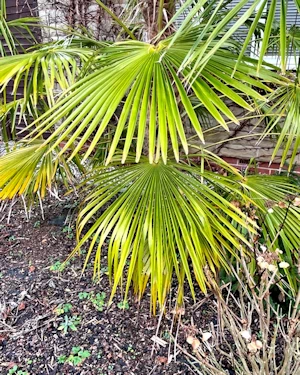
Trachycarpus fortunei from Greek trachys, rough, and karpos, fruit, referring to the fibrous, rough trunk of the palm; fortunei, after Scottish horticulturist Robert Fortune (1812 - 1880).
Windmill palm
Also called the Chusan palm, native to subtropical and temperate mountain forests of China, Japan, Myanmar and India where it typically grows to 12-20m. One of the hardiest of the palms, cultivated for its coarse but strong leaf sheath fibre, used for making rope, sacks, and other coarse cloth where strength is important. April 2026
 April 2026
Viburnum davidii viburnum - from Latin, referring to Viburnum lantana (the wayfaring tree); davidii - after Père Armand David, a Lazarist missionary who explored China between 1862 and 1874, collecting numerous botanical and zoological specimens.
David's viburnum
A compact, low-growing, and slow-spreading evergreen shrub, prized for its architectural, leathery, dark green leaves with three distinct, deep veins. It forms a neat, mounded shape, typically reaching 1 - 1.5 m high and wide. In spring, it produces flattened heads of small, white flowers, which are followed by long-lasting, metallic blue-black berries on female plants in autumn and winter.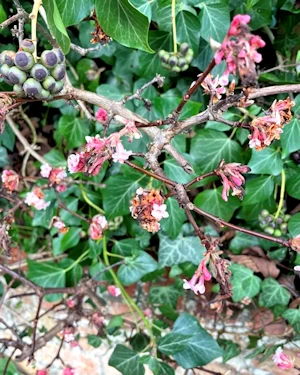 December 2025
Viburnum farreri viburnum - from Latin, referring to Viburnum lantana (the wayfaring tree); farreri - after Reginald John Farrer, an early 20th-century British explorer, author, and botanist
Farrer's viburnum
A small, upright shrub, typically growing to 3 m in height and spread. Strongly scented, pink-budded white flowers appear from November to March/April. It occasionally produces small, red berries in winter, although these are infrequent in cultivation. Deciduous leaves are ovate, prominently veined, and serrated; they start bronze and turn deep green, followed by red-purple in autumn.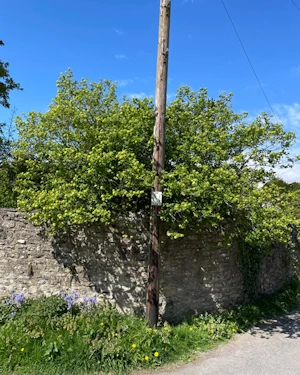 April 2026
 April 2026
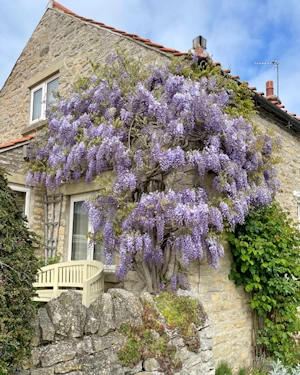
Viburnum opulus viburnum - from Latin, referring to Viburnum lantana (the wayfaring tree); opulus - refers to the similarity of its leaves to those of the maple genus acer opulus; roseum - Latin meaning rose-like. roseum
Snowball tree
A large, bushy deciduous shrub to about 3m in height, with dark green lobed leaves tinted purplish-red in autumn. Abundant, greenish-white or white flowers in dense rounded clusters to 6cm across, occasionally maturing to pink, are produced in late spring or early summer; the flowers are sterile so no fruit is produced. [AI]
 May 2026
 May 2026