×
![woodturning]()

Trees gallery - Garth End Cottage, Thornton le Dale
Ryedale, North Yorkshire

Garth End Cottage
We moved to Thornton le Dale in 1986, and have developed the garden from mainly tarmac and lawn to its current state over 40 years. There are a number of trees in the garden, some dating back before our arrival, others planted by us. There are slides from a talk about the garden's development on the site. April 2025
Acer pseudoplatanus acer - maple; pseudoplatanus - false plane, referring to a superficial similarity of leaves and bark to those of plane trees (genus platanus); brilliantissimum - Latin meaning most brilliant or most shiny, describing the tree's striking spring foliage, which emerges salmon-pink or bright shrimp-pink in colour brilliantissimum
Shrimp leaved sycamore
A popular cultivar of the common sycamore, grown for its modest size (to 4m in 20 years), and its salmon pink spring leaves. It displays greenish yellow flowers in spring and winged red fruit in the autumn. This one was planted in my garden in 2025. It looks like a graft onto a rootstock. October 2024
 October 2024
 October 2024
Acer griseum acer - maple; griseum from L. griseus - grey, referring to the undersides of the leaves
Paper bark maple
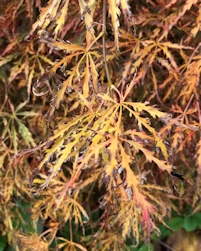
This acer griseum was tucked into a relatively small space with a beech and a birch for company. It seems to be thriving, about 10 years since planting, and the exfoliating bark is a never-ending delight. October 2024
 October 2024
 October 2024
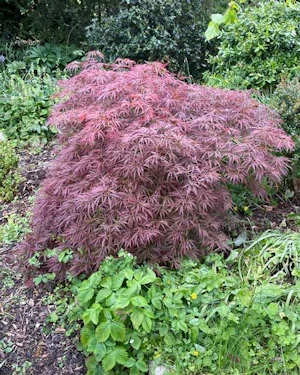
Acer palmatum acer - from the Latin for maple; palmatum, palm-like, referring to the 5 lobed hand shaped leaves dissectum - referring to the deeply cut leaves atropurpurpeum - very dark purple.
Japanese maple
This slow growing maple is about 27 years old in this photo. It is beginning to grow into space created by cutting back other shrubs and plants around it, but it is unlikely to ever be a tall tree. At least not in my lifetime.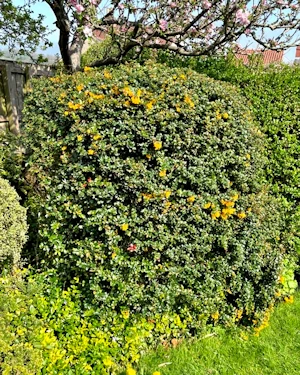 April 2025
 April 2025
Berberis darwinii berberis - Latinised from the Arabic for the plant; darwinii - after Charles Darwin, who found the plant in South America
Darwin's barberry
An evergreen thorny shrub, native to S Chile and Argentina, growing to 3–4 m. It has dense branches from ground level. The flowers are orange, 4–5 mm long, produced in dense racemes a flower cluster with the separate flowers attached by short equal stalks at equal distances along a central stem. The flowers at the base of the central stem develop first 2–7 cm long in spring. The fruit is a small purple-black berry 4–7 mm diameter, ripening in summer. The berries are edible but are very acidic. It is regarded as invasive in New Zealand, and is naturalised in S Australia, and in California. October 2024
 October 2024
Betula utilis betula - birch, derived from the Gaulish betu- meaning bitumen or asphalt, referring to the tar extracted from birches; utilis - useful, referring to the many uses of the tree; jacquemontii - honouring the French naturalist Victor Jacquemont jacquemontii
Himalayan birch
Striking white bark earns this tree its place in the garden. This peels off in wide bands, making it suitable for use as paper, at least for special messages. Tucked in beside a privet hedge, a pergola and a clipped beech tree.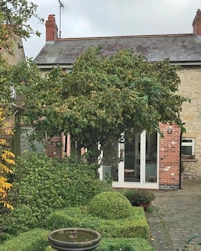
October 2024

October 2024
Corylus corylus - from Greek korylos 'helmet', referring to the nut husk's shape; avellana - from the Italian city Avella, where hazelnuts were cultivated; contorta - twisted avellana contorta
Corkscrew hazel
Delightfully twisting stems and crumpled leaves on this corkscrew hazel. Discovered as a mutation in a hedgerow by Henry Ellacombe in Gloucestershire in the 1860s. Often called "Harry Lauder's walking stick" after the Scottish singer who had a stick made from it for his stage act. Plentiful with nuts, which grow into ordinary straight hazels. May 2026
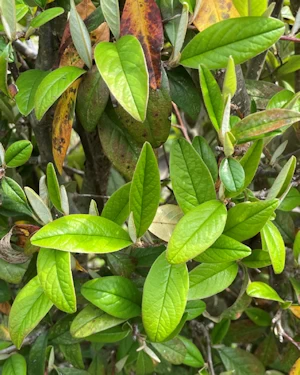 May 2026
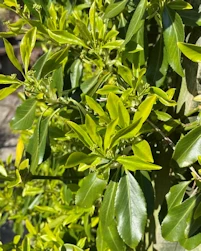
Cotoneaster cotoneaster - from Latin cotoneum meaning quince, and aster, which means resembling, referring to the similarity between the foliage of some cotoneaster species and that of the quince plant (Cydonia oblonga); salicifolius - from Latin salix, willow and folium, leaf, meaning willow-leaved. salicifolium
Willow leaved cotoneaster
A large shrub with a spreading or arching, sometimes herringbone branching structure. While in cultivation it typically reaches 1 - 2 m, in the wild it can grow up to 5 - 6 m. In late spring to early summer, it produces numerous small, white to creamy-white, five-petaled flowers, which appear in flat-topped clusters (corymbs), followed by spherical red berries which persist well into winter.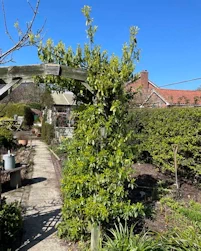 April 2025
 April 2025
Euonymous Euonymous: from Greek words eu, meaning good or lucky, and onoma (or nymus), meaning name. Possibly ironic, as all parts of the plant are poisonous if ingested. fortunei: after Robert Fortune (1812 - 1880), Scottish botanist and plant collector Fortunei
Spindle
A.k.a. Fortune's spindle, or winter creeper, an evergreen shrub growing as a climbing vine up to 20m. The flowers are inconspicuous, 5 mm in diameter, with four small greenish-yellow petals. The fruit is a smooth, dehiscent opening at maturity capsule with reddish arils.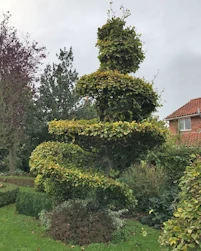 October 2024
 April 2025
Fagus sylvatica Fagus - Latin for beech; sylvatica -from Latin silvanus, of the forest
Beech topiary
Another tree present in the garden as a fairly young sapling when we moved in back in 1986. Here it is nearly 30 years on, having been gradually clipped into a spiral. April 2025
 April 2025
Malus domesticamalus - Latin for apple tree; domestica - from Latin domesticus, belonging to the house, highlighting its long history of cultivation near human dwellings; Egremont - linked to the estate of Lord Egremont (George Wyndham) at Petworth House in Sussex, England, where it was thought to have been first raised; russet - refers to the brownish, rough-skinned, and often firm-fleshed nature of the apple. Egremont russet
Egremont russet apple
This is a russet apple, which has been growing in our garden since we arrived - so it is over 40 years old. The apples need to be given a week or two having fallen or been picked, to allow them to sweeten.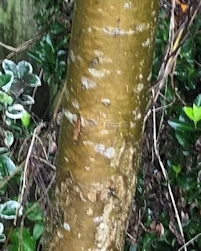
October 2024