×
![woodturning]()

Trees Gallery - RHS Bridgewater
Worsley, Salford

Magnolia sieboldii
Small flowered Magnolia
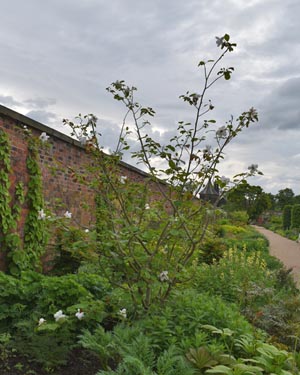
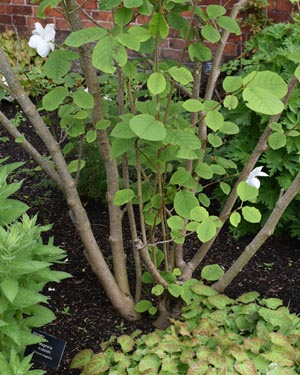
A.k.a. Korean mountain magnolia and Oyama magnolia, native to E Asia in China, Japan, and Korea. A large deciduous shrub or small tree growing to 5-10m. The flowers, unlike the spring flowering magnolias, open primarily in the early summer, but continue intermittently until late summer. They are pendulous, cup-shaped and pure white; the carpels are greenish and the stamens reddish-purple or greenish-white. It is named after the German doctor Philipp Franz von Siebold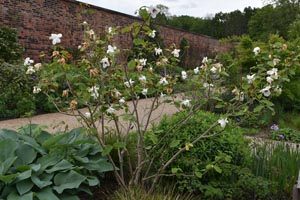

Magnolia wilsonii
Wilson's magnolia
A large, spreading deciduous shrub to 6m in height, with narrowly-ovate dark green leaves to 18cm long, downy beneath. Nodding, cup-shaped, highly scented, pure white flowers up to 10cm in width, with 9 tepals, and rich-crimson stamens are produced in late spring and early summer; fruit in autumn is pink and cylindrical. [RHS]
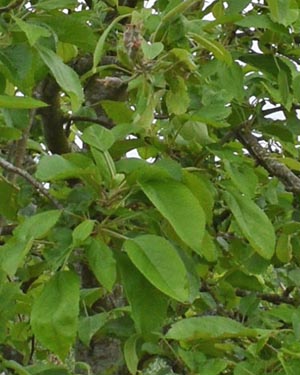

Malus domestica 'Worcester pearmain'
Worcester pearmain apple
A dessert apple cultivar of 150 years vintage. It produces attractive flowers. The fruit has an intense strawberry flavour when well-ripened and scarlet. Heavy, regular crops are produced and can be used from late September to October.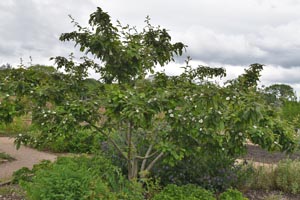

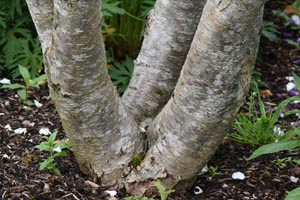
Mespilus germanica
Medlar
A large shrub or small tree, cultivated since Roman times for its peculiar fruit, which is usually eaten after bletting a process of softening fleshy fruits beyond ripening - with medlars leaving them in sawdust for several weeks It may be eaten raw and in a range of cooked dishes. The wild form is a thorny shrub to 4m. In the cultivated forms, the thorns are usually reduced or absent. The wood has a fine texture, very hard, with a white, slightly pink-tinted sapwood and is brownish core. The annual rings are clearly visible.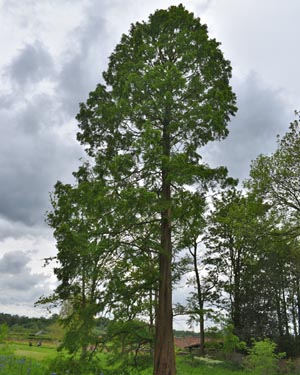
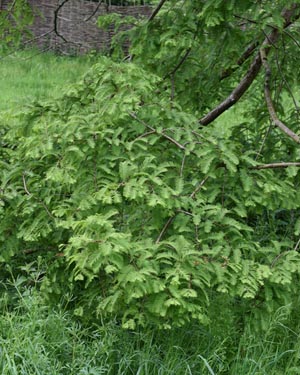
Metasequoia glyptostroboides
Dawn redwood
A fast-growing, endangered deciduous conifer native to Hubei and Hunan provinces in China, the sole living species of the genus Metasequoia. It can grow to 35m in 50 years, with fibrous brown bark on a trunk up to 1m in diameter.
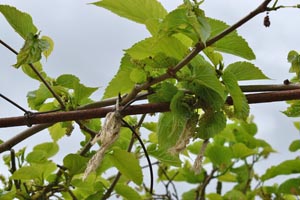
Morus alba
White mulberry
small to medium-sized tree native to China and India, which can grow to 20m tall. It is generally a short-lived tree with a lifespan up to 100, although there are some specimens known to be more than 250 years old. Widely cultivated to feed the silkworms employed in the commercial production of silk. Its berries are edible when ripe. It producesThe single-sex catkins; male and female flowers are usually found on separate trees although they may occur on the same tree. In the wild berries are deep purple, but in many cultivated plants it varies from white to pink. It is sweet but bland, unlike the more intense flavor of the red mulberry and black mulberry.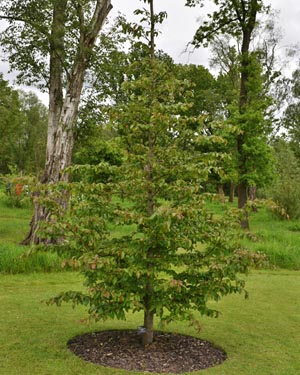
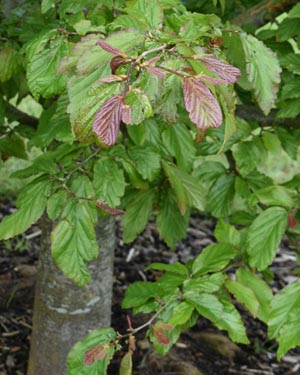
Parrotia persica 'Bella'
Persian ironwood
A small, often multi-stemmed, deciduous tree or shrub slowly reaching 8m. It has small, red, witch-hazel like flowers early on bare stems, followed by leaves which emerge red-green. They become glossy green through the summer and then red, yellow and purple in autumn. When mature, it has attractive flaky bark in winter.

Phellodendron amurense
Amur cork tree
A native of E Asia (China, Korea, Amur and Japan), a deciduous tree up to 15m. It has glossy, aromatic leaves. Clusters of small green flowers appear in summer, followed by small round black berries. It is a major source of huáng bò, one of the 50 fundamental herbs used in traditional Chinese medicine.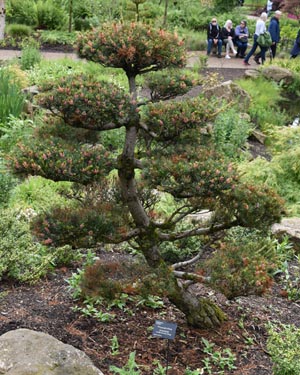


Pinus parviflora
Japanese white pine
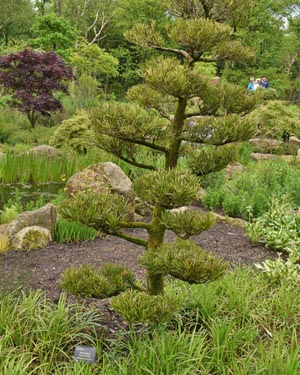
A native ofJapan and Korea, an evergreen conifer growing to 12m, that typically grows in a dense pyramidal habit when young, but with age develop more spreading branches and a flatter top, making it perfect for cloud pruning, as here. It bears ovoid light brown cones in autumn, often in whorls of 3 or 4, in extraordinary profusion.
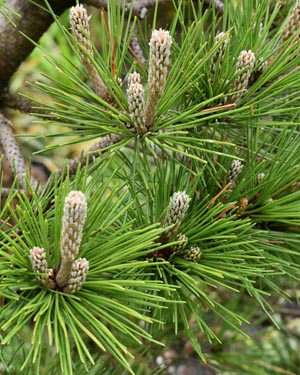
Pinus thunbergii sayonara
Japanese black pine
The species is a native of Japan, a large conifer growing to 30m, with a trunk over a metre in diameter. 'Sayonara' is a dwarf, slow-growing, evergreen cultivar, which produces a compact, irregular dome-shaped bush, reaching about 1m high and 1.5m across in 10 years. It can produce oval-shaped, brown cones, that taper to a point at the tips. On the species, the cones are sometimes clustered as many as fifty or sixty together. The Japanese train it into many grotesque shapes, and it is popular as a bonsai specimen.