×
![woodturning]()

Trees Gallery - RHS Bridgewater
Worsley, Salford

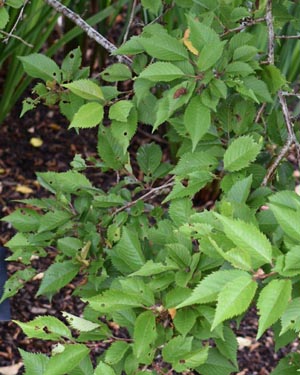
Prunus incisa praecox
Fuji cherry
A cultivar of p. incisa with white flowers in early spring and orange-red autumn foliage. 'Praecox' means 'precocious' which alludes to its early flowering - as early as November. The species is native to Japan, abundant around Mount Fuji. The petals do not remain on the flower for any great length of time, but the calyx and stamens persist and heighten its colour.
Prunus incisa 'The Bride'
Flowering cherry
A.k.a. Fuji cherry; sometimes the species name incisa is dropped, and this cultivar is referred to simply as p. 'The Bride'. It is a small, rounded, deciduous tree bearing pure white, single flowers with a deep red, central flush, in mid-spring. We were a little late for the blossom at its best. Dark green, sharply toothed leaves turn orange-red in autumn. It produces ovoid, purple-black fruit.

Prunus persica 'Peregrine'
Peach
The species p. persica is the species name for the peach, first domesticated in China, then spreading to Persia and eventually across Euope. 'Peregrine' is a self-fertile, fruiting culinary peach that produces white-fleshed fruit with brilliant crimson skin. It flowers in spring with single pale-pink flowers. A heavy cropper with an intense rich flavour.
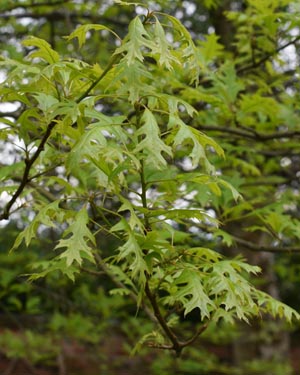
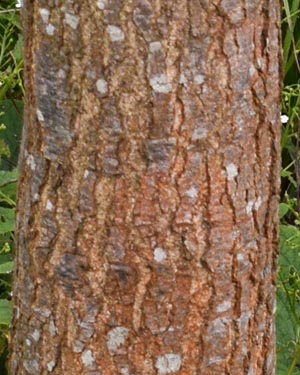
Quercus palustris
Pin oak
A.k.a. swamp oak or Spanish oak, a Native of the E USA. A deciduous tree growing to 30m, forming a dense head of slender branches pendulous at the ends. The acorns are about 12mm long and broad, flattish at the base, where they are enclosed by a shallow saucer-shaped cup. It is quick growing for an oak, but not long lived.

Rhododendron egret
Rhododendron egret
a compact dwarf variety with glossy, dark green leaves and clusters of funnel-shaped white flowers about 2cm in width in late spring open trusses, to 7cm long, of dainty funnel-shaped flowers, white tinged green and 2cm in width.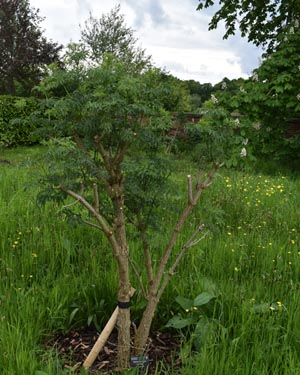
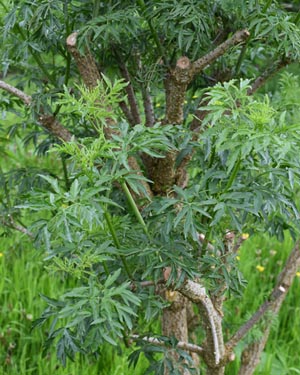
Sambucus nigra laciniata
Cut-leaved elder
A large, bushy, broadleaf deciduous shrub which produces flattened panicles of small, musk-scented, creamy-white flowers in early summer, followed by round, glossy black fruit.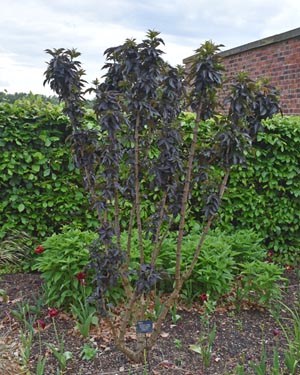
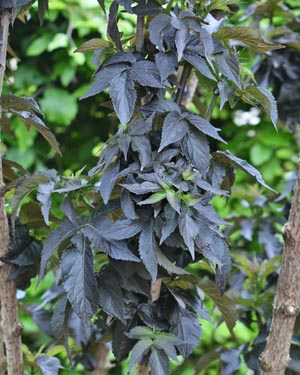
Sambucus nigra porphrophylla 'Black Tower'
Black elder
Elder is native to Europe, N. Africa and S.W. Asia. This cultivar is a tall, slender deciduous shrub primarily grown for its foliage, which emerges green in spring, but (if exposed to lots of sun) will soon turn a deep burgundy colour. In early summer, the stems are crowned with large, flattened sprays of lightly perfumed, small pink flowers.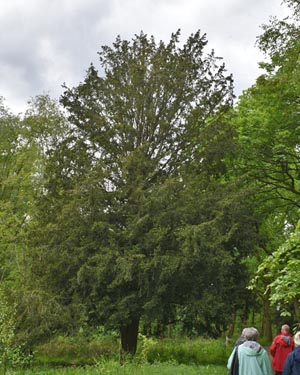
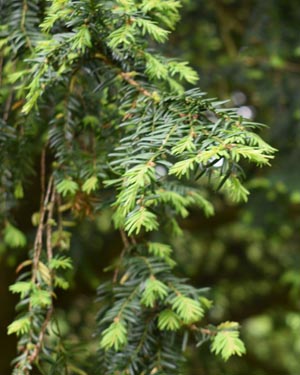
Taxus baccata
Common yew
A.k.a. European yew or English yew. An evergreen tree native to W, C and S Europe, NW Africa, N Iran, and SW Asia. A woodland tree in its native range, it is also grown as an ornamental tree, hedge or topiary. It has poisonous toxins that can be absorbed through inhalation, ingestion, and transpiration through the skin.

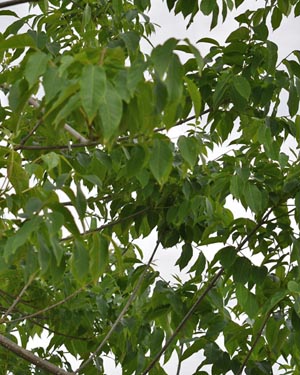
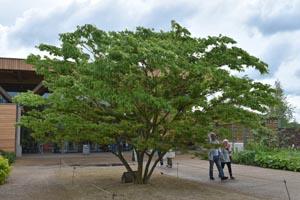
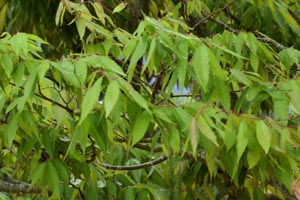
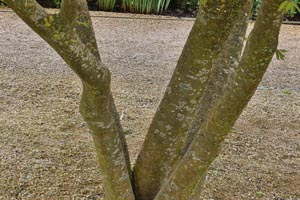
Tetradium daniellii
Bee bee tree
A.k.a. Korean evodia, native to Korea and SW China. A small tree to about 17m; branchlets downy when young, becoming reddish brown and glabrous. The flowers are small, white, borne in corymbs a type of inflorescence in which the lower flowers have longer pedicels than the upper ones, creating a flat-topped appearance. 15cm wide. Fruit capsules have a short, hooked beak.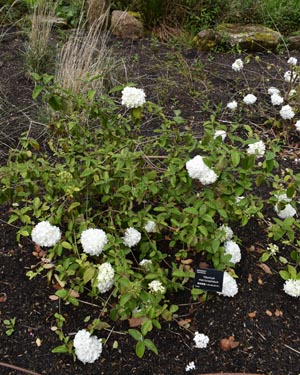
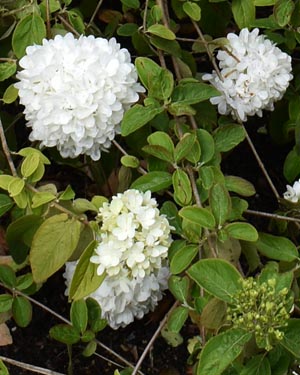
Viburnum macrocephalum
Chinese snowball viburnum
A.k.a. the hydrangea viburnum, or tree hydrangea, due to the similarity of its flowers to those of the hydrangea. A deciduous or semi-evergreen shrub native to China, where it is of great cultural significance. It will typically grow to 3-4m.