×
![woodturning]()

Trees Gallery - Burnby Hall Gardens. Page 2
Pocklington
 July 2026
 July 2026
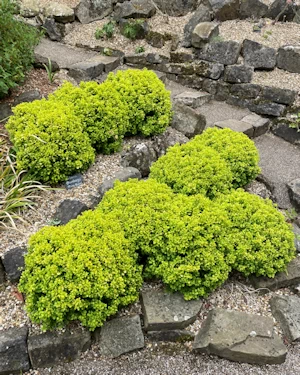
Berberis thunbergiiBerberis - from the Latinised form of the Arabic word barbārīs, which refers to the barberry fruit; thunbergii - afte; Carl Peter Thunberg (1743–1828), a celebrated Swedish naturalist and student of Carl Linnaeus; tiny gold - cultivar name highlighting the compact dwarf habit (growing to just 50cm) and its bright, golden-yellow spring foliage.
Golden barberry
A.k.a. Japanese barberry, tiny barberry, Thunberg's barberry. A dwarf deciduous shrub with tight, rounded habit and changing foliage colours. Reaching a maximum height and spread of just 30 to 50cm. In autumn leaves can become vibrant, fiery shades of orange and bright red before dropping for winter. July 2025
 July 2025
 July 2025
Betula utilis betula - birch, derived from the Gaulish betu- meaning bitumen or asphalt, referring to the tar extracted from birches; utilis - useful, referring to the many uses of the tree; jacquemontii - honouring the French naturalist Victor Jacquemont jacquemontii
Himalayan birch
A.k.a. Himalayan birch, white-barked Himalayan birch or Indian paper birch, a fast growing, deciduous tree reaching 15 - 20 m, native to W Himalayas. It is graceful in appearance and offering light dappled shade with its open, conical crown. In spring, yellow catkins appear, closely followed by dark green ovate leaves. In autumn, the foliage turns golden yellow before falling.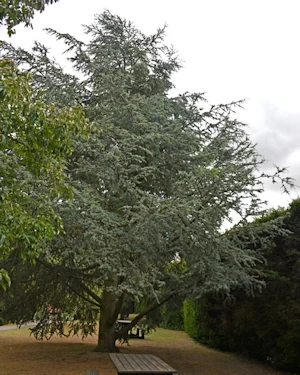 July 2025
Cedrus atlantica glauca cedrus - from Greek kedros, cedar; atlantica - from Latin, 'from the Atlas Mountains'; glauca from Latin, 'blue'
Altas cedar
A large coniferous evergreen tree, 30 to 35 m, with a trunk diameter of 1.5 to 2 m. A native of the Rif and Atlas Mountains of Morocco and Algeria. It is very similar to the other true cedars; some authorities consider it a subspecies of c. libani; others rank it as a distinct species. This glaucous variety has a blue tinge to the needles.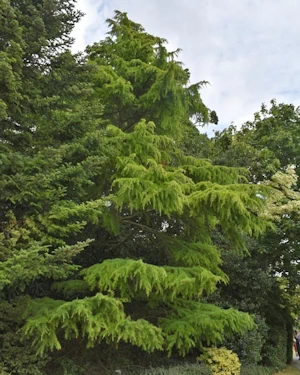 July 2025
 July 2025
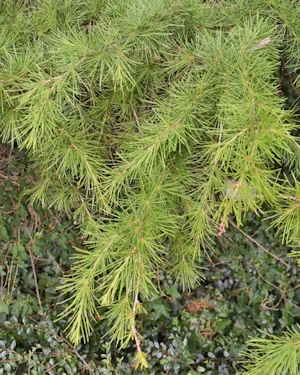
Cedrus deodara aurea cedrus - from Greek kedros, cedar; deodara - from Sanskrit devadāru, a compound of deva (god) and dāru (wood or tree); aurea - golden
Deodar cedar
A large evergreen coniferous tree reaching 40 - 50 m, with a trunk up to 3 m in diameter. It has a conic crown with level branches and drooping branchlets. The female cones are barrel-shaped, and disintegrate when mature (in 12 months) to release the winged seeds. The male cones are 4 - 6 cm long, and shed their pollen in autumn.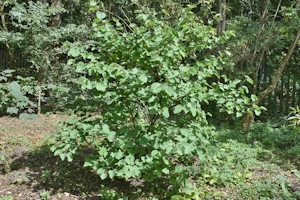 July 2025
 July 2025
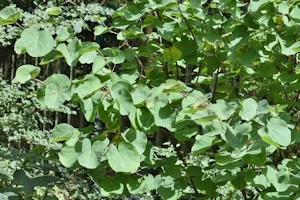
Cercis canadensis - Cercis: from Ancient Greek kerkis meaning weaver's shuttle, referring to the shape of the seed pods; canadensis - native to Canada and the eastern United States. Common Name (Redbud): Refers to the vibrant magenta-pink flowers that bloom on bare branches in early spring.
Eastern redbud - refers to the vibrant magenta-pink flowers that bloom on bare branches in early spring
A.k.a. spicewood or wild olive. It typically grows to 6 - 9 m with an 8 - 10 m spread. The bark is dark in colour, smooth, later scaly with ridges somewhat apparent, sometimes with maroon patches. The winter buds are tiny, rounded and dark red to chestnut in colour. The flowers are showy, light to dark magenta pink in colour, appearing in clusters from spring to early summer, on bare stems before the leaves, sometimes on the trunk itself. The fruits are flattened, dry, brown, pea-like pods which contain flat, elliptical, brown seeds, maturing in August to October. July 2025
 July 2025
Chamaecyparis : chamae - Greek 'dwarf' and kuparissos - cypress, referring to the dwarf cypress-like appearance; nootkatensis - after Nootka Sound on Vancouver Island, where the tree was discovered. nootkatensis
Nootka cypress
A.k.a. Nootka cedar, Alaska cedar, Yellow cypress, Callitropsis nootkatensis, Cupressus nootkatensis and Xanthocyparis nootkatensis. An evergreen conifer growing to 40 m. The bark is thin, smooth and purplish when young, turning flaky and grey with age. The branches are commonly pendulous, with foliage in flat sprays and dark green scale-leaves. The cones mature biannually. It can have an exceptional lifespan - one specimen in British Columbia was found to be 1,834 years old - some specimens may be over 3,000 years old. It is one of the parents of the hybrid Leyland cypress the other parent is Monterey cypress (Hesperocyparis macrocarpa) . July 2025
 July 2024
Cotinus coggygria - from Greek kotinus, wild olive. kokkugia, smoke tree royal Purple - a cultivar name referring to the purple foliage
Smoke bush
A purple-leaved cultivar with round leaves. A haze of fluffy, smoke-like plumes of green yellow flowers appear in June and July. July 2025
 July 2025
 July 2025
Crataegus lavalleei Crataegus: from the Greek words kratos, strength and akis, sharp, referring to the exceptionally hard, strong wood of the trees, as well as the sharp thorns found on many species in this genus. lavalleei after Pierre Alphonse Martin Lavallée (1836 - 1884), a 19th-century French botanist and horticulturist.
Hybrid cockspur thorn
A large shrub or small tree with thorny branches. Clusters of white flowers in spring are followed by orange or red fruits. It is a hybrid that arose between cultivated specimens of two species, C. mexicana and C. calpodendron (sometimes mistakenly called C. crus-galli). . July 2025
 July 2025
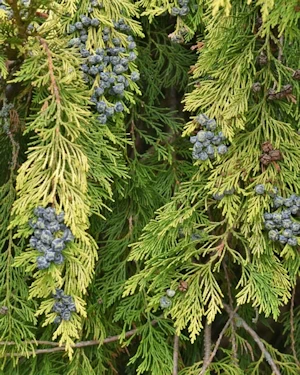
Cuprocyparis Cupro - from cupressus, Latin for cypress tree, the first of the hybrid's parents; cyparis - from Chamaecyparis, the second parent tree; Leyland Christopher Leyland owned Leighton Hall where the hybrid was first found; aurea - golden, referring to the yellow-tinged needles Leylandii aurea
Leyland cypress
A.k.a. Cuprocyparisus × leylandii, or Cupressocyparis leylandii, often referred to simply as leylandii, a fast-growing coniferous evergreen tree much used in horticulture, primarily for hedging. Even on poor sites plants have been known to grow to heights of 15 m at a metre per year, eventually reaching 25m. Their rapid, thick growth means they are sometimes used to achieve privacy, but such use can result in disputes with neighbours whose own property becomes overshadowed. The tree is a hybrid of Monterey cypress (Cupressus macrocarpa) and Nootka cypress (Cupressus nootkatensis). It is almost always sterile, and is propagated mainly by cuttings. Cones are 2 cm in length, with 8 scales and 5 seeds with tiny resinous vesicles a small, bladder-like sac or cavity, often filled with air or liquid.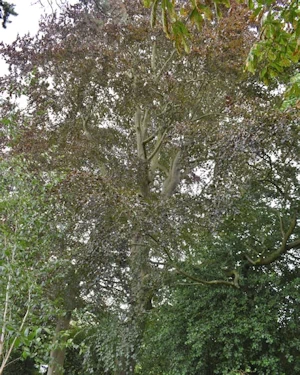 July 2025
 July 2025
 July 2025
Fagus sylvatica Fagus - Latin for beech; sylvatica -from Latin silvanus, of the forest; purpurea purple. purpurea
Copper beech
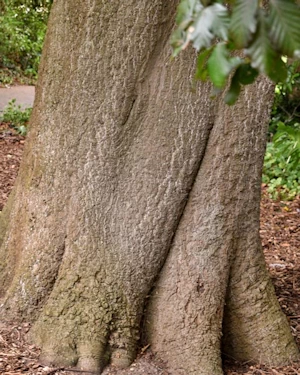
A.k.a. purple beech, a cultivated form of beech, though natural occurences do occur. It grows to more than 40m. The bark is smooth, thin and grey, often with slight horizontal etchings. It is monoecious both male and female flowers grow on the same tree . In spring tassel-like male catkins hang from long stalks at the end of twigs; female flowers grow in pairs, surrounded by a cup.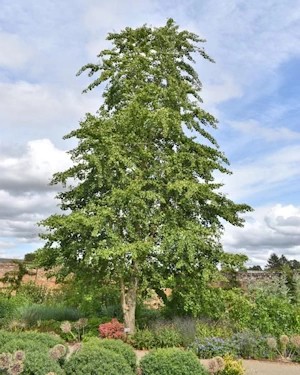 July 2025
 July 2025
 July 2025
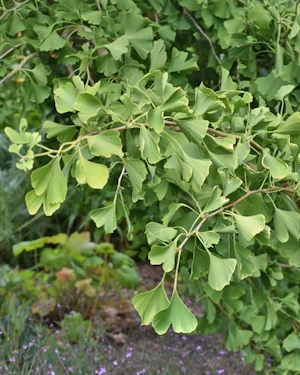
Ginkgo biloba Ginkgo (from yin xing or ginkyō) means silver apricot, referencing the fleshy, sometimes foul-smelling, seed coating; biloba - Latin for two-lobed, describing the distinctive fan-shaped leaves that are split into two distinct lobes.
Maidenhair tree due to its leaf resemblance to maidenhair ferns
A long-lived dioecious tree with unique fan-shaped leaves, capable of clonal reproduction, and known for its striking yellow autumn foliage. Specimens have been measured in excess of 1,600 years, and the largest living trees are estimated to exceed 3,500 years. Ginkgos are large trees, normally reaching a height of 20 - 35 m. Ginkgo biloba is dioeciouswith separate sexes, some trees being female and others being male. , with male plants producing small pollen cones with sporophylls a leaf or leaf-like structure that bears spores, which are reproductive cells . Female plants do not produce cones. Two ovules are formed at the end of a stalk, and after wind pollination, one or both develop into fruit-like structures containing seeds. The outer layer of the fruit (the sarcotesta the soft, fleshy outer layer of a seed coat, found in plants like pomegranates and cycads. Often brightly coloured or foul-smelling, to attract animals for seed dispersal ) is attractive in appearance, but contains butyric acid and smells foul like rancid butter or vomit when fallen. As a consequence, most trees in cultivation are male clones. July 2025
 July 2025
 July 2025