×
![woodturning]()

Trees Gallery - Guernsey Sausmarez Manor 1
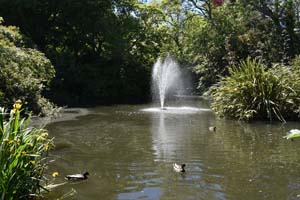
Sausmarez Manor
Sausmarez Manor is the home of the Seignure of Guerney, currently Peter de Sausmarez. A fascinating house with a long history, it has a thickly planted sub-tropical garden, as well as other garden areas with more standard Channel Island planting. There are 14 Champion Trees in the grounds, mostly in the subtropical garden.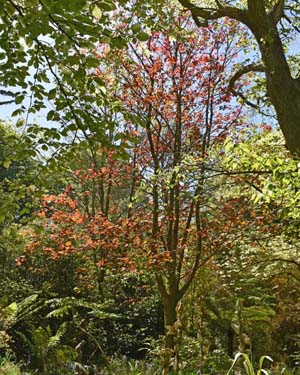

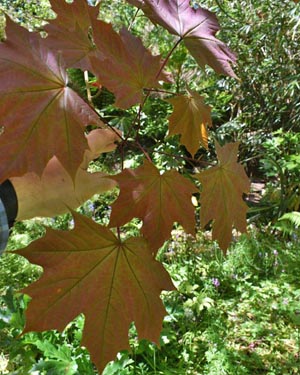
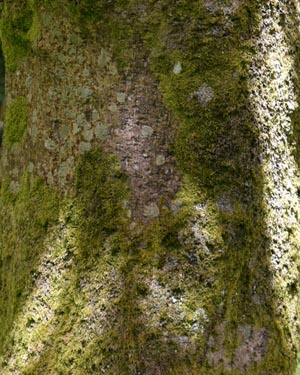
Acer platanoides Crimson King?
Norway maple Crimson King?
Straightaway with the first photo, I have uncertainty about the variety for this colourful maple. I am fairly certain on it being a. platanoides, but the bright orange-red colours in May are a little unnerving, as beautiful as they are in the afternoon sunshine. I'm opting for Crimson King until a better alternative is suggested.
Azara microphylla variegata
Box leaved azara
An evergreen shrub or tree native to Chile or Argentina, capable of growng to 10m. It has small, glossy dark green leaves broadly edged with cream, and tiny vanilla-scented yellow flowers in late winter or early spring, occasionally followed by dull orange berries. It tolerates full shade - useful as it was planted in deep shade in the Sausmarez sub-tropical garden.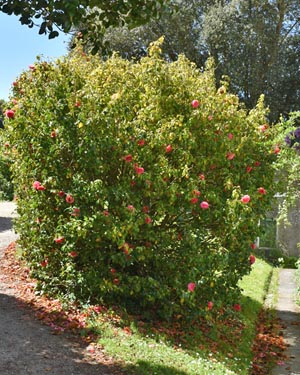

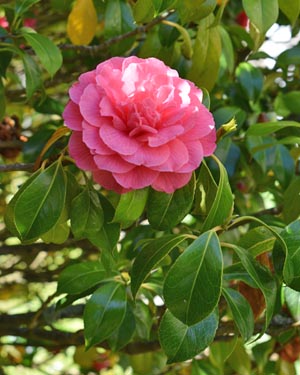
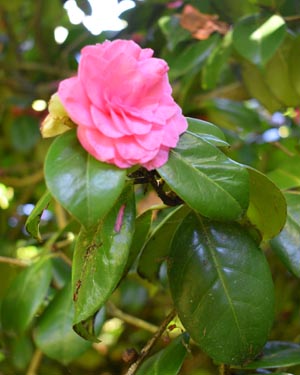
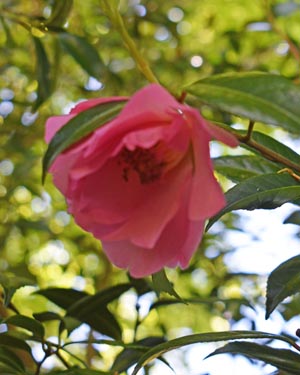

Camellia japonica
Camellia varieties
Camellias were in flower across the island, almost everywhere we went, in gardens and by the wayside. It is almost impossible for me to figure out what varieties are here out of the thousands of cultivars available, so I will not make the attempt.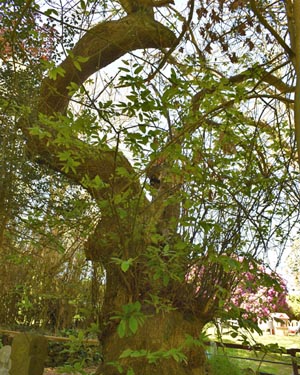
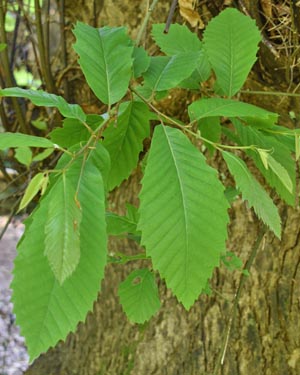
Castanea sativa
Sweet chestnut
Chestnuts can grow to 20–35m with a trunk often 2m in diameter, often ageing 500 - 600 years, with 1000+ year old specimens recorded. The bark often has a net-shaped (retiform) pattern with deep furrows or fissures running spirally in both directions up the trunk. The flowers of both sexes are borne in long, upright catkins, the male flowers in the upper part and female flowers in the lower part. The female flowers eventually form a spiky sheath. It is naturally self incompatible the plant cannot pollinate itself, making cross-pollination necessary .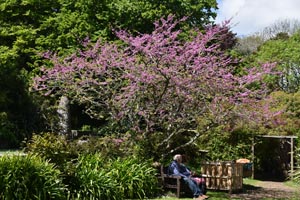
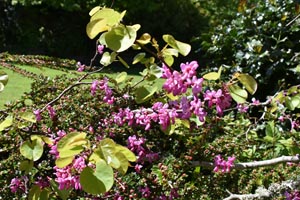
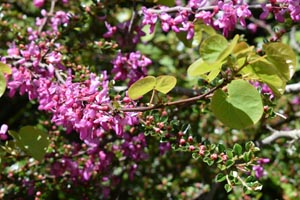
Cercis siliquastrum
Judas tree
A small deciduous tree native to Southern Europe and Western Asia. Often multi-trunked, it is an understory tree with a rounded crown that typically matures to 8m tall, and as wide. Deep purple pods will form after flowering.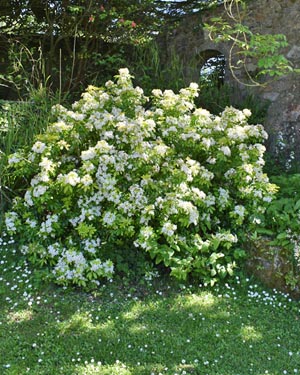
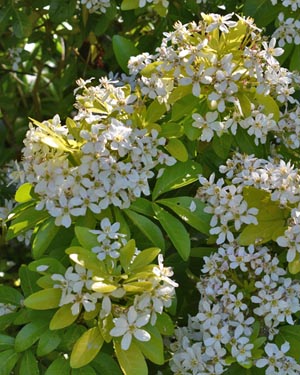
Choisya ternata
Mexican orange blossom
An evergreen shrub, growing up to 3m in height. Its leaves have three leaflets (hence ternata) and are aromatic, releasing a smell reminiscent of basil when crushed. The white flowers are scented, appearing in spring (sometimes with limited repeat flowering in autumn). A native of Mexico, very commonly planted as a garden specimen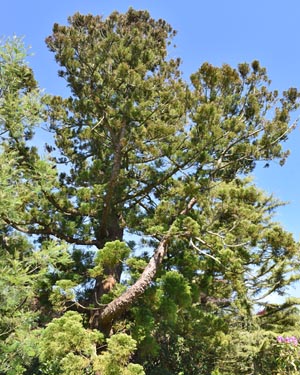
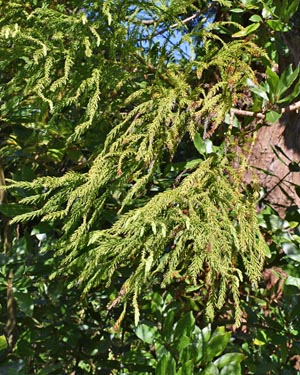
Cryptomeria japonica Lobbii
Japanese cedar
A.k.a. sugi. Cryptomeria is a very large evergreen tree, reaching up to 70m tall and 4m trunk diameter, with red-brown bark which peels in vertical strips. The seed cones are small and globular, with about 20–40 scales. It is superficially similar to the related sequoiadendron giganteum, from which it can be differentiated by the longer leaves, smaller cones and harder bark on the trunk (thick, soft and spongy in giant sequoia). This is the girth and height county champion of the Channel Islands.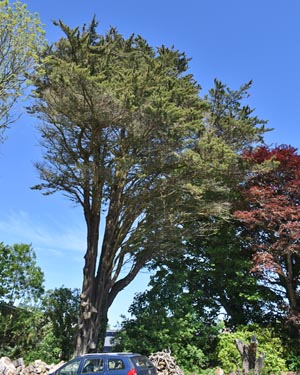
Cupressus macrocarpa
Monterey cypress
A.k.a. hesperocyparis macrocarpa. Native to California, a medium-sized coniferous evergreen tree, which often becomes irregular and flat-topped as a result of the strong winds that are typical of its native area. It grows to heights of up to 40m in perfect growing conditions, and its trunk diameter can reach 2.5 m. The foliage grows in dense sprays which are bright green in color and release a deep lemony aroma when crushed. The leaves are scale-like, produced on rounded (not flattened) shoots. It is frequently used on coastal sites as a shelter belt tree, alongside the Monterey pine, pinus radiata.