×
![woodturning]()

Trees Gallery - Guernsey Sausmarez Manor 3


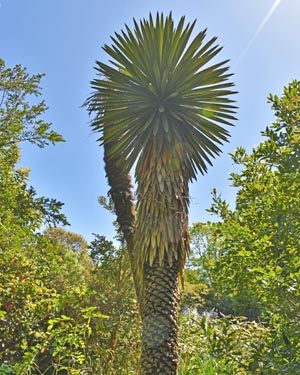
Podocarpus totara ?
Totara
I think this is the tree mentioned by the Tree Register as girth and height champion of Guernsey. (They have accepted my photos as such.) A native of New Zealand, growing to 30m, it is noted for its longevity and the great girth of its trunk. The bark peels off in papery flakes, with a purplish to golden brown hue. The sharp, dull-green, needle-like leaves are stiff and leathery, 2 cm long. This plant produces highly modified cones with two to four fused, fleshy, berry-like, juicy scales, bright red when mature. The cone contains one or two rounded seeds at the apex of the scales.[Wikipedia]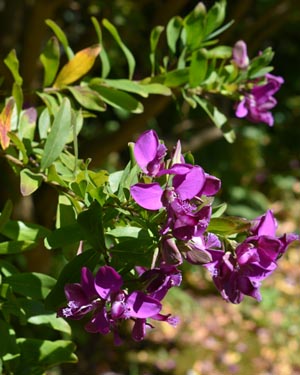
Polygata myrtifolia
Myrtle leaved milkwort
A.k.a. sweet pea bush. Native to S Africa, it is a tender, erect, bushy evergreen shrub or small tree with mid-green, myrtle like leaves. It bears clusters of purple, greenish-white flowers from spring through to autumn, that resemble those of sweet peas. The fruit is an oval, brown, dehiscent opening at maturity capsule which is narrowly winged.
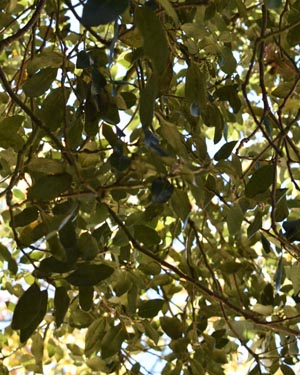

Quercus ilex
Holm oak
A.k.a. evergreen oak. An old, large specimen by the house, opposite the entrance to the sub-tropical garden. A native of the mediterranean, it is often planted as a shelter-belt tree, especially in coastal areas. Not officially listed as invasive, but it is increasing its spread, particular with climate change. Its timber is hard and tough, and has attractively coloured grain. It can grow to 28m with a girth possibly over 6m.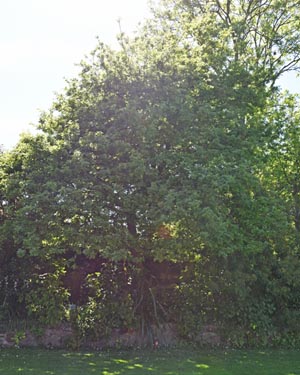

Quercus robur ?
Pedunculate oak
A.k.a. English oak, European oak, common oak. A large, deciduous tree native to most of Europe, growing 20 – 40m tall, forming a broad and spreading crown with sturdy branches beneath. Catins appear in spring, followed by acorns in clusters of 2-3 on a long peduncle stalk , carried in a shallow cup. It bears fruit in varying quantities each year, with mast yearsa year when trees produce bumper crops, particularly oak and beech. every few years, possibly a way of controlling predators in the lean years, but outfacing them in the mast years so that there is plenty of seed to germinate..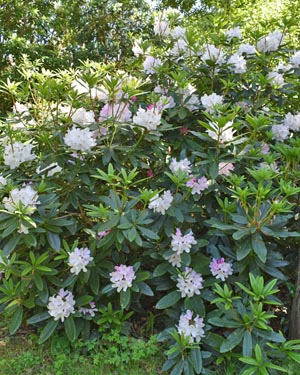

Rhododendron ssp.
Rhododendron
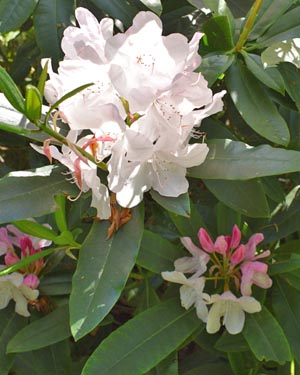
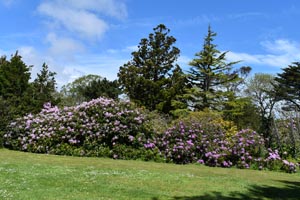
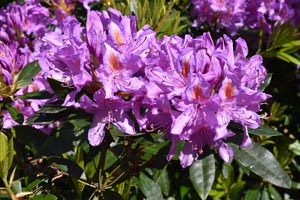
There were lots of rhododenron flowering, but no labels to tell what varieties. There was a large bank of what I think is r. ponticum, spreading across the bank at the front of the house. This is native to the Iberian Peninsula and the Caucasus region of NW Asia. Introduced to Britain, is has spread invasively and is a major pest in Snowdonia and Western Scotland, smothering virtually all native species under its dense canopy.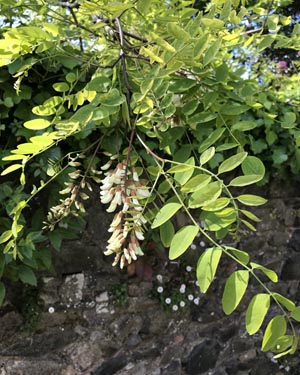
Robinia pseudoacacia
Black locust
A.k.a. False acacia. A native of the USA, but widely planted in other temperate countries, where it can be invasive and classed as a weed. It is a fast-growing, spreading tree to 25m tall with deeply furrowed rough bark and spines formed from stipules on twigs and suckers. The dark green leaves comprise 5-11 pairs of oval leaflets. Dense, drooping clusters of slightly scented white flowers, each 15-20mm long and with a yellow blotch at the base of the standard petal, are borne in late spring and summer and are followed in autumn by hairless, linear to oblong pods containing 4-10 seeds [RHS]
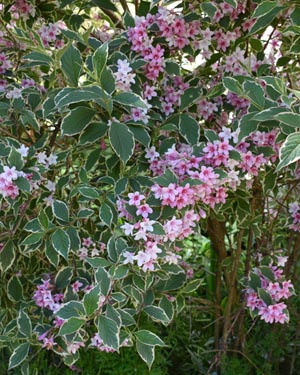
Weigela Florida Variegata
Weigela
A native of E Asia. A compact deciduous shrub about 1.2-1.8m tall, with narrowly oval, taper-pointed, mid to dark green leaves edged greenish-yellow aging to creamy-white, and clusters of funnel-shaped, light pink flowers to 3cm long, in early summer. [RHS]