×
![woodturning]()

Trees Gallery - Herm
Herm (page 3)
Herm is the smallest of the islands, and has the gentlest coastlines with long unspoilt beaches and bays. No cars and no crowds, a half hour ferry ride from Guernsey. The whole island is run by Herm estate: the estate manager, Lee Stewart, kindly helped me with a few identifications He told me that they have a lot of Australian and South African plants on the island.
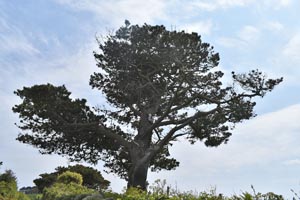
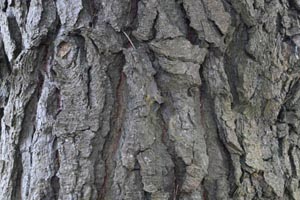
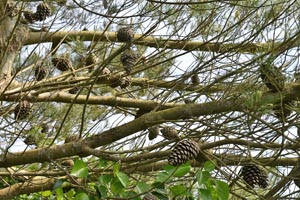
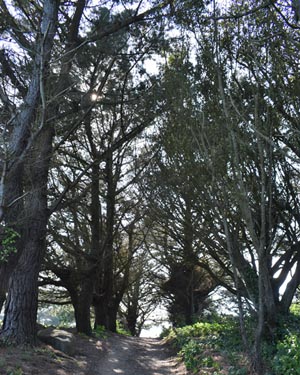
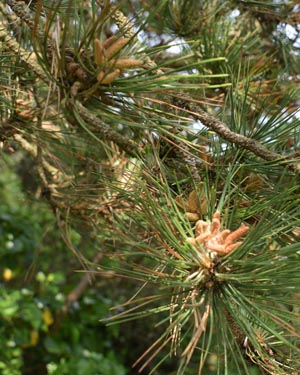
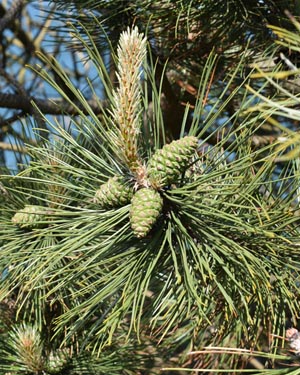

Pinus radiata
Monterey pine
A.k.a. pinus insignis, insignis pine or radiata pine. A native of thc Central coast of California and Mexico (on Guadalupe Island and Cedros island). A fast growing conifer, extensively cultivated as a plantation timber in many temperate parts of the world (marketed in the timber trade when chemically treated with preservatives as Accoya, ). Growing to 30m in the wild, up to 60m in cultivation. Used widely as a shelter belt tree, often sacrificially, along coastal areas. Its cones are serotinous they remain closed until opened by the heat of a forest fire; the abundant seeds are then discharged to regenerate on the burned forest floor. ,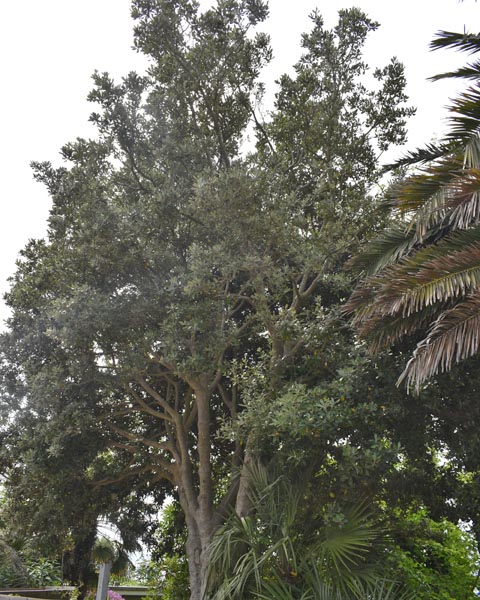
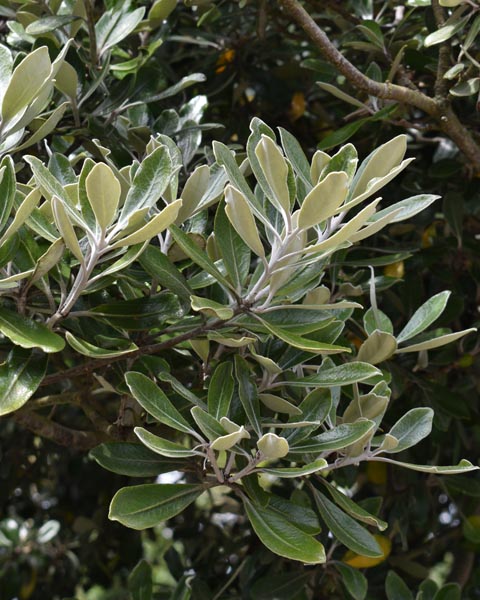

Pittosporum crassifolium
Karo
A.k.a. stiffleaf cheesewood, kaikaro or kihiki. A native of New Zealand, a relatively fast-growing large shrub or small tree up to 10m, with an fastigiate having upright usually clustered branches growth habit. The tomentum densely matted woolly hairs on the leaves provides protection against coastal winds by preventing salt damage and moisture loss. During the spring to early summer, karo produce fragrant burgundy red flowers in terminal umbels a flower cluster in which stalks of nearly equal length spring from a common centre and form a flat or curved surface . These are followed by green capsules, that then develop into woody seed pods with sticky black seeds.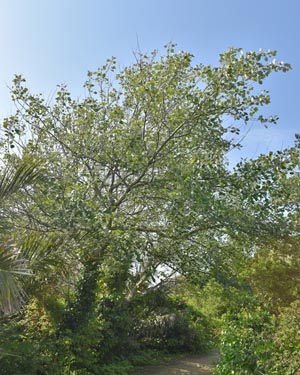
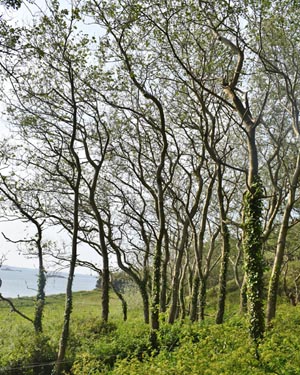
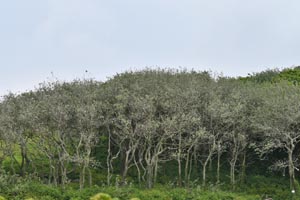
Populus (alba?)
White poplar
I think this is white poplar, a.k.a. silver poplar, which is closely related to aspen. Native to the Atlas Mountain, S and C Europe, and C Asia. A medium-sized deciduous tree, growing to 30m. The bark is smooth and greenish-white to greyish-white with characteristic diamond-shaped dark marks on young trees, becoming blackish and fissured at the base of old trees. It propagates by seed or by means of root suckers growing from the lateral roots, often as far as 20–30m from the trunk, to form extensive clonal colonies, as here on Herm.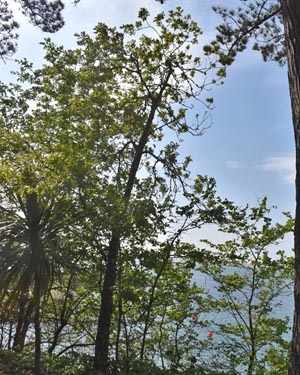
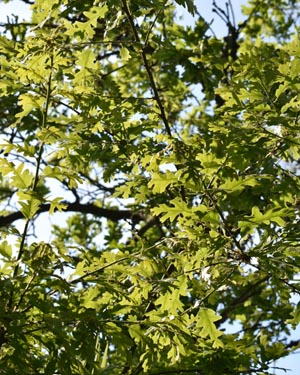
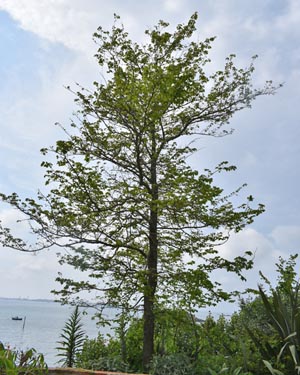
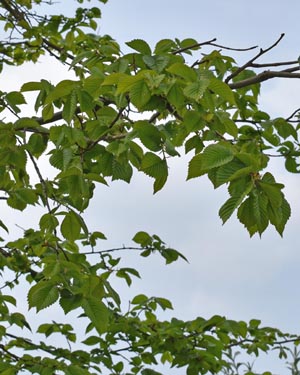
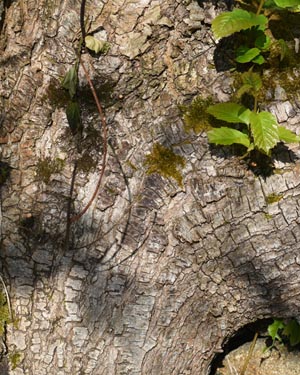
Quercus (cerris?)
Turkey oak
I think this is Turkey oak, suggested by the long irregular leaves. A native of S Europe and SW Asia, a widely spread neophyte in the UK and naturalised since at least the 1840s. is a deciduous broadleaf tree which can grow to 30m. The acorns are hairy, a clear distinction between this and the English oak, but it was too early in the year to use this identifier.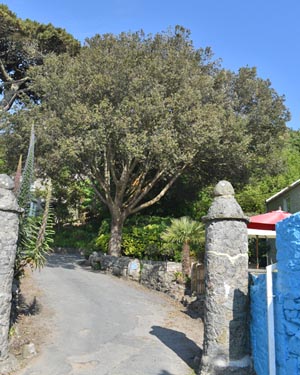
Quercus ilex
Evergreen oak
A.k.a. holly oak, or holm oak, a large evergreen oak native to the Mediterranean region, growing to 28m, and developing a huge head of densely leafy branches as broad as high. The trunk is sometimes over 6m in girth. Leaves are very variable in shape, most frequently narrowly oval, the margins sometimes entire, sometimes (especially on young trees) more or less remotely toothed. Acorns are produced one to three together on a short downy stalk, ripening in the first season.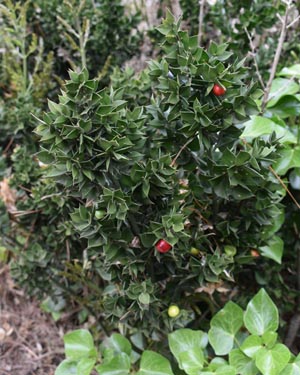

Ruscus aculeatus
Butcher's broom
A low evergreen dioecious shrub, with flat shoots known as cladodes shoot systems in which leaves do not develop; rather, the stems become flattened and assume the photosynthetic functions of the plant. that give the appearance of stiff, spine-tipped leaves. Small greenish flowers appear in spring, and are borne singly in the centre of the cladodes. The female flowers are followed by a red berry, and the seeds are bird-distributed, but the plant also spreads vegetatively by means of rhizomes. It is native to Eurasia and some northern parts of Africa. It occurs in woodlands and hedgerows, where it is tolerant of deep shade, and also on coastal cliffs. In Europe, Ruscus species were traditionally harvested for their flat and stiff branches to make small brooms that were used for clearing off and cleaning butchering blocks. One advantage of this stems fro antibacterial properties in the leaves. [Wikipedia]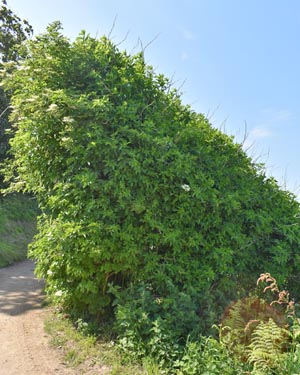

Sambucus nigra
Common elder
Native to the UK, a bushy large shrub or small tree. Flat sprays of fragrant hermaphrodite containing both male and female floral organs: pistils and stamens creamy flowers in early summer followed by small black berry. Mature elder trees can grow to a height of around 15m and can live for 60 years. Elder is characterised by its short bole, and grey-brown, corky, furrowed bark.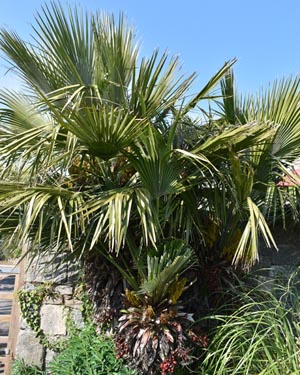

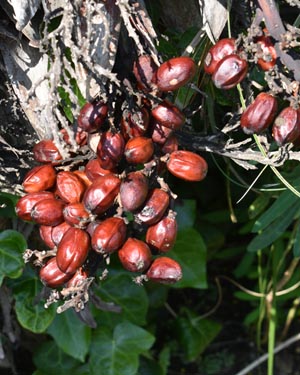
Trachycarpus fortunei
Chusan palm
A.k.a. Chinese windmill palm, or windmill palm , a hardy evergreen palm tree growing to 20m, native to parts of China, Japan, Myanmar and India. The trunk is very rough, with persistent leaf bases clasping the stem as layers of coarse fibrous material. Due to its widespread use as an ornamental plant, the palm has become naturalised in southern regions of Switzerland, and has become an invasive species of concern. It tolerates cool, moist summers as well as cold winters. Its coarse but very strong leaf sheath fibre is used for making rope, sacks, and other coarse cloth where great strength is important. [Wikipedia]