
Trees Gallery - Nunnington Hall page 3
Ryedale, North Yorkshire
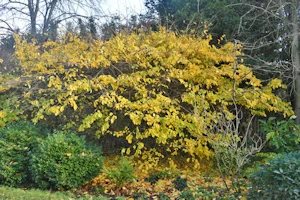 November 2023
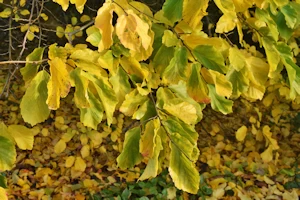 November 2023
 November 2023
 May 2024
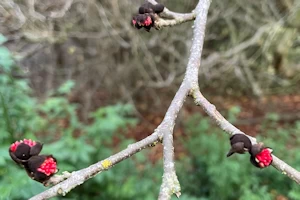 December 2024
Parrotia persica
Persian ironwood
A bright coloured leaf-show in late November. Leaves stay on the tree for an extended period as they turn a multitude of colours from yellow to deep red. The leaf show is followed by ruby-red flowers which resemble witch-hazel (they are closely related) in winter. Usually multi-stemmed, the tree oftern spreads much wider than its height. It is critically endangered (IUCN) International Union for Conservation of Nature in its native Iran, but is widely planted as an ornamental plant in parks and gardens across the country.
 November 2023
 November 2023
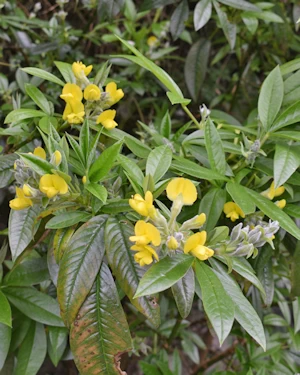 May 2024
Piptanthus nepalensis
Himalayan laburnum
A semi deciduous medium sized (3-4m) shrub which can develop a single trunk, though multiple shoots are more common. Quick growing and vigorous but fairly short lived as a result. It bears bright yellow pea-like flowers in upright racemes a flower cluster with the separate flowers attached by short equal stalks at equal distances along a central stem. . The flowers have hairy bracts and appear in May/June.
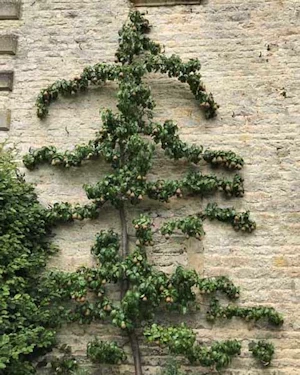 August 2021
Pyrus communis 'Beurre Hardy'
French butter pear
This pear is trained as an espalier a tree that is trained against a support with a central vertical stem and several tiers of horizontal branches , growing on the house wall as you enter the garden. There were some good looking pears borne on its tiered branches. Nick Fraser, head gardener, told me this variety is 'beurre hardy' beurre - butter (French), Hardy - after Jeanne Alexandre Hardy, chief gardener at the Luxembourg gardens in Paris in the 1800s - an old French variety still very popular for its melting butter taste. There are many other fruit trees trained on the walls around the garden.
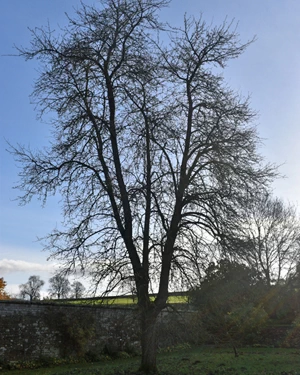 November 2023
 November 2023
 May 2024
 October 2025
 November 2023
 May 2024
Pyrus communis 'Black Worcester'
Black Worcester pear
Another probable Roman introduction, but certainly present since medieval times. The fruits store well, so provided a welcome ingredient of the winter diet, though ideally should be cooked to eat. These two large trees dominate the pear orchard on the east of the garden, showing what can be if pears are not pruned and trained. Sadly the right side one was felled in 2025, presumably due to disease. Three pears appear on the Worcester coat of arms, the county having a long tradition of growing these pears.
 November 2023
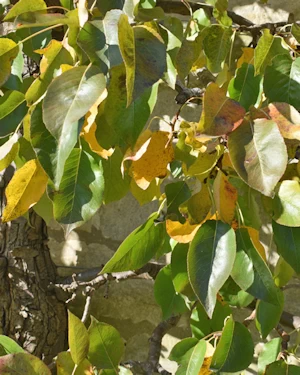 October 2025
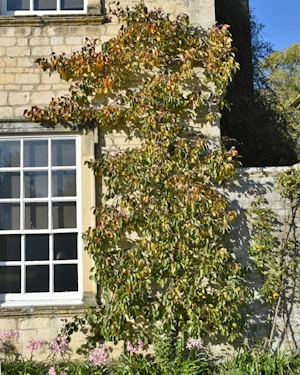 October 2025
Pyrus communis 'jargonelle'
Pear 'jargonelle'
Yet another possible Roman introduction, but certainly noted in Britain by 1629. An early cropping variety with good flavour, trained here as an espalier to keep it sheltered and offer some warmth from the south facing wall.
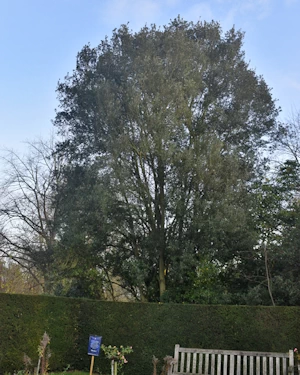 November 2023
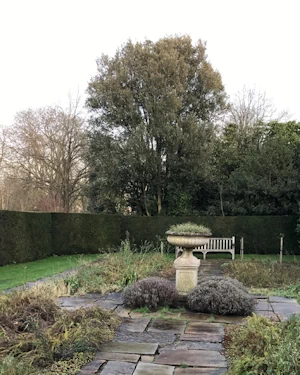 November 2023
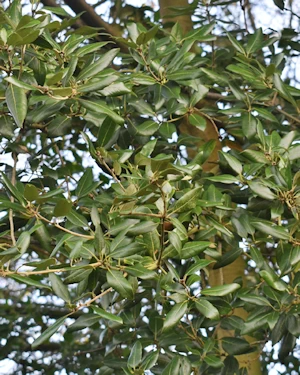 November 2023
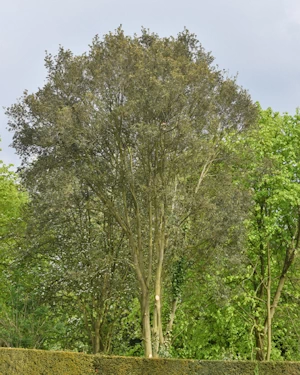 May 2024
Quercus ilex
Holm oak
An evergreen broadleaved tree commonly used in shelterbelts protective border formed of tall trees and shrubs (over 4.5m) planted in three or four staggered rows due to its resistance to wind and salt. It was introduced to Britain in the late 1500s. Here it is growing as a specimen tree planted in the mixed tree and shrub border of the lime avenue.
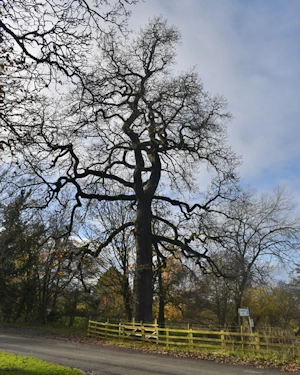 November 2023
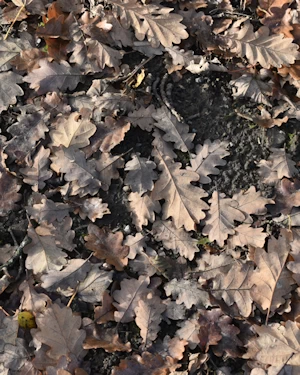 November 2023
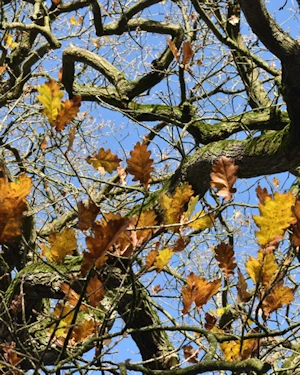 November 2023
 May 2024
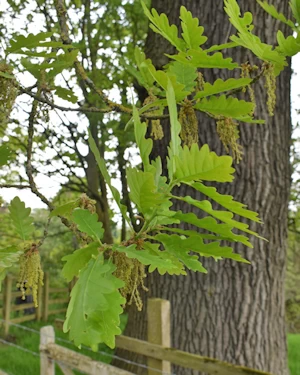 May 2024
Quercus Robur? Petraea?
Oak
This impressive oak is just across the road opposite the entrance to the car park. I think it is the English oak, Q. robur, but looking at the leaves on the ground they look more like sessile oak: they have stalks, and they do not appear to have intercalary veins comparatively large veins from the midrib to the sinus between two lobes. . Against this they do appear to have auricles a small ear-like projection from the base of a leaf or petal at their base, and the Ancient Tree Inventory appears to list a pedunculate oak just about here, along with 9 others around the car park . Could it be a hybrid of the two? They do hybridise quite readily. I couldn't find any acorns - peduncles a stalk bearing a flower or fruit or absence of peduncles on the acorn usually fix the identification.