×
![woodturning]()

Oldfern woodland and parklands gallery - Scampston page 5
Ryedale, North Yorkshire
 October 2025
 October 2025
 October 2025
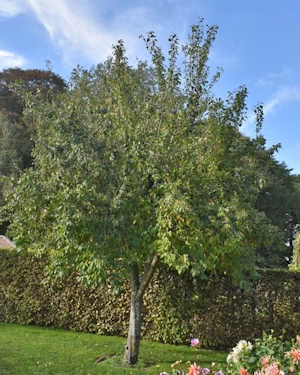
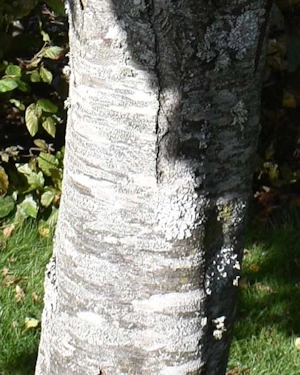
Prunus insititia prunus - genus name for a group of trees including plums, cherries, peaches, and apricots; insititia - grafted or established, referring to the historical use as a rootstock for grafting other fruit varieties.
Damson
A.k.a. Shropshire Prune, a small, deciduous, twiggy tree or shrub often found in hedges. It produces small, white, five-petaled flowers in early spring, followed by oval, plum-like fruit that is typically bluish-purple and has a tart, astringent flavour.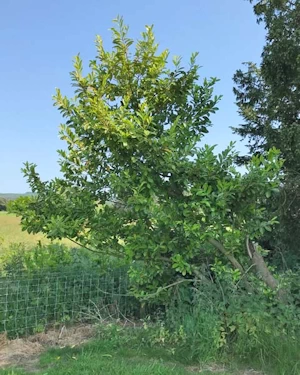 June 2023
 June 2023
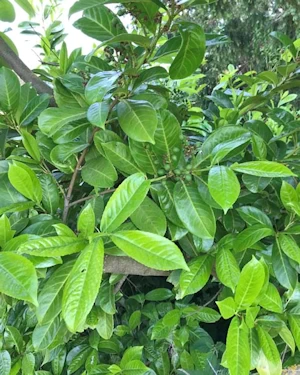
Prunus laurocerasus prunus Latin name for the plum tree, which was borrowed from the Ancient Greek word proúne. "Laurocerasus" combines the Latin words laurus, laurel, and cerasus, cherry, referring to the plant's laurel-like leaves and cherry-like fruit.
Cherry laurel
A.k.a. common laurel, an evergreen shrub or small to medium tree, growing to 5 to 15 m, native to regions bordering the Black Sea in SW Asia and SE Europe. The fruit is a small cherry 1 - 2 cm broad, turning black when ripe in early autumn. It is considered an invasive species in Britain, where it forms dense thickets in woodlands and on hillsides.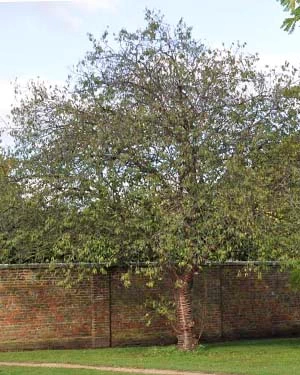 October 2021
 October 2021
Prunus serrula prunus - genus name for a group of trees including plums, cherries, peaches, and apricots; serrula, 'saw-like', referring to the serrated leaf margins
Tibetan cherry
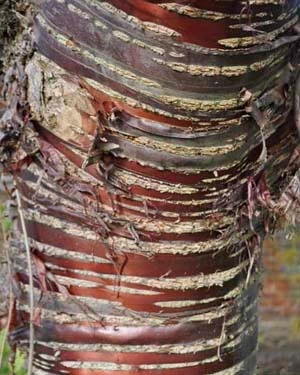
Standing next to the American black walnut is a Tibetan cherry, a popular ornamental tree in parks and gardens across the country. The main attraction is its bright red papery bark, with horizontal lenticels a loosely packed mass of raised pores in the bark of a woody plant, visible on the surface of a stem as a raised powdery spot, through which gaseous exchange occurs banding around the trunk.Prunus yedoensis prunus - Latin for plum tree or stone fruit, related to Greek proumne; yedoensis referring to Yedo, now known as Tokyo.
Yoshino cherry
A very popular choice for gardens, originating from Japan. Also known as sakura or Japanese cherry. Yoshino mountain has many thousands of these trees, planted in groves at different altitudes, so they blossom at different times.
June 2023
Pterocarya Pterocarya - from Greek pteron, wing, and karyon nut, referring to the tree's distinctive winged fruit; fraxinifolia - from Latin fraxinus, ash tree, and folia, leaf, noting that its compound leaves closely resemble those of an ash tree. fraxinifolia
Caucasian wingnut
A fast growing monoecious tree growing to 30m, the short, thick bole supporting widely spreading branches to form a rounded structure, not unlike the wych elm. The flowers appear in April, the male catkins thick and green, 7.5 - 12.5cm long, the females longer with less dense flowers, bearing red styles forming fruiting catkins 30 - 50cm long. The green, winged, nuts are approximately 1.8 cm wide. October 2021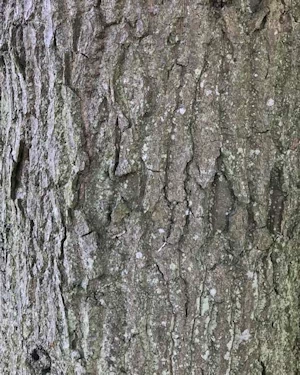
June 2023
Quercus cerris quercus - Latin name for oak, derived from the Proto-Indo-European root kwerkwu; cerris - from Latin cerrus, which was the specific name used by the Romans to identify this species
Turkey oak
Native to SE Europe and Asia Minor. It can grow to 30 m. Introduced to the UK as an ornamental in the 18th century, but is now impacting our native oak populations - it is much faster growing.
October 2021
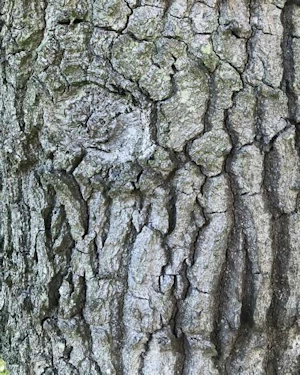
Quercus ilex quercus - Latin name for oak, derived from the Proto-Indo-European root kwerkwu; ilex - Latin for holm oak: evergreen leaves resemble those of holly (holm is an old English word for holly).
Evergreen oak
A.k.a. holm oak or holly oak, introduced to the UK in the 1500s, an evergreen broad leaved tree. Pictured here are immature green acorns, smaller and more pointed than those of the common oak. This one has possibly been pollarded the process in which the main branch systems of trees are pruned heavily to short stubs at some point - it has a thick trunk, but branches break out right down to ground level.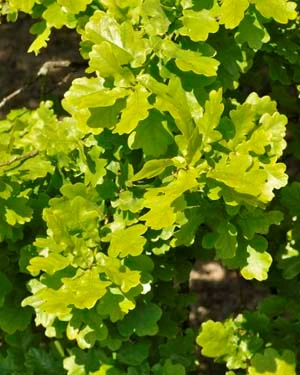
May 2021
June 2023
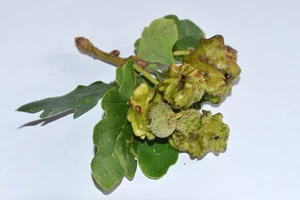
Quercus robur quercus - Latin name for oak, derived from the Proto-Indo-European root kwerkwu; robur - Latin for robust or strong, referencing the tree's sturdiness.
English oak
There are many oak trees in the parkland. Here are just a couple, looking splendid with their fresh spring leaves. Some of the oaks are listed on the Woodland Trust's Ancient tree Inventory, though only as "notable" or "veteran", not having reached "ancient" status as yet. My favourite timber for turning, especially if there is some burr in it, which is almost inevitable with the larger specimens. It seems to have become less available in recent years. August 2023
 August 2023
Andricus quercuscalicis
Knopper gall
Caused by a small wasp, whose larvae then feed inside the gall. They cause little damage to the Quercus robur host tree. More ...Rosa glauca rosa - Latin for rose; glauca Latin glaucus for bluish-grey/glaucous, highlighting the distinctive, waxy, grey-blue to purple foliage.
Wild rose
Probably r. glauca, but could be another wild rose variety. The stems are reddish-violet and sparsely prickly. Small (4cm), single, deep rose-pink flowers with white centers appear in clusters during early to mid-summer. Bright red, spherical hips develop in late summer and last into winter. A hardy, upright, and arching shrub that typically grows to 1.5 - 3 m in height.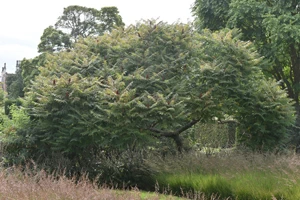 August 2023
 August 2023
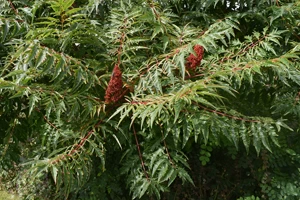
Rhus typhina rhus - Greek for the sumac tree, typhina from Latin meaning antler-like. This refers to the plant's velvety young branches that resemble antlers in velvet.
Stag horn sumac
A native to E North America, with impressive flower spikes, and brilliant red autumn colour. August 2023
 August 2023