×
![woodturning]()

Oldfern woodland and parklands gallery - Scampston page 6
Ryedale, North Yorkshire
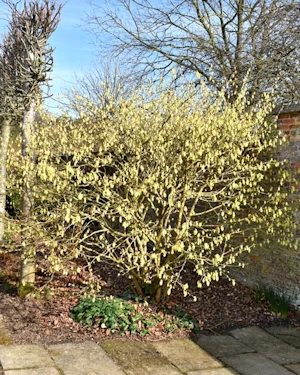 March 2025
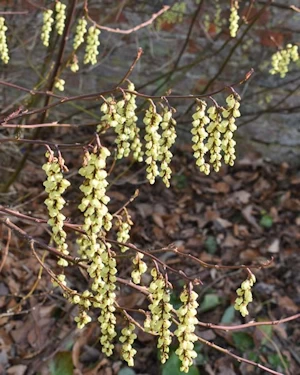 March 2025
Stachyurus chinensis from Greek stachys - ear of corn or spike; oura - tail, referring to the plant's cup-shaped pale yellow flower tassels that hang like a tail; chinensis - Chinese
Chinese stachyurus
Possibly s. praecox - the two species are very similar. S. chinensis is a spreading deciduous shrub or small tree growing to 3 - 4 m, native to China and Taiwan, with pendant racemes of 4-petalled flowers that appear on bare branches before the leaves emerge.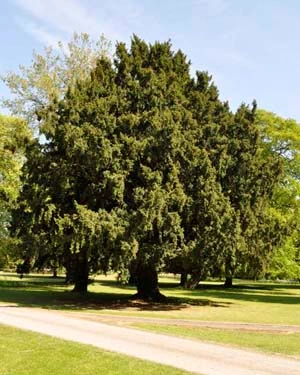 October 2021
Taxus baccata Taxus - from Greek 'toxus' or 'toxon'," meaning bow; or 'toxikon' meaning poisonous; baccata - Latin for 'bearing berries'; fastigiata - upright or columnar.
Yew
A large yew tree, quite unusual to be standing as a specimen tree on its own. Large yews are often seen in parkland in rows, having escaped from their original purpose as hedging and allowed to grow to their naturally large dimensions. This one looks like it is planted to reach maturity. I can't help thinking of the woodturning potential growing here! October 2021
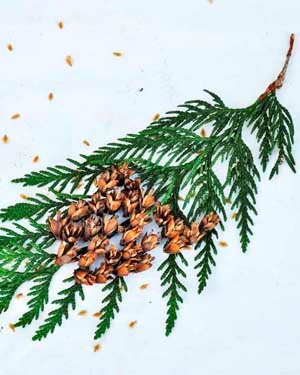 October 2021
 October 2021
Thuja plicata thuia - from Greek, a name for an aromatic evergreen wood. plicare - from Latin, meaning folded or pleated, referring to the arrangement of the scale-like needles on the branches.
Western Red Cedar
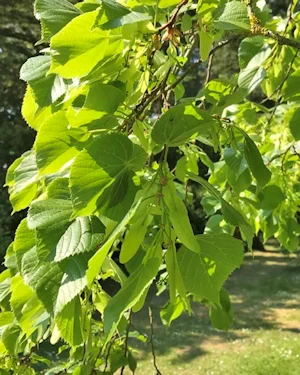
A tree native to North America, but planted in the grounds of most British stately homes from the 1740s onwards. Canadian specimens exist at 70 metres tall and perhaps 700 years old. This one is, I think, a little younger.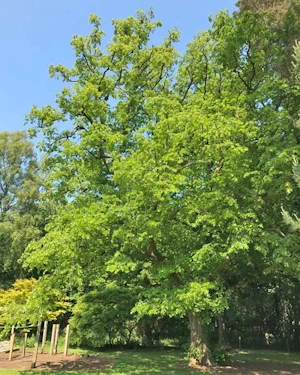 June 2023
 June 2023
 June 2023
Tilia cordata tilia - from the Latin for linden or lime tree; cordata - from Latin, meaning heart shaped.
Small leaved lime
Difficult enough to distinguish from other limes even with its leaves on, but this one had a label. The rarest of the three most common limes, now considered an indicator of ancient woodland. It is commonly planted as an ornamental, particularly in lime avenues on the entrances to large estates. It is possible to tell true species apart by the underside of the leaf. Common lime (T. x europaea) has tufts of white hairs between the vein joints, whereas these are rusty red in small-leaved lime. Large-leaved lime (T. platyphyllos) has hairs all over the underside. Common lime is a hybrid and is rare in the wild in the UK. Lime wood is soft and light, white-yellow and finely textured. It is easy to work and used in turnery, carving and furniture-making. The tree can grow to 40 m, with a trunk up to 1 m diameter.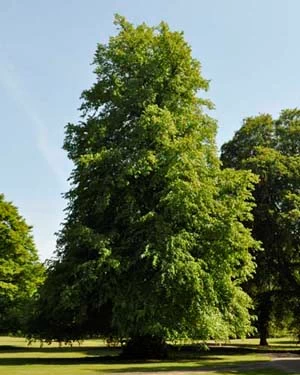 October 2021
Tilia europaea tilia - Latin name for the lime tree europaea, - European.
Common lime
Tall and slender, with a wide trunk bursting with burrs. A very common tree, much prized for woodcarving, slightly less so for woodturning, though there are some interesting burrs to be cut on this one.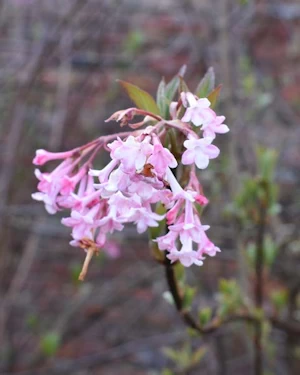 June 2023
Viburnum bodnantense Viburnum - Latin name for the wayfaring tree bodnantense - coming from the gardens at Bodnant in Wales
Arrowwood
A.k.a. Bodnant viburnum, a large, upright, deciduous shrub renowned for its intensely fragrant, tubular pink-to-white flowers that bloom on bare, upright stems from autumn to spring. Reaching up to 3m, it has bronze-tinted young foliage, green summer leaves, and maroon autumn color.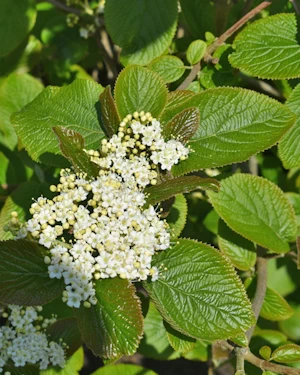 April 2026
 June 2023
Viburnum lantana Viburnum - Latin name for the wayfaring tree (v. lantana), likely derived from the Latin viere, meaning to weave or to plait, referring to the flexible, pliant nature of its branches; lantana - from Latin lentus, meaning pliant or flexible, describing the pliable twigs.
Wayfaring tree
A.k.a. cotton tree or coven tree. A vigorous, deciduous shrub to about 5m in height, with finely toothed, broadly ovate grey-green leaves to 12cm long, and domed clusters of small tubular white flowers in late spring, followed by oval to rounded red fruits which ripen to black, [RHS]Viburnum plicatum Viburnum - Latin name for the wayfaring tree (v. lantana), likely derived from the Latin viere, meaning to weave or to plait, referring to the flexible, pliant nature of its branches; plicatum - Latin meaning pleated or folded, which refers to the deeply veined, textured appearance of the plant's leaves
Japanese snowball
A deciduous shrub growing to 3 m, native to China, Japan, Korea and Taiwan. Leaves are opposite, 5 - 10 cm long, simple ovate to oval, with a serrated margin. Flowers are produced in flat corymbs 5 - 10 cm in diameter, comprising a central cluster of fertile yellowish-white flowers, surrounded by a ring of showy, sterile flowers which act as a target guide to pollinating insects. The fruit is an ovoid blue-black drupea fleshy fruit with thin skin and a central stone containing the seed. April 2026
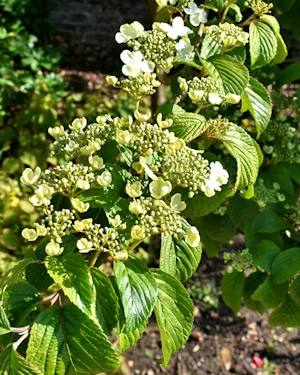 April 2026
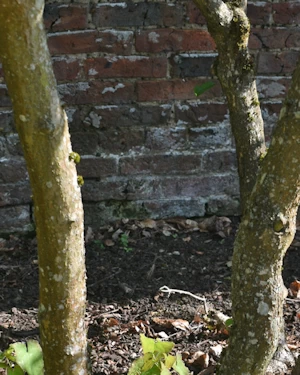 April 2026
Viburnum plicatum tomentosum shasta Viburnum - Latin name for the wayfaring tree (v. lantana), likely derived from the Latin viere, meaning to weave or to plait, referring to the flexible, pliant nature of its branches; plicatum - Latin meaning pleated or folded, which refers to the deeply veined, textured appearance of the plant's leaves; tomentosum - Latin, covered in fine matted hairs; shasta - a US geographical name, but not related to its origin
Doublefile Viburnum
A deciduous shrub with distinct, horizontal, tiered branching habit. It typically grows 2 m tall and 4 m feet wide, producing large, pure white, lacecap-like flower clusters in May. It has dark green textured leaves, turning burgundy-red in autumn, and red berries that turn black in summer. .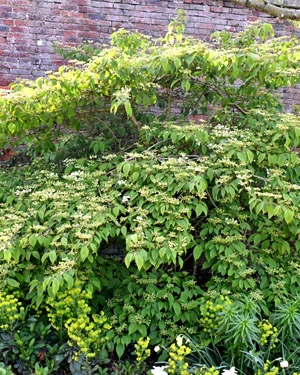 April 2026