×
![woodturning]()

Trees Gallery - Belsay Hall
Northumberland
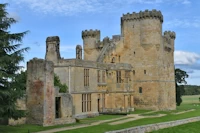
Belsay Hall
There are 30 acres of gardens at Belsay Hall, under the stewardship of English Heritage, formerly the seat of the Middleton family for seven centuries. The gardens around the new hall are joined to the medieval castle via a path through an old quarry, Quarry Garden, full of a wide variety of plants and trees.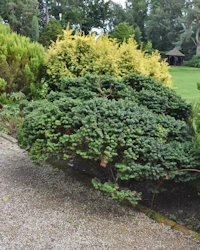 September 2024
 September 2024
Abies balsamea abies - from L. abeo - to rise, to go up; balsamea - from Latin balsamum, meaning balm or resinous ointment Hudsonia - probably refers to Hudson Bay in Canada, where this dwarf variety is foundHudsonia
Hudson fir
A.k.a. dwarf balsam fir. A slow-growing dwarf evergreen conifer, with a compact bun-shaped habit to 1 m tall, 1.5 m broad, taking 20 years to reach this size. It has a pleasant, balsamic fragrance. It does not produce cones.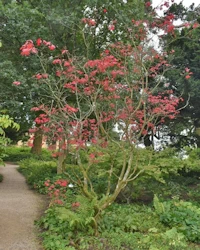 September 2024
 September 2024
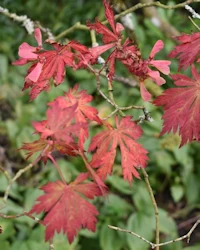
Acer aconitifolium acer - from the Latin for maple; palmatum, palm-like, referring to the 5 lobed hand shaped leaves; aconitifolium aconite-leaved, a description of the maple's deeply-cut, fern-like leaves that resemble those of the Monkshood plant.
Fernleaf Full Moon Maple
A large bushy deciduous shrub or small tree, growing to 4 m. Native to Japan. Leaves emerge with a soft green hue,, latertransforms into a spectacular array of vibrant reds, oranges, and yellows.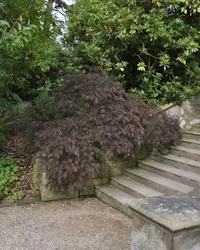 September 2024
 September 2024
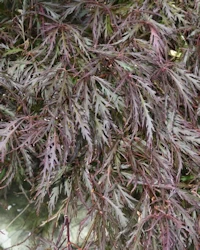
Acer palmatum acer - from the Latin for maple; palmatum, palm-like, referring to the 5 lobed hand shaped leaves dissectum - deeply cut; purpurea purple or red. dissectum purpurea
Japanese maple
A.k.a laceleaf, cutleaf or threadleaf maple. A slow-growing shrub of broadly arching habit, native to Japan, Korea and China, typically growing to 4 m, with a larger spread. It has deep purple, 7 - 11 lobe and finely toothed leaves which turn orange in autumn.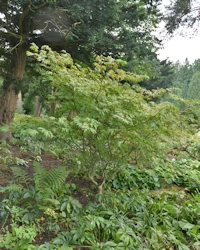 September 2024
 September 2024
 September 2024
Acer palmatum acer - from the Latin for maple; palmatum, palm-like, referring to the 5 lobed hand shaped leaves; dissectum - deeply cut;
Japanese maple
A.k.a laceleaf, cutleaf or threadleaf maple. A slow-growing shrub of broadly arching habit, native to Japan, Korea and China, typically growing to 4 m, with a larger spread. There are so many varieties that unless there is a name tag, it is difficult to pin down the correct one.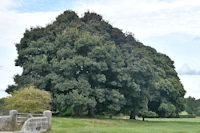 September 2024
 September 2024
Acer pseudoplatanus acer - maple; pseudoplatanus - false plane, referring to a superficial similarity of leaves and bark to those of plane trees (genus platanus)
Sycamore
Not native to Britain, but they have been here for many years and are well established across the country. These broadleaf trees can grow to 35m and live for 400 years. Twigs are pink-brown and hairless. Small, green-yellow flowers hang in spikes, or 'racemes'. After pollination by wind and insects, female flowers develop into distinctive winged fruits known as samaras.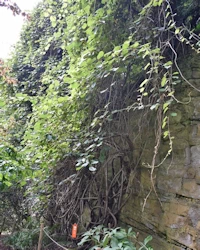 September 2024
Actinidia chinensis - from Greek aktis, meaning ray or star, referring to the radiating styles of the plant's flowers; and Latin "chinensis", from China.
Kiwi fruit
A fruiting vine native to China. It is one of some 40 related species of the genus actinidia, and the origin of most commercial varieties of kiwifruit. Fruit colour may vary from green through brown to gold, depending on cultivar.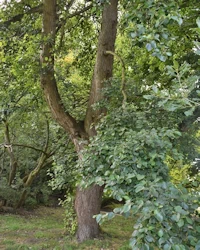 September 2024
 September 2024
Alnus cordata Alnus - from Latin for alder tree, and cordata meaning heart-shaped, which describes the leaves of this species.
Italian alder
It is a medium-sized tree growing up to 25 m, with a trunk up to 1 m in diameter, deciduous but with a very long season in leaf, from April to December. The bark is smooth with greyish brown colour. Male catkins are slender, pendulous, reddish and up to 10 cm long; pollination is in early spring, before the leaves emerge. The female catkins are ovoid, dark green to brown, hard, woody, developing into pseudo-cones. September 2024
 September 2024
Aralia elata Aralie - Old French-Canadian name for the genus; elata, Latin word meaning 'elevated' or 'high', reflecting its often tall, tree-like growth habit, and the large, clustered leaves that give it an umbrella-like appearance at the ends of its branches.
Japanese angelica tree
A.k.a. Chinese or Korean angelica-tree, an upright deciduous small tree or shrub growing to 10 m, native to E Asia (in Russia, China, Taiwan, the Korean Peninsula, and Japan).The bark is rough and grey with prickles. The fruit is a small black drupe.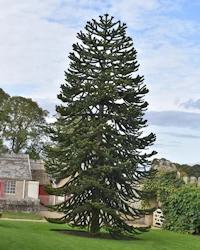 September 2024
 September 2024
 September 2024
 September 2024
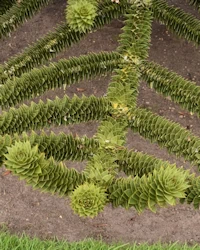
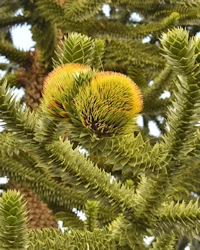
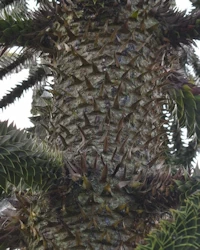
Araucaria araucana araucaria - after a region of Chile; araucana - the native tribe who used the tree's seeds for food.
Monkey puzzle
A.k.a. monkey tail tree, pewen, pehuen pine or piñonero, an evergreen tree growing to 30–40 m, native to C and S Chile and W Argentina. It is on the IUCN list as endangered in its native region due to logging, forest fires, and grazing. It is usually dioecious male and female cones on separate trees . The male (pollen) cones are oblong and cucumber-shaped. It is wind pollinated. The bark can be up to 15 cm thick, possibly an adaptation to resist wildfires.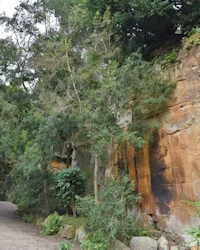 September 2024
 September 2024
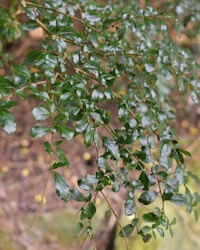
Azara microphylla azara - after 18th-century Spanish diplomat and patron of science José Nicolás de Azara; microphylla - from the Greek words mikros, small, and phyllon, leaf
Box leaf azara
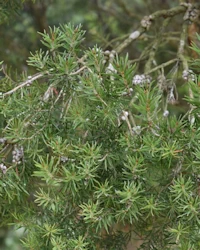
A small, upright, evergreen tree or large shrub growing to 10 m, native to Chile and Argentina. It has tiny, vanilla-scented flowers in winter. It is the hardiest of the azaras, withstanding temperatures down to −15 °C, and also tolerates full shade, as here in the quarry wood at Belsay.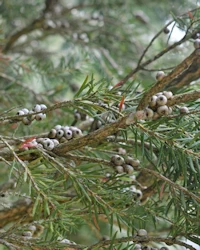 September 2024
 September 2024
Callistemon rigiduskallos - from Greek meaning beauty and stemon, stamen, referring to the plant's showy stamens; rigidus is Latin for rigid, describing the stiff, erect branches and narrow, straight leaves.
Bottlebrush
A medium-sized, upright, evergreen tropical shrub that will grow to 5 m in its native habitat, native to Australia. Flowers feature numerous bushy bright red stamens that encircle the stem in cylindrical spikes resembling bottlebrushes. Flowers bloom intermittently throughout the year.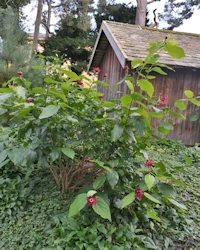 September 2024
 September 2024
Calycanthus floridus from Greek kalyx - calyx; "anthos" - flower, referring to the flower's structure; floridus", Latin, meaning "flowering,"
Carolina allspice
A.k.a. eastern sweetshrub or spicebush, a flowering shrub growing to 3 m, a native of SE USA. The flowers are solitary, featuring a reddish brown to reddish purple colour when they bloom in spring. The flowers are perfect having both stamens and carpels on the flowers. .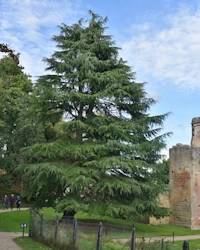 September 2024
 September 2024
Cedrus deodara cedrus - from Greek kedros, cedar; deodara - from Sanskrit devadāru, a compound of deva (god) and dāru (wood or tree).
Deodar cedar
A large evergreen coniferous tree reaching 40–50 m, with a trunk up to 3 m in diameter. It has a conic crown with level branches and drooping branchlets. The female cones are barrel-shaped, and disintegrate when mature (in 12 months) to release the winged seeds. The male cones are 4–6 cm long, and shed their pollen in autumn.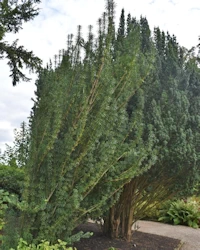 September 2024
Cephalotaxus fortunei kephale: - Greek for head, referring to the clusters of its flowers; taxus - genus name for yew; fortunei - after Scottish botanist Robert Fortune, who introduced the species to the UK from China in the 19th century.
Chinese plum-yew
A.k.a. Fortune's yew plum, plum yew, Chinese cowtail pine, or san jian shan (三尖杉; pinyin: sǎnjiānshān). A coniferous shrub or small tree native to N Burma and China, growing to 20 m, usually multi-stemmed with an open and loosely rounded crown. The ribbed new shoots remain green for three years after emerging..Glossy leaves are a deep yellowish-green to dark green, borne almost horizontally from the branchlet. The pollen cone is actually a capitula, or a conglomerate, of 6 to 14 cones, awhitish in colour. Arils an exterior covering that develops after fertilization as an outgrowth from the ovule stalk. Often called berries, but they are essentially fleshy cones. are initially yellow or green, turning to purple when ripe.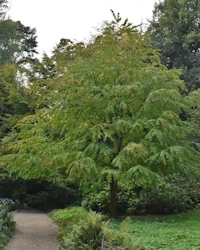 September 2024
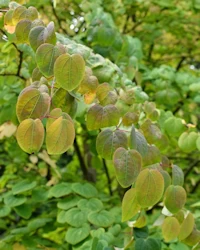 September 2024