×
![woodturning]()

Trees Gallery - Belsay Hall
Northumberland
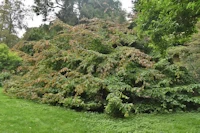 September 2024
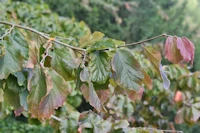 September 2024
Parrotia persica - named after Georg Friedrich Parrot (1767 - 1852), a German naturalist; and persica refers to the tree's native habitat, Iran (i.e. Persia).
Persian ironwood
A quick growing multi-stemmed tree growing to 30 m and 15 m wide. The bark is smooth, pinkish-brown flaking to leave a mosaic of cinnamon, pink, green, and pale yellow patches in a similar manner to plane trees. The flowers are somewhat similar to witch-hazel flowers but dark red; they are likewise produced in late winter on bare stems, but differ in having only four rounded sepals with no petals. The fruit is a two-part capsule containing two seeds, one in each half. September 2024
 September 2024
 September 2024
Picea abies picea from the Latin word pix, meaning pitch or resin, referring to the tree's sticky resin; abies - fir, referring to the similarity to the abies genus; Clanbrassiliana - after Lord Clanbrassil (1730 - 1798), who discovered the original witch's broom mutation in Northern Ireland around 1780. clanbrassiliana
Dwarf Norway spruce
A dwarf conifer which slowly makes a broad mound up to 2 m, of dark green, short needles with cinnamon-brown winter buds. The congested branches grow in layers creating a more globose form in its adolescence.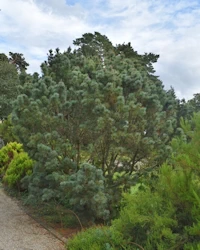 September 2024
 September 2024
Pinus mugo - pinus, Latin for pine; mugo, Italian for 'small mountain pine'; pumilio, Latin for dwarf or small, describing its compact, low-growing habitl glauca, refers to a bluish or greyish-green needle colour. pumilio glauca
Dwarf Mountain Pine
The species is a shrubby pine of variable habit, native of the mountains of Central Europe. Winter-buds cylindric, resinous, with numerous scales. Cones are solitary or in clusters of two or three near the tips of the shoots, very shortly stalked or sessile, brown and glossy when ripe. The apex of the scales is flat with a central boss. It often forms dense entanglements of snake-like stems, but it may be erect-branched. September 2024
 September 2024
Pinus sylvestris pinus- Latin for pine silva - woodland or forest, reflecting the tree's habitat.
Scots pine
An evergreen conifer native to northern Europe. Mature trees grow to 35m and can live for up to 700 years. The needle-like leaves are blue-green and slightly twisted, and grow in pairs on short side shoots. Scots pine is monoecious both male and female flowers grow on the same tree. Male flowers comprise clusters of yellow anthers at the base of shoots. Female flowers are small, red-purple and globular, and grow at the tips of new shoots. [Woodland Trust] September 2024
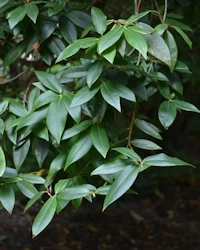 September 2024
Rhododendron - Rhodon: Ancient Greek for rose; déndron, tree; augustinii - after the Irish plantsman Augustine Henry (1857 - 1930), who discovered the plant in central China in 1886 augustinii
Augustin's rhododendron
A large evergreen shrub, to 2m tall and wide, with narrow, tapered leaves, up to 11cm long, with upper surfaces covered with a fine down whilst the undersides are scaly with pale hairs along the midrib. Open, funnel-shaped flowers, to 7cm across, are borne in mid and late spring in trusses of two to five and range in colour from white to a deep violet-blue with greenish-brown spots on the throats. [RHS]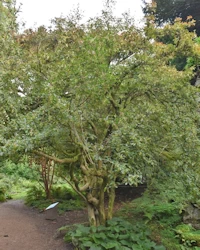 September 2024
 September 2024
Rhododendron - Rhodon: Ancient Greek for rose; déndron, tree; cinnabarinus, Latin meaning vermilion or cinnabar red, referring to the colour of the flowers. cinnabarinum
Cinnabar red rhododendron
A straggling evergreen shrub that grows to 3 m, native of E Nepal, Bhutan, Sikkim, SE Tibet, and SW China. The funnel shaped flowers are very variable in colour, ranging from yellow to cinnabar red and plum colours.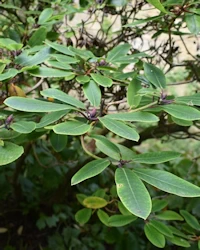 September 2024
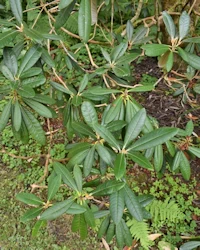
Rhododendron - Rhodon: Ancient Greek for rose; déndron, tree; fortunei, after Scottish botanist Robert Fortune (1812–1880), who discovered and introduced the species to the West from China. fortunei
Fortune's rhododendron
An evergreen shrub growing to 12 m, native to China. It has leathery leaves that are oblong-elliptic, measuring up to 14 cm long. It blooms from April to May, producing trusses of 6–12 flowers that are campanulate, white to pink, and fragrant. September 2024
 September 2024
Rhododendron - Rhodon: Ancient Greek for rose; déndron, tree; niveum, Latin for 'snowy', referring to the white, snow-like covering (indumentum) on the undersides of its leaves. niveum
Snowy rhododendron
An evergreen shrub or small tree that grows to 6 m, native to NE India, Bhutan, and SE Tibet. It has leathery leaves that are oblanceolate to elliptic, up to 11 cm long. When young the leaves are covered in a white indumentum, which falls off the upper surface but remains on the underside. The flowers are an intense magenta or lilac, and held in a compact ball above the leaves.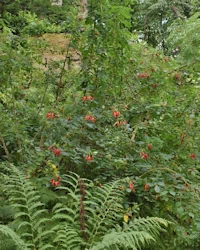 September 2024
 September 2024
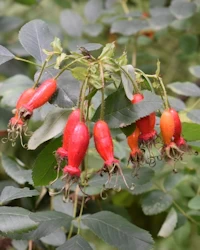
Rosa moyesii - Rosa Latin name for rose; moyesii, after Rev. James Moyes (1876-1930), a missionary with the China Inland Mission who provided support to the botanist Ernest Wilson. fortunei
Moyes' rose
A vigorous deciduous shrub growing to 4 m, native to W China, with plentiful matte green leaves and flat red or pink flowers, with yellow central stamens, in summer. These are followed in autumn by prominent bottle-shaped rose-hips. September 2024
 September 2024
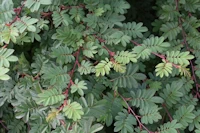
Rosa omeiensis - Rosa Latin name for rose; omeiensis, refers to Mount Omei in Szechwan, China, where the species was first collected by botanist E.H. Wilson.
Himalayan rose
A shrub which grows to 4 m, native to C and SW China. It is often very spiny. The flowers are 2.5–3.5 cm diameter, white, with (unusually for a rose) only four petals. The hips are red to orange-yellow, 8–15 mm diameter, with persistent sepals, and often bristly. [Wikipedia]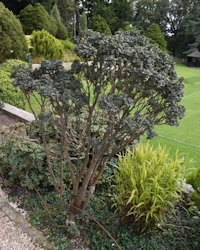 September 2024
 September 2024
Salix boydii - Salix Latin for willow; Boydii - after William Boyd (1831-1918), the Scottish botanist who discovered the plant in the Angus hills in the late 1800s.
Dwarf willow
A compact, upright, deciduous shrub growing very slowly into a gnarled bush up to 1m in height, with rounded, hairy, greyish, veiny leaves to 2.5cm in length. Insignificant grey female catkins are sparingly produced [RHS]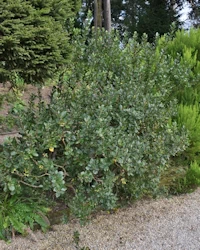 September 2024
 September 2024
Salix hastata - Salix Latin for willow; Hastata - spear-shaped, referring to the characteristic halberd-shaped leaves.
Halberd willow
A shrub growing to 2 m tall, forming thickets. The species is dioecious male and female reproductive parts occurring on separate plants . Catkins are up to 5 cm long, with flowers pollinated mainly by bees. It has an almost circumpolar distribution.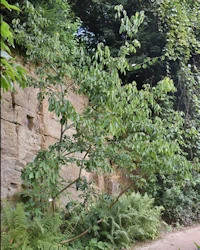 September 2024
 September 2024
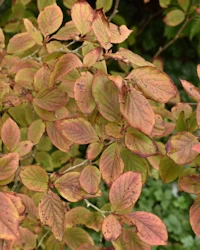
Staphylea - staphyle, Greek (στάφυλη), meaning a raceme or cluster of flowers, referring to the plant's flower panicles; holocarpa from the Greek holos (ὅλος), meaning whole or undivided, and karpos (καρπός), meaning fruit, describing the plant's whole or undivided fruit; rosea, Latin meaning rosy or pink. holocarpa rosea
Chinese bladdernut
'Rosea' is an upright shrub, or small, spreading tree, with blue-green leaves, bronze in spring, composed of three leaflets up to 10cm long. Small, hanging clusters of pink, bell-shaped flowers appear in mid- to late spring before the leaves, followed by greenish-white, inflated fruit up to 5cm long September 2024
 September 2024
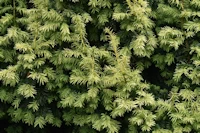
Stewartia stewartia - after John Stuart, earl of Bute; pseudocamellia - false camellia, because the flowers resemble those of the camellia pseudocamellia
Japanese stewartia
A.k.a. deciduous camellia, a small to medium-sized tree, growing to 10–15 m, often with multiple stems and low branching trunks. The bark is smooth textured, exfoliating as the plant ages, and has a camouflaged or mottled appearance with patterns of dull orange and green with grey mixed in. The flowers are up to 8 cm wide, with five white petals with orange anthers; they are shaped like those of the related Camellia, round and flat to somewhat cupped. They are produced in summer, generally in June until the end of August; each flower is short-lived, but many are produced that open over many weeks. The fruit is a brown capsule, triangular in shape with four or five angles, persistent on the trees but not showy. September 2024
 September 2024
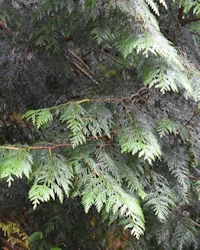
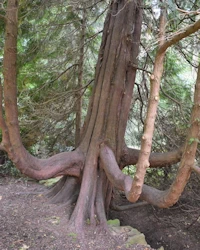
Taxus baccata - taxon Greek for bow; baccata, Latin for bearing berr; aurea, Latin for golden or variegated, referring to the plant's golden-yellow foliage aurea
Golden yew
Taxus baccata is a species of evergreen tree in the family Taxaceae, native to W, C and S Europe, as well as NW Africa and SW Asia. The plant is poisonous, with toxins that can be absorbed through inhalation, ingestion, and transpiration through the skin. Consuming any part of the tree, excluding the aril, can be deadly. T. baccata aurea is a group of slow growing evergreen conifers, with golden yellow or yellow-striped needles when young, turning green as they mature.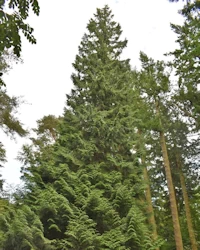 September 2024
 September 2024
 September 2024
Thuja plicata thuia - from Greek, a name for an aromatic evergreen wood. plicare - from Latin, meaning folded or pleated, referring to the arrangement of the scale-like needles on the branches.
Western red cedar
A large to very large tree, ranging from 45 to 70 m. It can live well over a thousand years, with the oldest verified aged 1,460. The cones are slender, up 18 mm long, and 5 mm broad. They are green to yellow-green, ripening brown in autumn about six months after pollination, and open at maturity to shed the seeds.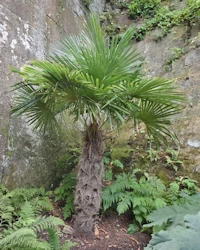 September 2024
 September 2024
 September 2024
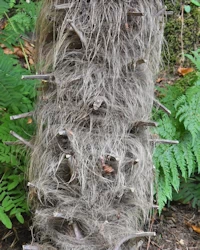
Trachycarpus fortunei from Greek trachys, rough, and karpos, fruit, referring to the fibrous, rough trunk of the palm; fortunei, after Scottish horticulturist Robert Fortune (1812 - 1880).
Windmill palm
Also called the Chusan palm, native to subtropical and temperate mountain forests of China, Japan, Myanmar and India where it typically grows to 12-20m. One of the hardiest of the palms, cultivated for its coarse but strong leaf sheath fibre, used for making rope, sacks, and other coarse cloth where strength is important. September 2024
 September 2024
 September 2024