×
![woodturning]()

Trees Gallery - Floors Castle
Kelso, Scottish Borders

Floors Castle
Victorian Kitchen Gardens within a Walled Garden, a formal Millennium Garden with French-style parterre and summer house, and a wider estate planted with many trees, formal and informal, with a woodland walk.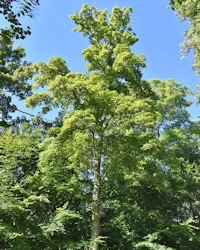 September 2024
 September 2024
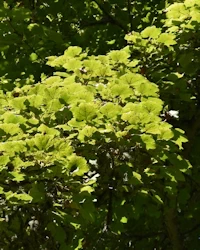
Acer pseudoplatanus acer - maple; pseudoplatanus - false plane, referring to a superficial similarity of leaves and bark to those of plane trees (genus platanus)
Sycamore
Not native to Britain, but they have been here for many years and are well established across the country. These broadleaf trees can grow to 35m and live for 400 years. Twigs are pink-brown and hairless. Small, green-yellow flowers hang in spikes, or 'racemes'. After pollination by wind and insects, female flowers develop into distinctive winged fruits known as samaras. September 2024
 September 2024
 September 2024
 September 2024
 September 2024
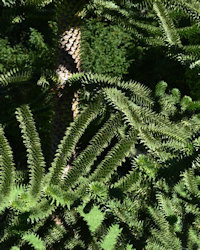
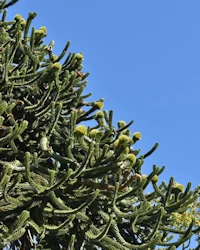
Araucaria araucana araucaria - after a region of Chile; araucana - the native tribe who used the tree's seeds for food.
Monkey puzzle
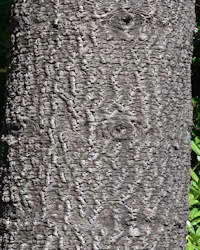
A.k.a. monkey tail tree, pewen, pehuen pine or piñonero, an evergreen tree growing to 30–40 m, native to C and S Chile and W Argentina. It is on the IUCN list as endangered in its native region due to logging, forest fires, and grazing. It is usually dioecious male and female cones on separate trees . The male (pollen) cones are oblong and cucumber-shaped. It is wind pollinated. The bark can be up to 15 cm thick, possibly an adaptation to resist wildfires.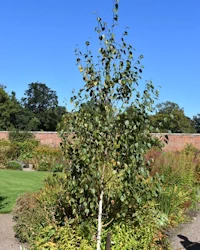 September 2024
 September 2024
Betula utilis betula - birch, derived from the Gaulish betu- meaning bitumen or asphalt, referring to the tar extracted from birches; utilis - useful, referring to the many uses of the tree; jacquemontii - honouring the French naturalist Victor Jacquemontjacquemontii
Himalayan birch
A.k.a. white-barked Himalayan birch or Indian paper birch, a fast growing, deciduous tree reaching 15 - 20 m, native to W Himalayas. It is graceful in appearance and offering light dappled shade with its open, conical crown. In spring, yellow catkins appear, closely followed by dark green ovate leaves. In autumn, the foliage turns golden yellow before falling.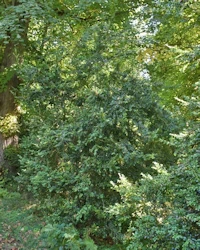 September 2024
 September 2024
Buxus sempervirens buxis - Latin name for box tree; semper ever virens green, reflecting the evergreen nature of box.
Common box
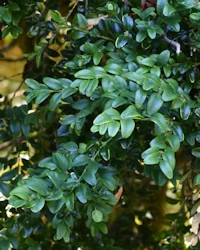
Mainly used for topiary and clipped to tight, small forms, but left alone it is an evergreen shrub or small tree growing to 9 m, native to W and S Europe, NW Africa, and SW Asia. The monoecious flowers male and female reproductive parts are on the same plant are inconspicuous but highly scented, greenish-yellow, with no petals, and are insect pollinated; the fruit is a three-lobed capsule containing three to six seeds.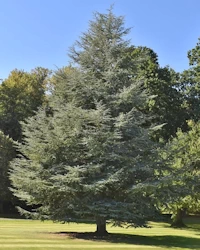 September 2024
 September 2024
 September 2024
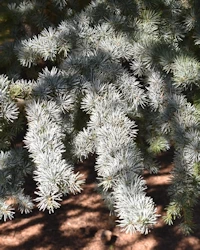
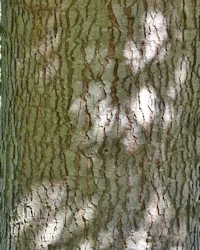
Cedrus atlantica cedrus - from Greek kedros, cedar; atlantica - Latin, 'from the Atlas Mountains' glauca
Altas cedar
A large coniferous evergreen tree, 30 to 35 m, with a trunk diameter of 1.5 to 2 m. A native of the Rif and Atlas Mountains of Morocco and Algeria. It is very similar to the other true cedars; some authorities consider it a subspecies of c. libani; others rank it as a distinct species. This glaucous variety has a blue tinge to the needles.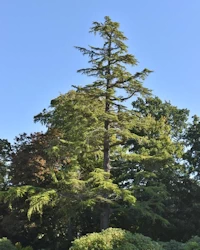 September 2024
Cedrus deodara cedrus - from Greek kedros, cedar; deodara - from Sanskrit devadāru, a compound of deva (god) and dāru (wood or tree).
Deodar cedar
A large evergreen coniferous tree reaching 40–50 m, with a trunk up to 3 m in diameter. It has a conic crown with level branches and drooping branchlets. The female cones are barrel-shaped, and disintegrate when mature (in 12 months) to release the winged seeds. The male cones are 4–6 cm long, and shed their pollen in autumn.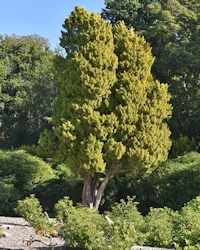 September 2024
Cryptomeria japonica krypto - from Greek, hidden; meros - part; referring to the concealed reproductive parts japonica - of Japan.
Japanese cedar
A.k.a. Japanese redwood, a very large evergreen tree native to Japan, reaching up to 70 m with 4 m trunk diameter. It is superficially similar to the related giant sequoia (Sequoiadendron giganteum), from which it can be differentiated by the longer leaves and smaller cones, and the harder bark on the trunk (thick, soft and spongy in giant sequoia).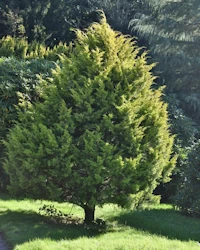 September 2024
Cupressus macrocarpa - Cupressus, cypress tree, ultimately from the Greek word for the tree, kypárissos; makros, large; karpos, fruit: Monterey pine has relatively large cones
Monterey Pine
A.k.a. hesperocyparis macrocarpa one of several species of cypress trees native to California. A medium-sized coniferous evergreen tree. The leaves are scale-like, produced on rounded (not flattened) shoots.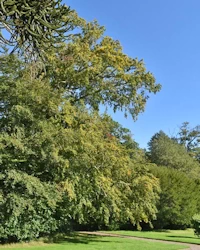 September 2024
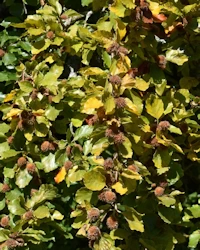 September 2024
Fagus sylvatica Fagus - Latin for beech; sylvatica - from Latin silvanus, of the forest
Common beech
Native across Europe, growing to a height of more than 40 m and develop a huge domed crown. The reddish brown, torpedo-shaped leaf buds form on short stalks and have a distinctive criss-cross pattern. Beech is monoeciousboth male and female flowers grow on the same tree . In April and May the tassel-like male catkins hang from long stalks at the end of twigs, while female flowers grow in pairs, surrounded by a cup. Beech woodland is shady and characterised by a dense carpet of fallen leaves and mast husks which prevent most woodland plants from growing. Only specialist shade-tolerant plants can survive beneath a beech canopy.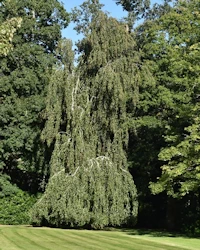 September 2024
 September 2024
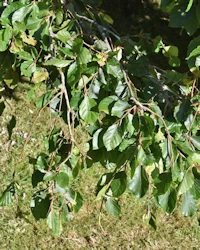
Fagus sylvatica Fagus - Latin for beech; sylvatica - from Latin silvanus, of the forest; pendula, weeping or drooping pendula
Weeping beech
This cultivar of the European beech, on which the branches droop from a tall central stem, was found in an English parkland in the 1830s, and propagated by cuttings ever since, being sold as a popular ornamental tree. It can grow to 25 metres.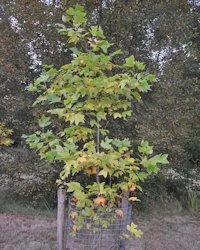 September 2024
 September 2024
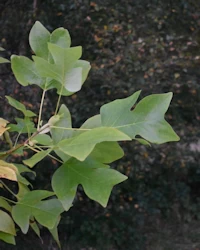
Liriodendron tulipifera from Greek leirion - 'lily'; dendron - tree; tulipifera - tulip-bearing, referencing the flower's appearance
Tulip tree
A.k.a. whitewood, fiddletree, lynn-tree, hickory-poplar, and yellow-poplar. A large, deciduous tree native to North America, growing to 50 m. In late spring or early summer, mature tulip trees produce upright, cup-shaped flowers with yellow-green petals and orange markings inside. The tree's overall shape is pyramidal or broadly conical. Fast growing with a tall straight trunk, it is very commercially valuable timber.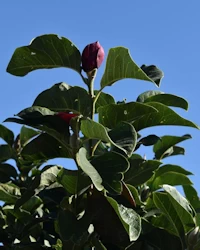 September 2024
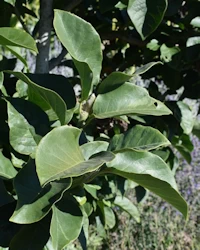 September 2024
 September 2024
Magnolia Felix JuryMagnolia, genus named after French botanist Pierre Magnol (1638-1715); Felix Jury from the hybrid's' breeder, Mark Jury, who named it after his father, Felix.
Magnolia Felix Jury
This large, pink-flowered magnolia is a hybrid of m. Atlas and m. Vulcan, both of which were developed using m. Lanarth and genes from m. liliiflora. A relatively small deciduous tree growing to 6m, producing very large, waterlily-shaped flowers with broad petals in early to mid-spring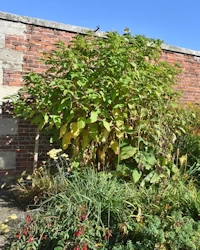 September 2024
 September 2024
Phytolacca - from Greek phyton, plant, Latin lacca red dye, referring to the plant's ability to yield a crimson-colored dye or pigment from its berries.
Pokeweed
A.k.a. pokebush, pokeberry, pokeroot, inkberry or poke sallet, a genus of perennial herbs, shrubs, and trees growing from 1 to 25 m, native to America and E Asia. All parts are poisonous to mammals, though the dark purple to black berries are eaten by birds, which are not affected by the toxin as the seeds have hard outer shells and remain intact in the digestive system until passed. This variety is probably p. americana, possibly p. acinosa (Indian pokeweed). September 2024
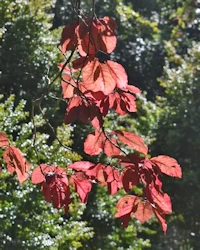 September 2024
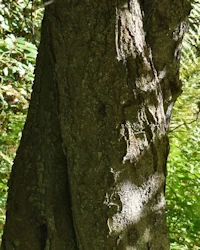 September 2024
Prunus cerasifera - prunus, Latin for plum tree or cherry tree; cerasus, cherry tree; ferre, to bear; atro, dark; purpureus purple. (atropurpurea?)
Cherry plum
A.k.a. myrobalan plum, in the wild a large shrub or small trees reaching 8–12 m, native to Eurasia and naturalized elsewhere. It is one of the first European trees to flower in spring, often starting in mid-February before the leaves have opened. The small flowers are white or pale pink with five petals and many stamens. The fruit is an edible drupe a fleshy fruit with thin skin and a central stone containing the seed , ripening to yellow or red from early July to mid-September.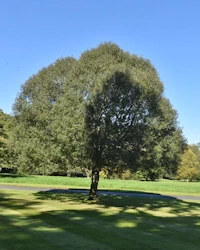 September 2024
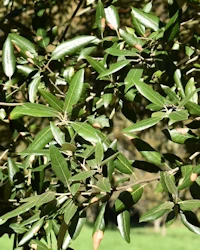 September 2024
Quercus ilex quercus - Latin name for oak, derived from the Proto-Indo-European root kwerkwu; ilex - Latin for holm oak: evergreen leaves resemble those of holly (holm is an old English word for holly).
Holm oak
Also called holly oak or evergreen oak, due to the similarity of its leaves to the holly. A native of the mediterranean, it was planted extensively in Britain as tall hedging and coastal shelter belts, and is now naturalised across much of the suthern part of the country, a spread likely to continue northwards as climate change improves conditions for it here.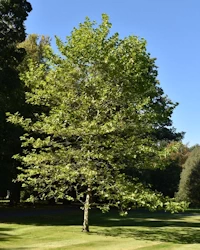 September 2024
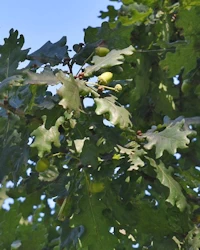 September 2024
 September 2024
Quercus robur quercus - Latin name for oak, derived from the Proto-Indo-European root kwerkwu; robur - Latin for robust or strong, referencing the tree's sturdiness.
Common oak
A.k.a. English oak or pedunculate oak, native to mixed woodland areas from the British Isles to the Caucasus, and has been widely planted in North America since the 1600s. It is a large, majestic, deciduous tree of the white oak group that typically grows in cultivation to 30 m with a broad-spreading, rounded crown. Small monoecious separate male and female catkins appear on the same tree yellow-green flowers appear in spring as the leaves emerge. Fruits are oval acorns 2.5 cm long, on long stalks (peduncles).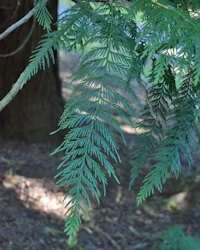 September 2024
 September 2024
 September 2024
Thuja plicata thuia - from Greek, a name for an aromatic evergreen wood. plicare - from Latin, meaning folded or pleated, referring to the arrangement of the scale-like needles on the branches.
Western red cedar
A large to very large tree, ranging from 45 to 70 m. It can live well over a thousand years, with the oldest verified aged 1,460. The cones are slender, up 18 mm long, and 5 mm broad. They are green to yellow-green, ripening brown in autumn about six months after pollination, and open at maturity to shed the seeds. The trunk here exhibits the common feature of heavy, low horizontal branching.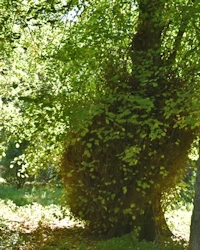 September 2024