×
![woodturning]()

Trees Gallery - St Andrews Botanic Gardens. Page 2
Fife, Scotland
 October 2024
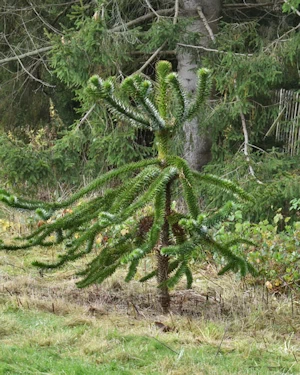
Araucaria araucana araucaria - after a region of Chile; araucana - the native tribe who used the tree's seeds for food.
Monkey puzzle
A.k.a. monkey tail tree, pewen, pehuen pine or piñonero, an evergreen tree growing to 30–40 m, native to C and S Chile and W Argentina. It is on the IUCN list as endangered in its native region due to logging, forest fires, and grazing. It is usually dioecious male and female cones on separate trees . The male (pollen) cones are oblong and cucumber-shaped. It is wind pollinated. The bark can be up to 15 cm thick, possibly an adaptation to resist wildfires. I have noticed young monkey puzzle trees planted in many gardens and woodlands visited recently.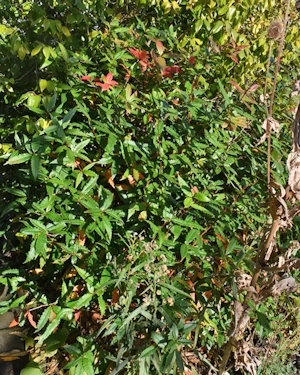 October 2024
 October 2024
Berberis hypokerina berberis - Latinized from Arabic barbaris, or barberry; hypo means "under; kerina means horn or waxy, referring to the plant's vividly white undersides of its leaves.
Silver holly
A.k.a. violet-bead barberry, or Burmese barberry, a small evergreen shrub up to 2.5m tall and wide, native to Myanmar, with arching reddish-green stems and holly-like, rigid, triangular-spined, grey-green leaves to 15cm long, often white beneath. Dense clusters of lemon-yellow flowers 1 cm across in early summer are followed by white tinged, blue-black fruit in autumn October 2024
 October 2024
Betula alleghaniensis betula the Latin word for birch; alleghaniensis: of the Allegheny, referring to its native range in the Allegheny Mountains, part of the larger Appalachians.
Yellow Birch refers to the yellowish or bronze-colored bark of young trees, which becomes more silver and flaky with age
A.k.a. golden birch, or swamp birch, or in Quebec, merisiera, and previously classified as Betula lutea. It is a medium sized deciduous tree native to NE North America, growing to 25 m with a trunk up to 0.9 m in diameter, making it the largest North American species of birch. It is long-lived, typically 150 years, sometimes up to 300 years. Dark green leaves are alternate, oval, with a pointed tip and often a slightly heart shaped (cordate) base, with a finely serrated (doubly serrate) margin. It is monoecious both male and female flowers occur on the same tree .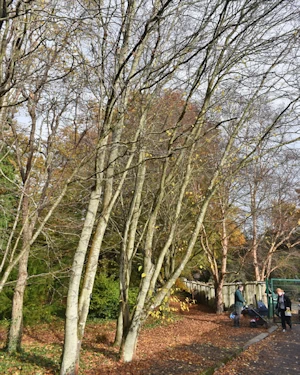 October 2024
 October 2024
Betula lenta betula - birch; lenta, pliable or tough, . referring to the strong and flexible twigs and wood.
Sweet birch
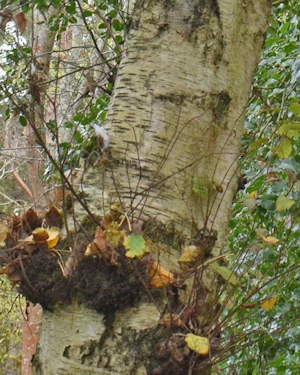
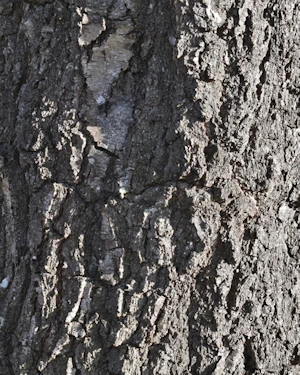
A.k.a. black birch, cherry birch, mahogany birch, or spice birch, a medium-sized deciduous tree reaching 30 m, native to E North America. al. The twigs, when scraped, have a strong scent of wintergreen due to methyl salicylate, which is produced in the bark. The leaves are alternate, ovate, with a finely serrated margin. The flowers are wind-pollinated catkins, the male catkins pendulous, the female catkins erect.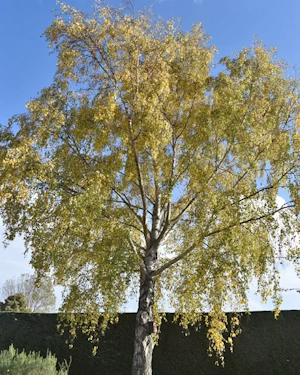 October 2024
 October 2024
 October 2024
Betula pendula betula - birch, possibly from betu, meaning tar or bitumen, which can be extracted from the tree, pendula - hanging down (L.)
Silver birch
Leaves are light green, small and triangular-shaped with a toothed edge, which fade to yellow in autumn. Monoecious both male and female flowers (catkins) are found on the same tree catkins emerge from April to May, the male catkins long, yellow-brown, hanging in groups of two to four, like lambs' tails. Female catkins are smaller, short, bright green and erect.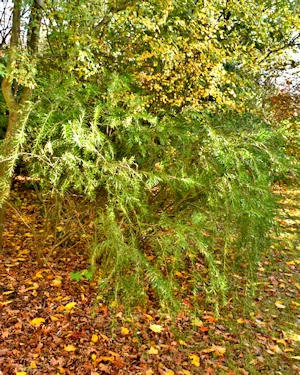 October 2024
 October 2024
Callistemon viminalisCallistemon from Greek kalos, beautiful, and stemon, stamen, referring to the showy, beautiful stamens of the flower; viminalis - Latin for having long, flexible twigs, alluding to the pendulous or weeping branches.
Weeping bottle-brush
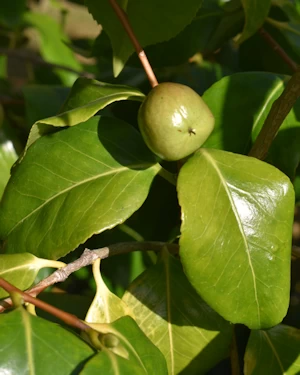
A small tree with willowy foliage, with striking red bottlebrush flowers, mostly in summer. When the flowers go, groups of seed capsules encircle the branchlets like knobby sleeves, where they remain for years without releasing their powdery seed. The sleeves of previous years can be tracked back along the branches where they may in due course become engulfed by new wood. Australians steeped the flowers in water to make a bush remedy for sore throats. October 2024
 October 2024
 October 2024
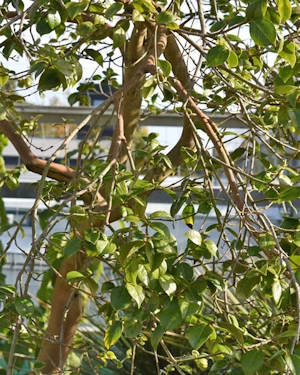
Camellia cuspidata camellia - after the Jesuit missionary and botanist Georg Joseph Kamel; cuspidata - Latin for 'with a point' or 'suddenly narrowed to a short, rigid tip', a description of the leaves.
Camellia cuspidata
A large, upright, evergreen shrub to around 3 m tall that becomes bushy with age. Solitary, pure white, cup-shaped flowers 2-3 cm in diameter are borne in spring.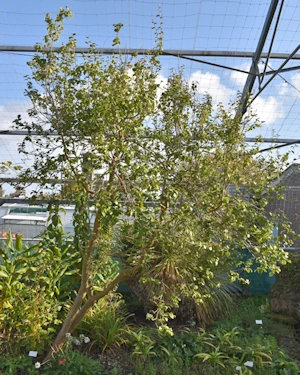 October 2024
 October 2024
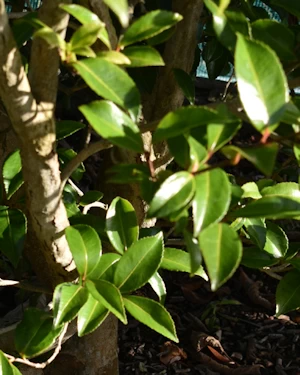
Camellia grijsii camellia - after the Jesuit missionary and botanist Georg Joseph Kamel; grijsii - after Carolus F. M. de Grijs (1832–1902), a Dutch military surgeon and plant collector in China;
Grijs' camellia
A bushy, upright, evergreen shrub eventually forming a small tree of about 3-4m high, with dark green leaves and single, scented, white flowers with heart-shaped, notched petals in late winter (January to March). It was discovered in Fujian province in China by de Grijs in 1861. October 2024
 October 2024
Camellia oleifera camellia - after the Jesuit missionary and botanist Georg Joseph Kamel; oleifera - Latin for oil bearing
Oil-seed camellia
A large shrub or small tree widely distributed in China and cultivated extensively there as an important source of edible oil (known as tea oil or camellia oil). It grows to 6 m with thin, upright, multiple trunks and branches. It is found in forests, thickets, banks of streams and foothills. Single, white, fragrant flowers are produced in mid to late autumn.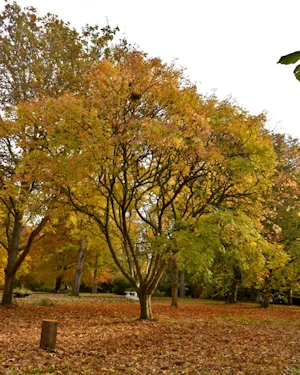 October 2024
 October 2024
 October 2024
 October 2024
Castanea sativa castanea - after the town of Castanum in Thessaly, where it grew in abundance; sativa - Latin for 'cultivated' or 'sown'.
Sweet chestnut
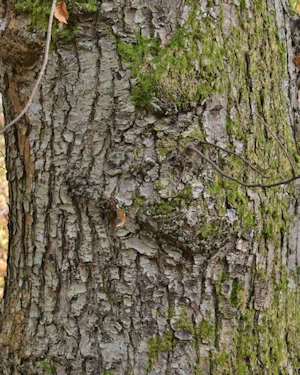
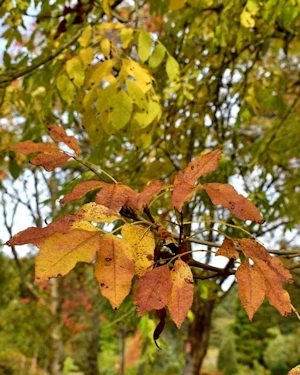
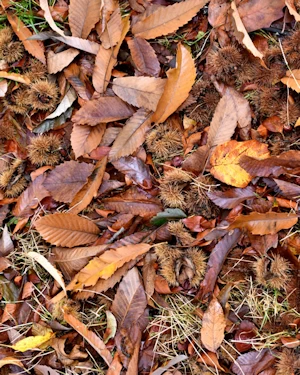
A.k.a. Spanish chestnut or European chestnut, a tree native to S Europe and Asia Minor, growing to 25m with a trunk often 2 m or more in diameter. The flowers of both sexes are borne in 10–20 cm long, upright catkins, the male flowers in the upper part and female flowers in the lower part. The female flowers eventually form a spiky sheath that deters predators from the seed. It is naturally self incompatible meaning that the plant cannot pollinate itself, making cross-pollination necessary. . Trees can live to an age of 500 to 600 years, even 1,000 years or more.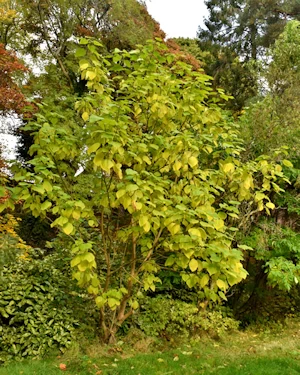 October 2024
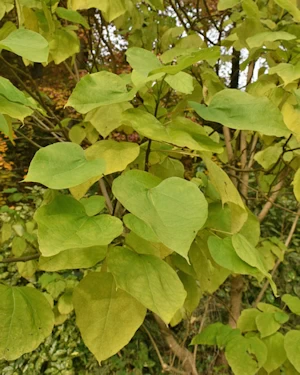 October 2024
Catalpa speciosa catalpa from a Muscogee (Native American) word kutuhlpa, meaning winged head, referring to the seeds; speciosa - Latin for 'showy' or 'spectacular', referring to its large white flowers.
Northern catalpa
A.k.a. hardy catalpa, western catalpa, cigar tree or catawba. It is a medium-sized, deciduous tree growing to 30 m. It has a trunk up to 1 m in diameter, with brown to gray flaky bark, native to the midwestern United States. The flowers are 3–6 cm across, trumpet shaped, white with yellow stripes and purple spots inside; growing in panicles of 10–30. The fruit is a long, thin legume-like capsule, 20–40 cm long,which turns brown in autumn and often stays attached to tree during winter. The pod contains numerous flat, light brown seeds with two papery wings.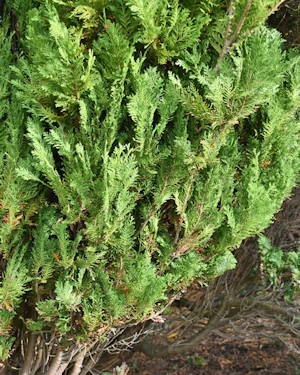 October 2024
 October 2024
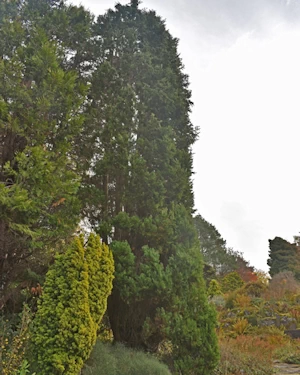
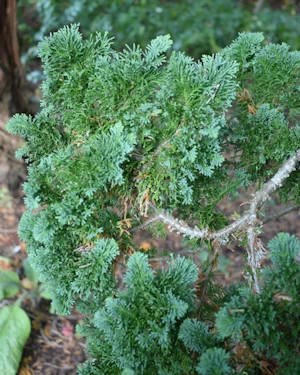
Chamaecyparis Chamaecyparis: - dwarf cypress; lawsoniana - after Scottish nurseryman Charles Lawson; Kilmacurragh, named after the Irish garden where it originatedlawsoniana Kilmacurragh
Lawson's cypress
A large evergreen tree growing to 50 m with trunk up to 2 m in diameter. The bark is silver-brown, vertically furrowed, and up to 25 cm thick at the base. The seed cones are globose, 7–14 mm in diameter, green at first, maturing brown in autumn. Trees can live up to about 600 years of age.Leaves rich green; habit columnar, resembling that of the Italian cypress. It bears the name of the once-famous Irish garden where it originated. The parent tree perhaps no longer exists but it was propagated before the garden fell into decay and is now well established in cultivation. October 2024
 October 2024
 October 2024