×
![woodturning]()

Trees Gallery - St Andrews Botanic Gardens. Page 4
Fife, Scotland
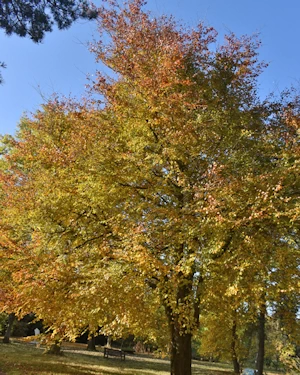 October 2024
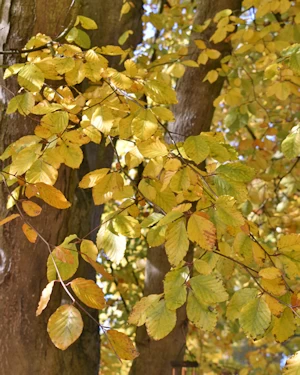 October 2024
 October 2024
Fagus sylvatica Fagus - Latin for beech; sylvatica -from Latin silvanus, of the forest; atro - dark; purpurea - purple atropurpurea
Copper Beech
Native across Europe, growing to a height of more than 40 m and develop a huge domed crown. The reddish brown, torpedo-shaped leaf buds form on short stalks and have a distinctive criss-cross pattern. Beech is monoeciousboth male and female flowers grow on the same tree . In April and May the tassel-like male catkins hang from long stalks at the end of twigs, while female flowers grow in pairs, surrounded by a cup. Beech woodland is shady and characterised by a dense carpet of fallen leaves and mast husks which prevent most woodland plants from growing. Only specialist shade-tolerant plants can survive beneath a beech canopy.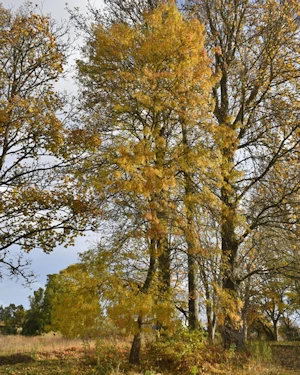 October 2024
 October 2024
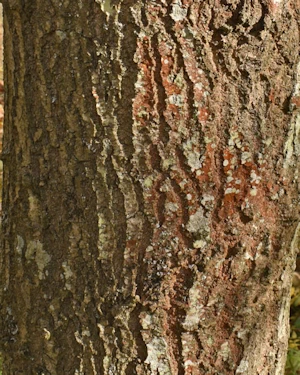 October 2024
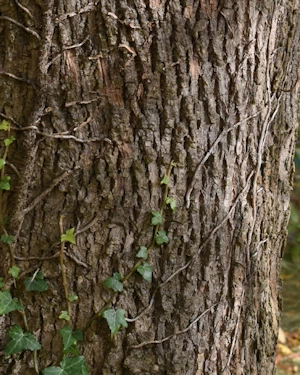
Fraxinus angustifolia Fraxinus, Latin word for ash; angustus, Latin for narrow; folium, leaf, referring to the leaves; oxycarpa from Greek oxys, sharp and karpos (fruit), referring to the fruit's pointed shape. oxycarpa
Raywood ash
A.k.a. Claret Ash. A fast-growing, medium to large deciduous cultivar growing to 15–20 m, with narrow, glossy leaves in summer and brilliant purple and red-wine autumn foliage. Narrow and upright when young, broadening to a full, rounded canopy with age. The flowers are produced in inflorescences which can be male, hermaphrodite or mixed male and hermaphrodite. Flowering occurs in early spring. The fruit when fully formed is a samara 3–4 cm long, the seed 1.5–2 cm long with a pale brown wing.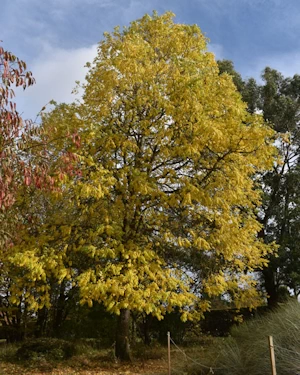 October 2024
 October 2024
 October 2024
Fraxinus latifolia Fraxinus, Latin word for ash; latus, Latin for broad; folia, leaf, referring to the broad leaflets
Oregon ash
a medium-sized deciduous tree that can grow to 20–25 m, native to W North America. It is common for the leaves and bark to show signs of disease and brown rot on otherwise healthy plants. Unlike bigleaf maples, ash twigs have woolly hairs. In mid to late spring, the tree produces small insignificant flowers. It is dioecious it requires two separate plants (male and female) to successfully pollinate and reproduce . The fruit, produced by female trees, is a cluster of samaras, 3–5 cm long that includes wings similar to maple trees.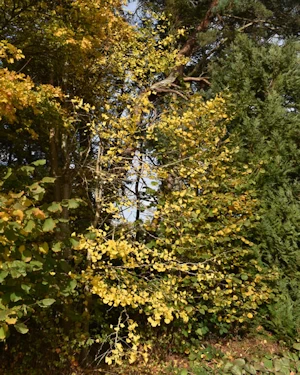 October 2024
 October 2024
Ginkgo biloba Ginkgo (from yin xing or ginkyō) means silver apricot, referencing the fleshy, sometimes foul-smelling, seed coating; biloba - Latin for two-lobed, describing the distinctive fan-shaped leaves that are split into two distinct lobes.
Maidenhair tree due to its leaf resemblance to maidenhair ferns
A long-lived dioecious tree with unique fan-shaped leaves, capable of clonal reproduction, and known for its striking yellow autumn foliage. Specimens have been measured in excess of 1,600 years, and the largest living trees are estimated to exceed 3,500 years. Ginkgos are large trees, normally reaching a height of 20–35 m. Ginkgo biloba is dioeciouswith separate sexes, some trees being female and others being male. , with male plants producing small pollen cones with sporophylls a leaf or leaf-like structure that bears spores, which are reproductive cells . Female plants do not produce cones. Two ovules are formed at the end of a stalk, and after wind pollination, one or both develop into fruit-like structures containing seeds. The outer layer of the fruit (the sarcotesta the soft, fleshy outer layer of a seed coat, found in plants like pomegranates and cycads. Often brightly coloured or foul-smelling, to attract animals for seed dispersal ) is attractive in appearance, but contains butyric acid and smells foul like rancid butter or vomit when fallen. As a consequence, most trees in cultivation are male clones.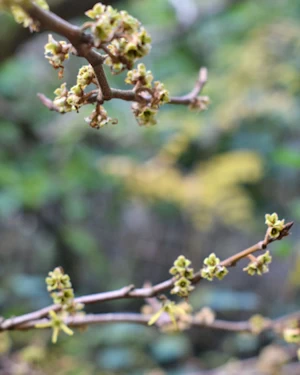 October 2024
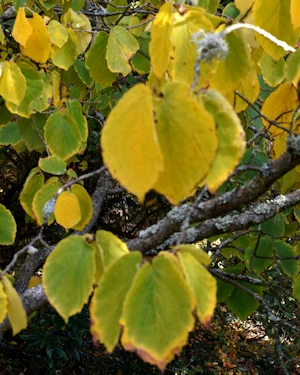
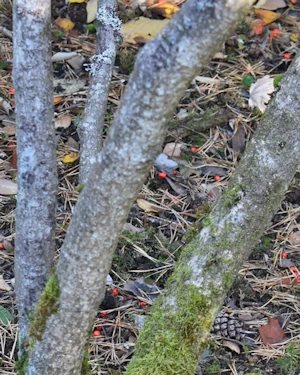
Hamamelis x intermedia hama Greek, meaning at the same time; and melon meaning apple or fruit, referring to the plant's unusual characteristic of producing flowers while the previous year's fruits are still ripening; x intermedia a hybrid cross, between h. mollis and h. japonica, displaying characteristics between the two parents. 'Arnold Promise: developed at Arnold Arboretum in Boston, Massachusetts; the promise is of seasonal change in spring, due to the bright flowers. Arnold Promise
Witch hazel 'Arnold Promise'
A vigorous, large spreading shrub, with an upright, fan-shaped vase form. Large, long-blooming four-petalled yellow flowers curl and uncurl in response to the weather, borne feely from December to March. They have a pleasant, 'tart' fragrance. In autumn, leaves turn yellow, orange to red hues.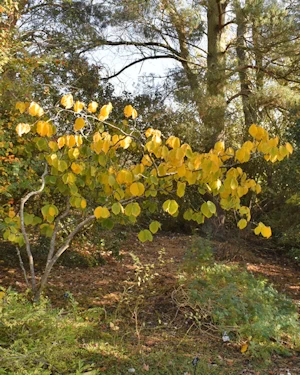 October 2024
 October 2024
 October 2024
Hamamelis mollis hama Greek, meaning at the same time; and melon meaning apple or fruit, referring to the plant's unusual characteristic of producing flowers while the previous year's fruits are still ripening; mollis - Latin for soft, describing the leaves.
Chinese witch from an old English word for pliable hazel
. A deciduous large shrub or small tree growing to 8 m, native to C and E China. Yellow flowers, often with a red base, have four ribbon-shaped petals 15 mm long, growing in clusters, flowering is in late winter to early spring on bare branches. The fruit is a hard woody capsule 12 mm long, which splits explosively at the apex at maturity one year after pollination, ejecting the two shiny black seeds.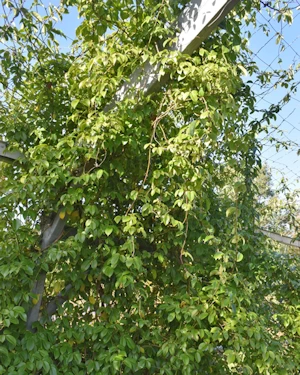 October 2024
 October 2024
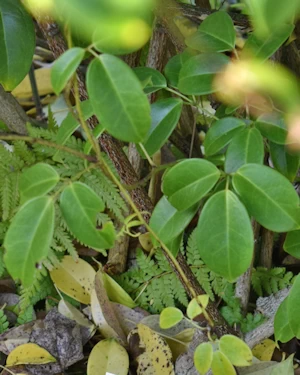
Holboellia coriacea Holboellia after Danish ornithologist Carl Peter Holboell (1795-1856); coriacea, from Latin meaning leathery, describing the tough leaves.
Sausage vine
A vigorous, astonishingly hardy, evergreen climber with dark green, leathery leaves and short, elongated, violet coloured 'sausage' fruits, which are edible (though bitter). It is native to C China where it grows in scrubby thickets and mountain slopes. It has extremely fragrant flowers which can vary from white through pale green to pale purple, and appear in clusters in spring and early summer. October 2024
 October 2024
 October 2024
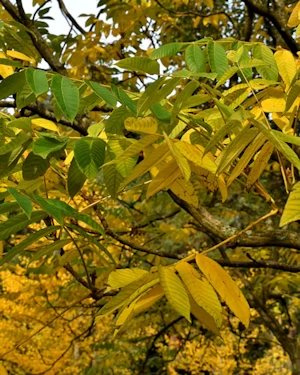
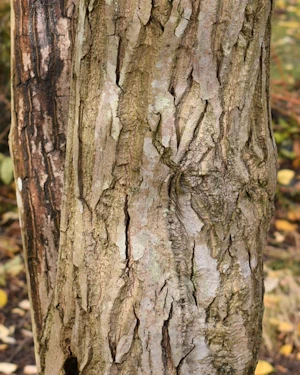
Juglans ailantifolia Juglans: Latin from Jovis, meaning Jupiter and glans, meaning acorn or nut; Jupiter's nut reflects the high regard the Romans had for the fruit; ailantia: from an Indonesian word for Ailanthusa folia, Latin for leaf - noting a resemblance of the leaves to those of the Ailanthus, the tree of heaven; cordiformis: from Latin meaning heart-shaped, referring to the flattened heart shape of the nuts on this specific variation of Japanese walnut. cordiformis
Japanese walnut
The species is a deciduous tree growing to 20 m, native to Japan. The male flowers are inconspicuous yellow-green catkins produced in spring at the same time as the new leaves appear. The female flowers have pink/red pistils. The fruit is a spherical nut surrounded by a green husk before maturity, produced in bunches of 4–10. This cultivar, the heartnut, is a cultivar distinguished by its heart-shaped fruit (in cross-section), which is very hard to crack. It is sweet without a bitter aftertaste often intrinsic with black and Persian walnuts. October 2024
 October 2024
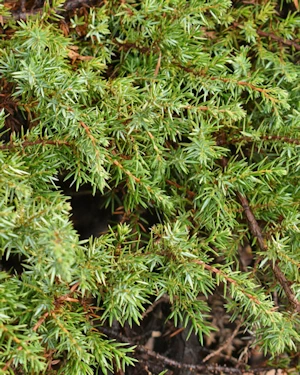
Juniperus communis juniperus : - from the Latin name for the tree, possibly with the meaning 'young and fresh'; communis - Latin for common; Hornibrookii after Murray Hornibrook (1874-1949), an Irish nurseryman who raised and introduced this specific prostrate, spreading cultivar from seeds reportedly collected in China by the plant explorer Ernest Wilson. Hornibrookii
Juniper
A noticeboard was by the juniper plants: Common juniper is the most widely distributed conifer in the world. Occuring right across the northern hemisphere, it grows in a vast range of habitats from the sea level to 2400m altitude. A wide range of different forms can be observed, from the trees of 18m in height to carpeting shrubs reaching just 18 cm in height. As a result, many subspecies have been described - in Scotland you are likely to see subsp. communis or subsp. nana. Globally, this plant has a Red List assessment of least concern. However, within the UK, over time populations have been reduced by muirburn the burning of heather moorland for wildlife and land management , overgrazing, and removal of scrub habitat. In some places, there is very little regeneration - Juniper seed requires bare soil to germinate and the young plants are vunerable to grazing. Juniper is also threatened by a pathogen called Phytopthora austocedri which was first described in 2007 and first confirmed in the UK in 2011. The origin of this pathogen remains unclear, but it is a serious problem, causing die-back and death in a number of natural populations.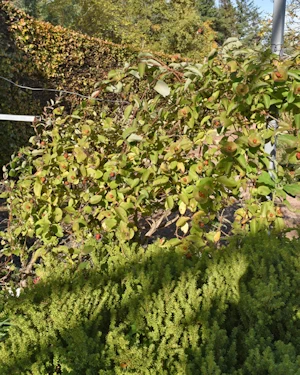 October 2024
 October 2024
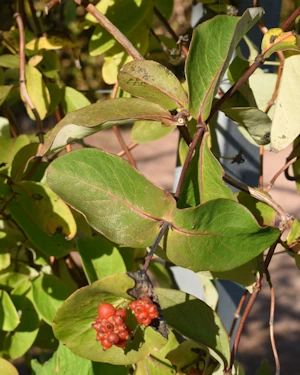
Lonicera tragophylla Lonicera -after German botanist and physician Adam Lonitzer (1528 - 1586); tragophylla: from Greek tragos (τράγος) meaning goat, and phyllon (φύλλον), meaning leaf. This possibly refers to the belief that the leaves were a favorite food of goats.
Chinese honeysuckle
A deciduous climbing shrub growing to 6 m, native to Central China, where it inhabits forest, scrub and rocky crevices. It has grey-green leaves and trumpet-shaped, pure rich yellow flowers in late summer and autumn. Unlike many honeysuckles it is unscented. October 2024
Lophomyrtus obcordata Lophos - from Greek meaning crest or tuft, referring to the crown-like appearance of its flowers; Myrtus means myrtle, as it belongs to the myrtle family; ob - reverse; cordata - heart-shaped, referring to the leaves."
Rōhutu
A.k.a. tutuhi (Maori), a tall bushy shrub which can reach up to 6 m, native to New Zealand, usually found in lowland forest. It has a smooth trunk, beige hidden by pieces of greyish bark.The branchlets are numerous, erect and slightly pubescent. The leaves are much smaller than those of other trees of the same genus. They are thick, heart-shaped, opposite or fasciculate to grow or form in bundles or clusters , glabrous when adult (and pubescent before), and 5 to 10 mm long and wide. They are rather fragile and brittle.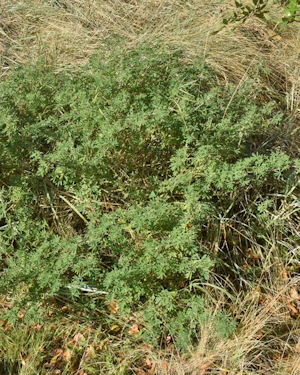 October 2024
 October 2024
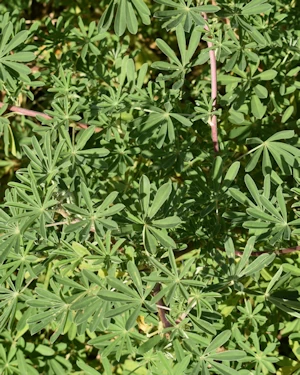
Lupinus arboreus Lupinus - from Latin meaning wolf, possibly because people thought they devoured the soil's nutrients, though they actually fix nitrogen; arboreus: from arbor meaning tree, distinguishing it from herbaceous lupins.
Tree lupin
A.k.a. yellow bush lupin, an evergreen shrub growing to 2 m, indigenous to California. In spring it bears many racemes a flower cluster with the separate flowers attached by short equal stalks at equal distances along a central stem. The flowers at the base of the central stem develop first. , 30 cm long, of fragrant, soft yellow, pea-like flowers. It has become an invasive species in many areas.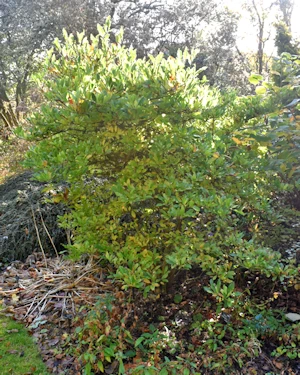 October 2024
 October 2024
Magnolia stellata Magnolia - after Pierre Magnol (1638–1715), a distinguished French botanist and the director of the Montpellier Botanic Garden; stellata: Latin, meaning with spreading rays or star-like, referencing the shape of the flowers; Waterlily is the cultivar name, referencing the similarity to nymphae flowers. water lily
Star magnolia
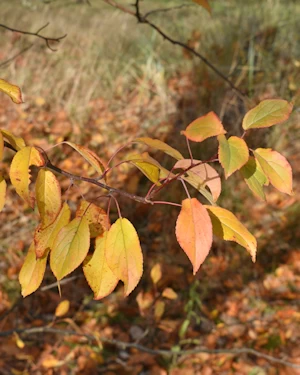
A slow-growing deciduous shrub or small tree growing to 2.5 m, native to Japan. It bears large, showy white or pink flowers in early spring, before its leaves open. Flower colour varies from white to rich pink. The flowers are star-shaped, with at least 12 thin, delicate petal-like tepals, some cultivars (such as water lily) having more than 30. Fruits are reddish-green, knobby, aggregate, about 5 cm long.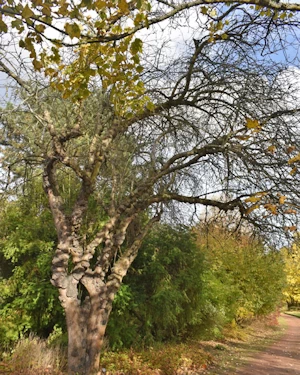 October 2024
 October 2024
 October 2024