×
![woodturning]()

Trees Gallery - St Andrews Botanic Gardens. Page 5
Fife, Scotland
 October 2024
 October 2024
 October 2024
Metasequoia - meta - changed or transformed; so the genus name means like a sequoia glyptostroboides - oides is a Greek suffix meaning resembling, so the tree resembles glyptostrobus, the Chinese swamp cypress (glypto - carved, grooved, strobus - cone).
Dawn redwood
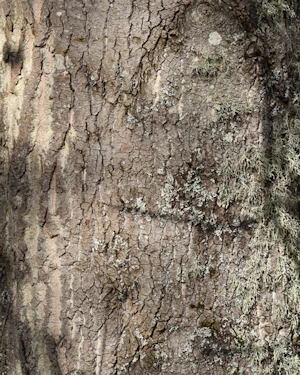
A vigorous, fast-growing deciduous conifer with fibrous, orange-brown bark, making a large, narrowly conical tree to 25m tall. The globose pollen cones are 5–6 mm long, produced on long spikes in early spring, but only on trees growing in regions with hot summers. Older trees may form wide buttresses on the lower trunk, and distinctive "armpits" under each branch. The bark is vertically fissured and tends to exfoliate in ribbon-like strips.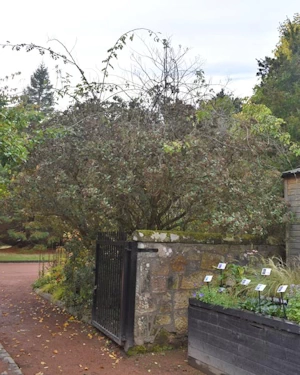 October 2024
 October 2024
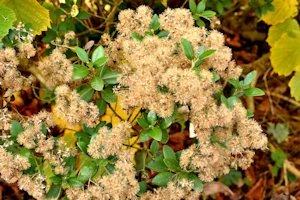
Olearia olearia, after Johann Gottfried Olearius (1635-1711), a 17th-century German scholar, theologian, and botanist; avicennii efers to the mangrove genus, folia: leaves, so together this means 'with leaves like those of the mangrove'"; paniculata: Latin meaning tuft or panicle, so 'having flowers arranged in panicles'. avicennifolia x paniculata
Mountain akeake hybrid
A hybrid. The first parent is a.k.a. Daisy bush, and is a small, bushy shrub or tree that grows up to 6 m, native to new Zealand. It has thin, papery bark and angular branchlets covered in white tomentum. Flowers are clustered and daisy-like with white rays and purple central disks. They emerge between November and February and have a sweet scent. They develop into fluffy seeds. The second parent is a small evergreen tree known as akeraho, again native to New Zealand, hasmany similar characteristics.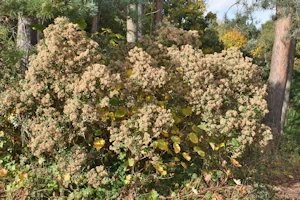 October 2024
 October 2024
Olearia haastii olearia, after Johann Gottfried Olearius (1635-1711), a 17th-century German scholar, theologian, and botanist; haastii - after Sir Julius von Haast (1822–1887), a German-born New Zealand geologist and explorer.
New Zealand daisy bush
A natural hybrid resulting from a cross between o. avicenniifolia and o. moschata, both native to New Zealand. A dense, bushy shrub with smooth, oval, evergreen leaves; dark green and glossy above, felted white below. Dense sprays of star-shaped, white flowers appear in mid to late summer.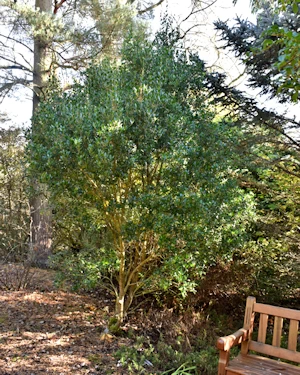 October 2024
 October 2024
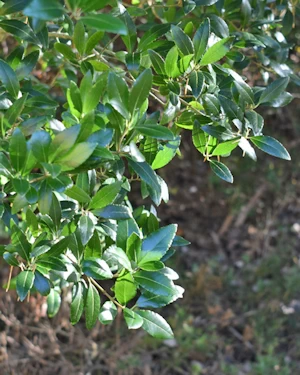
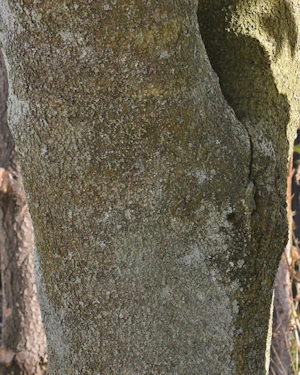
Osmanthus decorus osma - Greek meaning smell or fragrance anthos meaning "flower"; decorus: Latin meaning fitting, proper, or elegant, referring to the plant's regular habit.
Osmanthus
A.k.a phillyrea decora, and dunce cap.A rounded, dense, medium-sized evergreen shrub to a height of 3m, native to Caucasia. It has dark green, leathery oval-shaped leaves. In mid spring, numerous small clusters of highly scented, tubular white flowers appear. These are followed by small, oval, purplish-black drupes a fleshy fruit with thin skin and a central stone containing the seed that ripen in autumn. October 2024
 October 2024
 October 2024
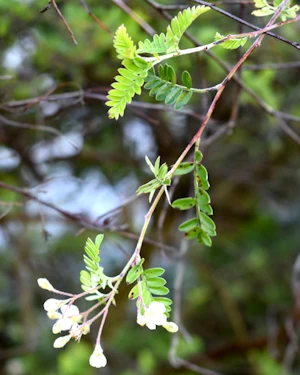
Osmanthus yunnanensis osma - Greek meaning smell or fragrance anthos meaning flower; yunnanensis - from the Chinese province of Yunnan.
Yunnan sweet olive
A.k.a Yunnan osmanthus or Chinese osmanthus, an evergreen shrub or small tree growing to 12 m, native to Yunnan and Sichuan in the far SW of China. In winter and spring, small clusters of creamy-white flowers in the leaf axils produce an intense fragrance. These are followed by egg-shaped fruit, dark purple with a white bloom. October 2024
 October 2024
Osteomeles schwerinaeOsteo: Greek meaning bone, meles meaning apple, referring to the very hard, bone-like texture of the fruit (pomes); schwerinae- probably after the German town of Schwerin; micro Greek meaning small and phylla meaning leaf. microphylla
Chinese emperor plum
An evergreen shrub growing to 2.5 m in the open, considerably more against a wall; a native of Yunnan and other parts of W. China. It has long, slender, flexible branchlets covered with short grey hairs. Leaves are pinnate, composed of eight and a half to fifteen and a half pairs of obovate leaflets. The fruits are edible and can be eaten raw or used to make jellies and jams. The fruits have a sweet flavor. It is grown in gardens as an ornamental plant. It is also used in bonsai.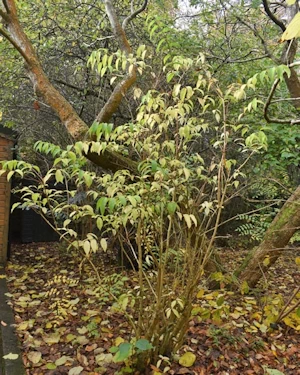 October 2024
 October 2024
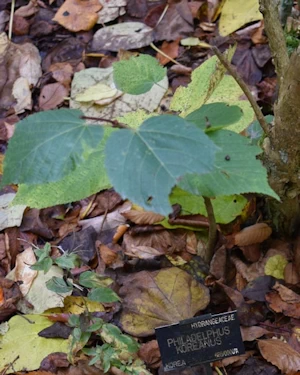
Philadelphus koreanus philadelphos from Greek, meaning loving one's brother or sister, or brotherly love. Possibly named in honour of Ptolemy II Philadelphus, a 3rd-century BCE Macedonian king of Egypt and a known patron of the arts and sciences; koreanus: from Korea.
Korean mock orange
A medium to large, multi-stemmed, deciduous shrub native to Korea. .It produces abundant, single, bowl-shaped, pure white flowers in late spring to early summer, typically in terminal clusters. It has a strong, sweet, citrus-like fragrance, similar to orange blossoms, The bark is dark brown, smooth, shiny, often exfoliating in thin strips with age.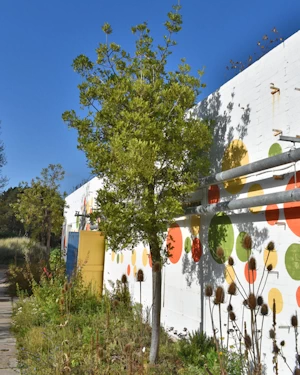 October 2024
 October 2024
Phyllocladusphyllon - Greek meaning leaf; Klados young shoot or branch; this describe leafy, photosynthetic stems; trichomanes - maidenhair ferns; oides Greek meaning resembling or like, so the tree has a similarity to ferns. trichomanoides
Celery pine
A.k.a. tānekaha pine, is a medium-sized forest tree growing to 25 m, native to New Zealand. The leaves are sparse, tiny, scale-like, 2–3 mm long, and only green (photosynthetic) for a short time, soon turning brown. Photosynthesis is performed by phylloclades, which are highly modified, leaf-like short shoots, arranged alternately, 10–15 on a shoot. The seed cones are berry-like, with a fleshy white aril surrounding but not fully enclosing the single seed. Like the kauri, tānekaha shed their lower branches, producing smooth straight trunks and knot-free timber which is sought after for its strength.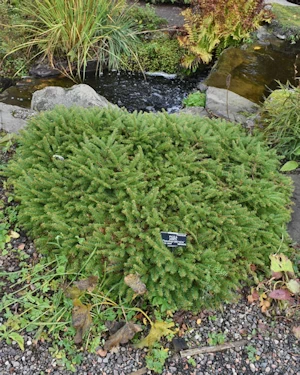 October 2024
Picea abies picea from the Latin word pix, meaning pitch or resin, referring to the tree's sticky resin; abies - fir, referring to the similarity to the abies genus; Pseudo Greek pseudēs, meaning false or deceptive; Prostrata Latin meaning prostrate or laying full length along the ground, so a dwarf plant, but not a truly prostrate specimen. pseudoprostrata
Dwarf Norway spruce
A wide-spreading, low-growing dwarf cultivar of the common Norway Spruce, characterized by its dense, wild-looking branches that stay close to the ground. A slow-growing evergreen conifer known for its broad, flat habit, unlike its towering, pyramidal parent species. It has the dark glossy green needles typical of Norway spruce.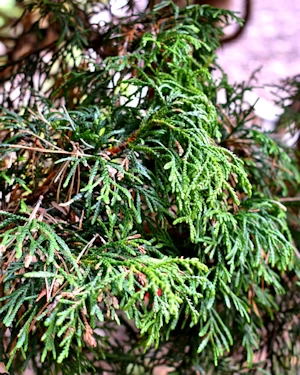 October 2024
 October 2024
Picea omorika Picea Latin pix meaning pitch or tar, referring to spruce resin; omorika is the native Serbian/Bosnian name for spruce, and symbolizes slenderness in local folklore, fitting the tree's graceful, narrow shape.
Serbian spruce
A.k.a. Pančić spruce, after the Serbian botanist Josif Pančić. A medium-sized evergreen coniferous tree growing to 20 m, native to W. Serbia, E Bosnia and Herzegovina. The two pictured here are the standard, upright conical version, and the drooping cultivar. The cones are 4–7 cm (2–3 in) long, fusiform, dark purple when young, maturing to dark brown, with stiff scales. Grown widely as an ornamental, it is also used as Christmas trees, timber and paper production, particularly in N.northern Europe, though its slow growth makes it less important than Sitka spruce or Norway spruce. [Wikipedia]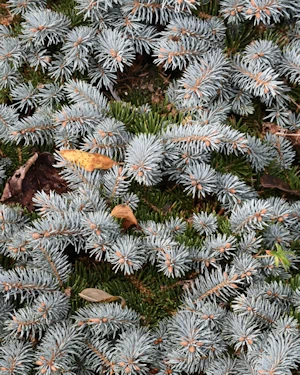 October 2024
Picea pungens Picea Latin pix meaning pitch or tar, referring to spruce resin; ; pungens Latin meaning sharply pointed, piercing, or prickly, escribes the tree's stiff, sharp, and often blue-tinged needles.
Blue spruce
A large conifer reaching 50 m in the wild, more often 18 m in cultivation. It has scaly grey-brown bark with a cinnamon-red undertone on its trunk. On older trees the bark becomes deeply furrowed and scaly. The narrow, needle-like, evergreen leaves are quite sharply pointed and may be dull green, blue, or pale white. Strobili pollen producing cones , develop throughout the crown, but are more common in the upper half. Purple-brown seed cones form at the top of the tree in May/June and release their mature seeds in the autumn of the same year, turning light brown as they mature. October 2024
 October 2024
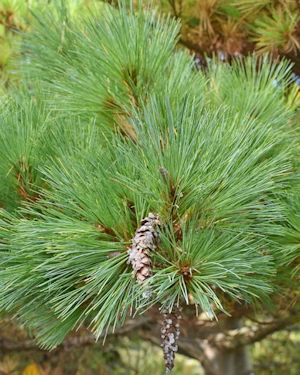
Pinus strobus Pinus Latin for pine; strobus from Greek meaning whirling, likely describing the shape or arrangement of its cones.
Eastern White Pine
A.k.a. Weymouth pine, northern white pine, white pine and soft pine, a large pine native to E North America. The seed cones are slender, 8–16 cm long and have scales with a rounded apex and slightly reflexed tip, often resinous. Branches are spaced every 45 cm on the trunk with 5-6 branches like spokes on a wagon wheel.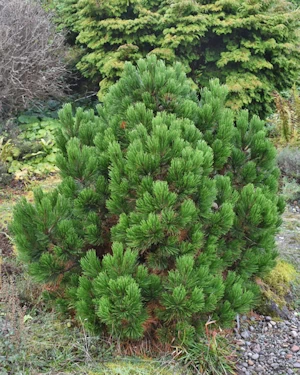 October 2024
 October 2024
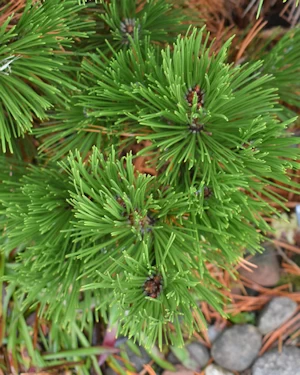
Pinus leucodermis Pinus Latin for pine; leuco Greek meaning white or pale, dermis meaning skin or bark, referring to the distinctive ash-grey to whitish bark of the mature tree. Schmidtii - after Eugen Smidt, a Czech who discovered the original old, compact specimen growing in the mountains near Sarajevo, Bosnia, in 1926. Schmidt
Bosnian pine 'Schmidt'
A.k.a. Pinus heldreichii. A very slow-growing conifer forming a broadly ovoid dwarf shrub with rigid, deep green needles. The species has distinctive bark that becomes grey-brown and deeply grooved into scale-like plates as it ages, often described as snakeskin crocodile-skin texture. While the dwarf cultivar may not develop this mature bark quality due to its small size, it will still produce small cones that emerge a striking blue-purple color before ripening to a pale brown.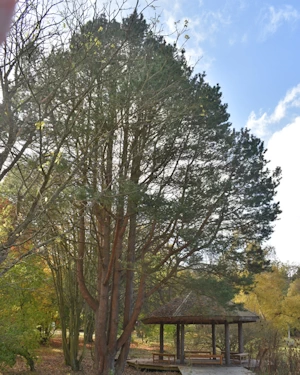 October 2024
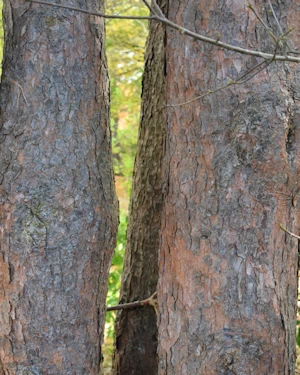 October 2024
Pinus mugo pinus - Latin for pine, (pitu - resin); mugo - an old Tyrolese name, likely referring to a diminutive of musk, implying an aromatic or mossy quality
Dwarf mountain pine
. A.k.a. mountain pine, scrub mountain pine, Swiss mountain pine, bog pine, creeping pine, or mugo pine. A small, slow-growing, evergreen, often multi stemmed, tree, native to S and E Alps and the Balkan peninsula, capable of reaching 3–6 m. It has matt-textured, thin-scaled nut-brown symmetrical cones.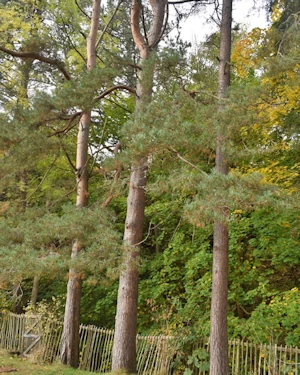 October 2024
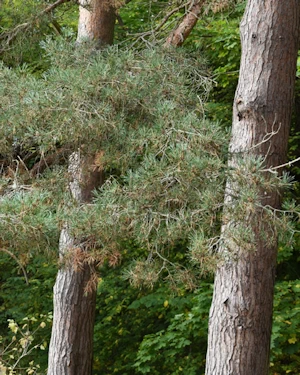 October 2024
Pinus sylvestris pinus- Latin for pine silva - woodland or forest, reflecting the tree's habitat.
Scots pine
An evergreen conifer native to northern Europe. Mature trees grow to 35m and can live for up to 700 years. The needle-like leaves are blue-green and slightly twisted, and grow in pairs on short side shoots. Scots pine is monoecious both male and female flowers grow on the same tree. Male flowers comprise clusters of yellow anthers at the base of shoots. Female flowers are small, red-purple and globular, and grow at the tips of new shoots. [Woodland Trust]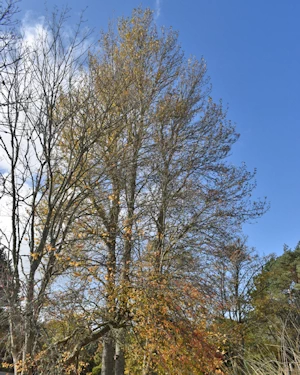 October 2024
 October 2024
 October 2024