×
![woodturning]()

Trees Gallery - St Andrews Botanic Gardens. Page 7
Fife, Scotland
 October 2024
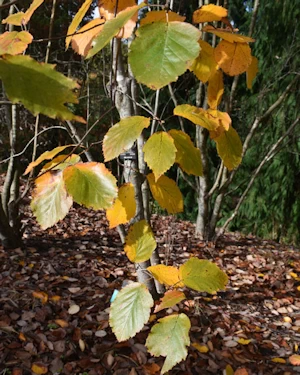 October 2024
 October 2024
Sorbus devoniensis Sorbus - Latin meaning red or reddish-brown, referring to the berries; devoniensis - of Devon (ensis means of a place), referring to the location where the tree is found: mainly in SW England particularly Devon.
Devon whitebeam
A.k.a. French Hales or Hails, a corruption of the French word alise (service tree fruit), and broad-leaved Whitebeam, a medium sized tree, reaching up to 13 m. A hybrid between s. torminalis (Wild Service Tree) and s. aria (Common Whitebeam). . The flowers are creamy-white clusters (umbels) blooming in late spring.These turn into rounded, orange-brown berries that ripen to a russet-red, becoming soft and edible (medlar-like) in autumn.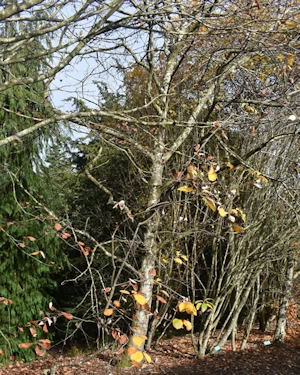 October 2024
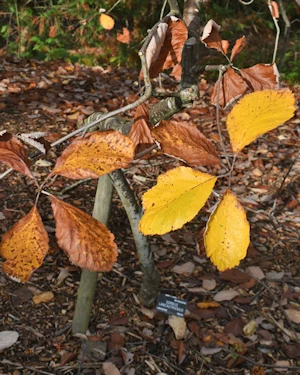 October 2024
Sorbus lancastriensis Sorbus - Latin meaning red or reddish-brown, referring to the berries; devoniensis - of Devon (ensis means of a place), referring to the location where the tree is found: mainly in SW England particularly Devon.
Lancashire whitebeam
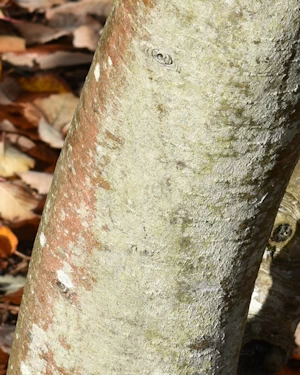
A.k.a. aria lancastriensis, and Lancastrian mountain ash, it grows only in a small area north of Morecambe Bay in Lancashire and Cumbria. A deciduous shrub or small tree growing to 6 m. Creamy white blossom in spring is followed by bright orange-red berries.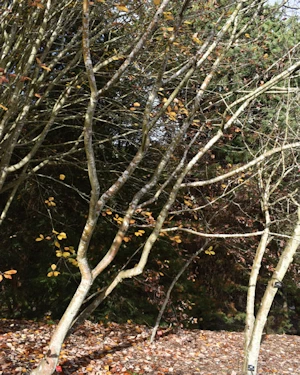 October 2024
 October 2024
Sorbus minima Sorbus - Latin meaning red or reddish-brown, referring to the berries; minima: from Latin minimus, meaning least or smallest, referring to the plant's size.
Lesser whitebeam
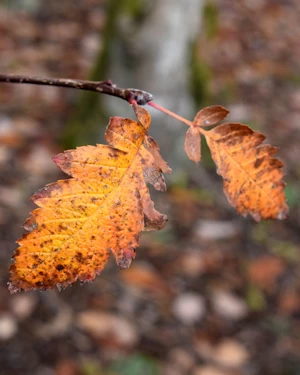
A.k.a. Hedlundia minima, and least whitebeam, a deciduous shrub in the rose family Rosaceae. It belongs to the genus Hedlundia, which includes species that have arisen from a hybridisation between members of the genus Sorbus (rowans) and members of genus Aria (whitebeams). It is an apomictic asexual development of seed or embryo without fertilization microspecies endemic to Wales. Probably a hybrid between the rock whitebeam (A. rupicola) and the rowan (S. aucuparia). It is a slender, deciduous shrub which can reach 3 m. The leaves are 6–8 centimetres long and are fairly narrow and oval in shape, acutely pointed at the tip and base. Flowers are produced in May and June and their white petals are 4 mm long. The red berries are 6–8 mm diameter.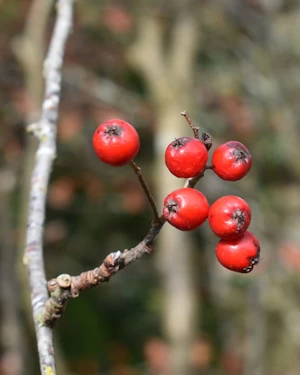 October 2024
 October 2024
 October 2024
Sorbus pseudofennica from Greek: sorbus - service tree; pseudofennica - false Finnish, as it resembles a sorbus native to Finland
Arran service-tree
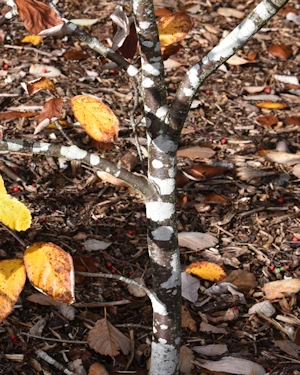
A.k.a. Hedlundia pseudofennica the taxonomy has been updated, with S. pseudofennica now classified within the newly created genus Hedlundia. and Arran cut-leaved whitebeam, a rare tree endemic to the Isle of Arran in Scotland, threatened by habitat loss. It is thought to be a naturally occurring hybrid between H. arranensis and Sorbus aucuparia. Hedlundia arranensis is itself a hybrid between Aria rupicola and sorbus aucuparia. Apomixis asexual development of seed or embryo without fertilization and hybridisation are common in some groups of sorbus species. There are at least two of these trees in the Garden, one labelled Hedlundia pseudofennica, the other sorbus pseudofennica. October 2024
 October 2024
 October 2024
Sorbus rupicola from Greek: sorbus - service tree; rupicola - from Latin rupes meaning rock and cola meaning dweller, inhabitant, indicating it grows on rocks.
Rock whitebeam
This deciduous tree or woody shrub clings to areas of rocky woodland and fissures in limestone cliffs. A parent species of the rarer Arran whitebeam, the rock whitebeam is becoming increasingly hard to find. It has upright stems and oval, serrated mid-green leaves. It can reach 10m high. Flowers are white, 12–16mm diameter and grow in loose clusters in June to July, similar to those of rowan but larger. These are followed by deep red berries, 12–15 mm in diameter, broader than long, with numerous lenticels holes that allow internal gases to escape scattered over the surface. The berries fruit from September to November. October 2024
 October 2024
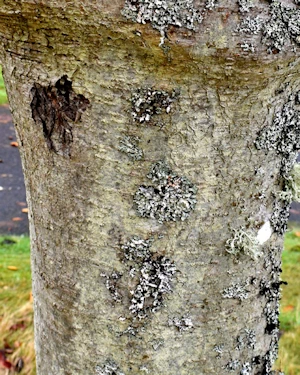 October 2024
Sorbus sargentiana from Greek: sorbus - service tree or rowan; sargentiana - after American dendrologist Charles Sprague Sargent (1841-1927).
Sargent's rowan
A small to medium-sized deciduous tree growing to 16 m, native to SW China, where it grows at altitudes of over 2000 m. It is (20–52 ft) tall, with a trunk up to 50 cm (20 in) in diameter, and a rounded crown. The flowers are 5–7 mm in diameter, with five white petals and 20 yellowish-white stamens, produced in very large corymbs a type of inflorescence in which the lower flowers have longer pedicels than the upper ones, creating a flat-topped appearance. in late spring to early summer. The fruit is a small pome a fruit consisting of a fleshy enlarged receptacle and a tough central core containing the seeds, e.g. an apple, pear, quince, rowan. , bright orange-red to red, maturing in early autumn; it is juicy, and readily eaten by thrushes, which disperse the seeds.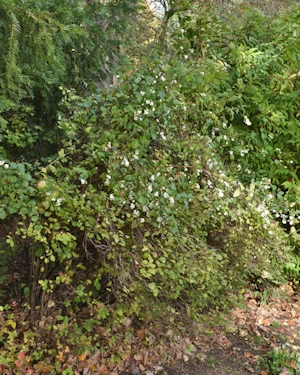 October 2024
 October 2024
Symphoricarpus albus from Greek symphorein meaning to bear together and karpos meaning fruit, describing its clustered berries; albus Latin for white, referring to the berries.
Snowberry
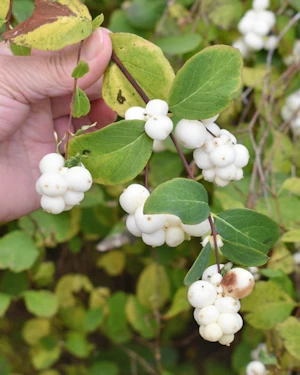
An erect, deciduous shrub, reaching 1–2 m high, producing a stiff, branching main stem and several smaller shoots from a rhizome. It can be invasive, spreading and colonizing an area to form a dense thicket. The inflorescence is a raceme of up to 16 flowers. Each flower has a small, five-toothed calyx of sepals. The bell-shaped, rounded corolla is bright pink in colour. It has pointed lobes at the mouth and the inside is filled with white hairs. The fruit is a fleshy white berry-like drupe a fleshy fruit with thin skin and a central stone containing the seed .The plant sometimes reproduces via seed but it is primarily vegetative, reproducing by sprouting from its spreading rhizome.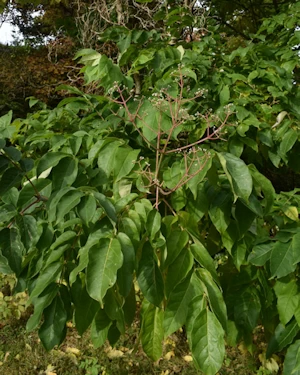 October 2024
 October 2024
Tetradium daniellii tetra from Greek meaning four, adion Latin, parts; daniellii: after William Freeman Daniell (1818–1865), a British army surgeon and botanist who served in West Africa.
Bee-bee tree
A.k.a. Korean evodia,a native to Korea and SW China. A small tree reaching 20 m, and having pinnate leaves with 7-11 leaflets. Scented white flowers of 3-4mm are borne in corymbs a type of inflorescence in which the lower flowers have longer pedicels than the upper ones, creating a flat-topped appearance which are highly attractive to bees, hence the common name bee tree. Small red seed pods, each with a distinct hooked beak, are produced in late summer. When ripe these will split to reveal two glossy black seeds, which are a favourite with birds [Cambridge Botanic Garden].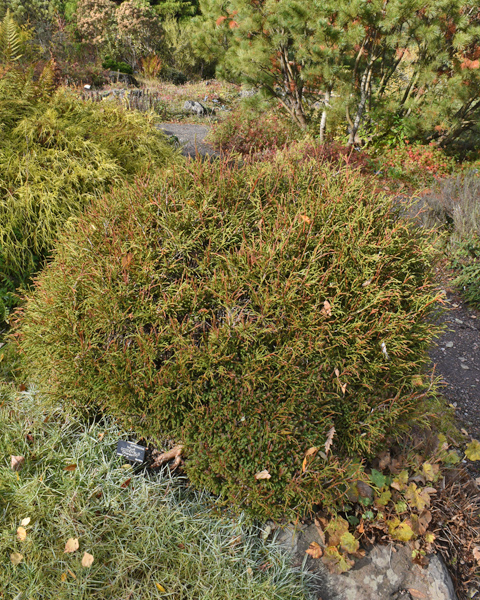 October 2024
 October 2024
Thuja occidentalis: from Greek thyia meaning sacrifice or burnt offering, possibly relating to burning of the resin as incense; occidentalis Latin meaning western; Ohlendorff, after a German nurseryman from Hamburg, Johann Heinrich Ohlendorff (1788–1857) Ohlendorffii
Ohlendorff's American Arborvitae
A slow-growing, dwarf evergreen conifer, with dense, mounding form, irregular upright habit, and unique thread-like, juvenile foliage that is chocolate-green, turning reddish in winter. Capable of growing to 3 m if not pruned. October 2024
 October 2024
 October 2024
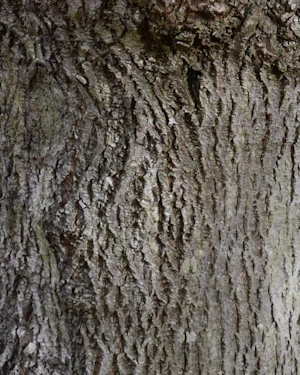
Tilia platyphyllos Tilia Latin word for lime/linden tree; platys Grek meaning broad, phyllon meaning leaf.
Large leaved lime
A narrowly domed tree possibly reaching 40 m, though more typically 25 m. The small, fragrant, yellowish-white flowers are arranged in drooping, cymose a cyme is a flower cluster with a flat or round top, the central flower blooms first, followed by the peripheral flowers. Each flower stalk ends in a single flower clusters in groups of 3 to 4. Their whitish-green, leaf-like bracts have an oblong-obovate shape. The fruit is a round greenish-grey nutlet, with a woody shell. October 2024
 October 2024
 October 2024
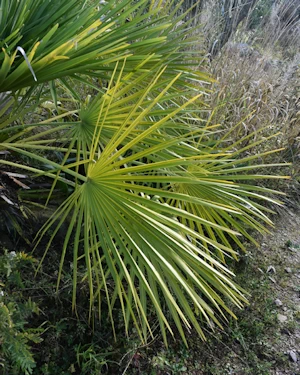
Trachycarpus fortunei from Greek trachys, rough, and karpos, fruit, referring to the fibrous, rough trunk of the palm; fortunei, after Scottish horticulturist Robert Fortune (1812 - 1880).
Windmill palm
Also called the Chusan palm, native to subtropical and temperate mountain forests of China, Japan, Myanmar and India where it typically grows to 12-20m. One of the hardiest of the palms, cultivated for its coarse but strong leaf sheath fibre, used for making rope, sacks, and other coarse cloth where strength is important.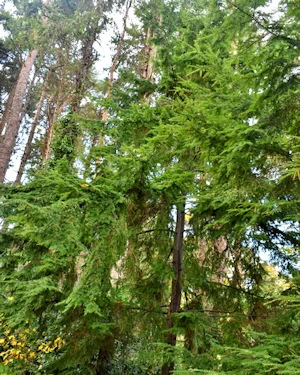 October 2024
 October 2024
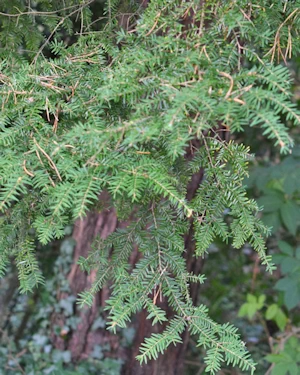
Tsuga heterophylla hetero - different or varied, phylla - leaves; referring to the different lengths of needles on a single branch.
Western hemlock
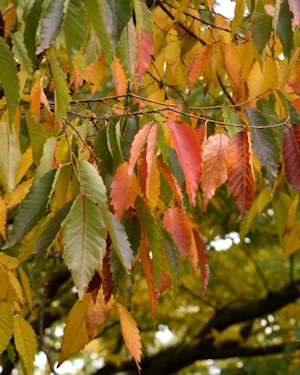
A noticeboard by the tree says: Western Hemlock is native to the western parts of the USA and Canada. If it often a dominant species, forming extensive forests, but it also occurs with Douglas Fir (Pseudotsuga menziesii) and Sitka Spruce (Picea sitchensis) – both well known conifer species which are cornerstones of UK forestry. Western Hemlock is widely used for timber and for paper pulp. This stately tree can reach 60m in height. Needles grow on a short stalk, are of different lengths, and have rounded tips. The small cones help to distinguish it from Douglas Fir and Sitka Spruce. The small trees growing here were not planted and have all seeded from an older tree. Western Hemlock can regenerate easily in shade, including under an existing canopy. The seed can germinate on existing substrates, such as leaf mould, needle duff, old stumps or fallen tree trunks. This can give it a competitive advantage over trees which need bare soil and also be beneficial for foresters. However, it can be problematic if it allows it to invade valuable natural habitats such as Scots pine forest or native broadleaf woodland. Western Hemlock is the state tree of Washington, USA.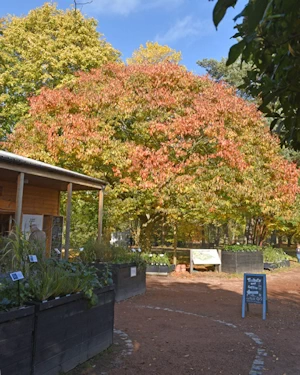 October 2024
 October 2024
 October 2024