×
![woodturning]()

Trees Gallery - St Andrews Botanic Gardens. Page 3
Fife, Scotland
 October 2024
 October 2024
 October 2024
 October 2024
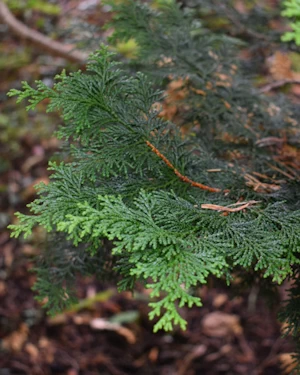
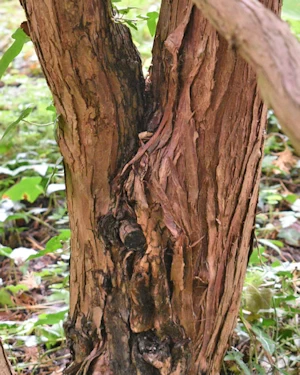
Chamaecyparis obtusa chamaecyparis: derived from the Greek words chamae - 'on the earth' or 'dwarf' and kyparissos - cypress; obtusa: Latin for blunt or obtuse, referring to the blunt tips of the leaves; flabelliformis: from Latin flabellum, fan, and formis, shaped, describing the plant's distinctive, flattened, fan-like sprays of foliage flabelliformis
Hinoki False cypress
This is a dwarf, slow-growing cultivar of the Japanese Hinoki false cypress, known for its dense, irregularly globose shape and fan-like sprays of slightly bluish-green foliage. It grows only a few cm per year, reaching a height of perhaps 1.8 m in 50 years.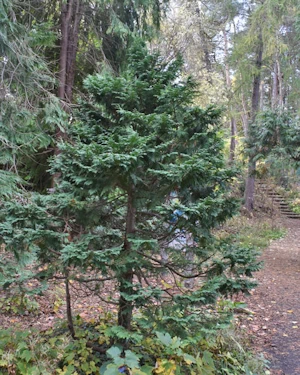 October 2024
 October 2024
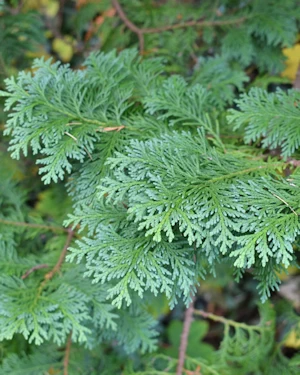
Chamaecyparis obtusa chamaecyparis: derived from the Greek words chamae - 'on the earth' or 'dwarf' and kyparissos - cypress; obtusa: Latin for blunt or obtuse, referring to the blunt tips of the leaves; nana: from Latin meaning dwarf or small nana
Hinoki False cypress
This cultivar is very slow-growing and after 10 years may only reach 20 cm inches tall, although it eventually will reach 90 cm. Dark-green foliage forms twisting, fan-shaped branchlets in dense, tiered layers and have a sweet fragrance when crushed. At maturity, it forms a compact, flattened globe with horizontal branches.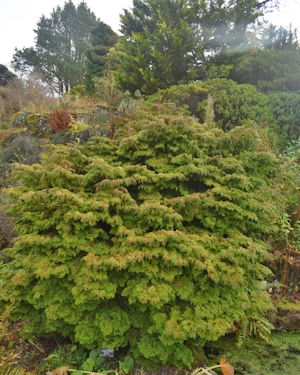 October 2024
 October 2024
Chamaecyparis obtusa chamaecyparis: derived from the Greek words chamae - 'on the earth' or 'dwarf' and kyparissos - cypress; obtusa: Latin for blunt or obtuse, referring to the blunt tips of the leaves; pygmaea: from Latin meaning dwarf or small pygmaea
Hinoki cypress 'Pygmaea'
A dwarf evergreen conifer with a globose, spreading habit, reddish-brown stems and fan-shaped bronze-green foliage which becomes darker in cooler conditions or during the winter. Growth rate: It is a very slow grower, adding about 5 - 7 cm per year. After 10 years it might be 60 - 90 cm.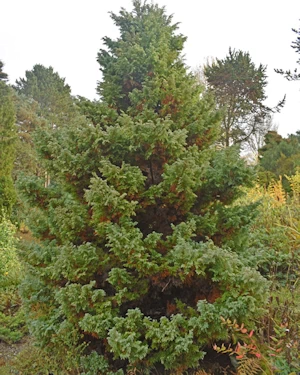 October 2024
 October 2024
Chamaecyparis pisifera chamaecyparis: derived from the Greek words chamae - 'on the earth' or 'dwarf' and kyparissos - cypress; pisifera: from Latin pissum, meaning pea, and ferre, meaning to bear. This refers to the very small, rounded, pea-sized cones; Boulevard: The cultivar was discovered as a sport of c. pisifera squarrosa at Boulevard Nursery, Newport, Rhode Island, in 1934. Boulevard
Sawara cypress 'Boulevard'
A dense, slow-growing evergreen conifer forming a large, conical shrub to 8m, with soft, silvery blue-grey foliage, often tinged purple in winter.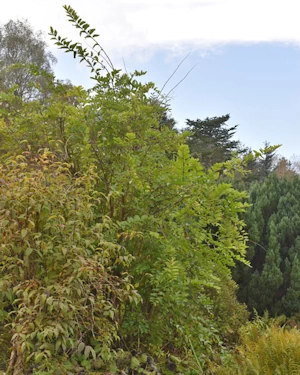 October 2024
 October 2024
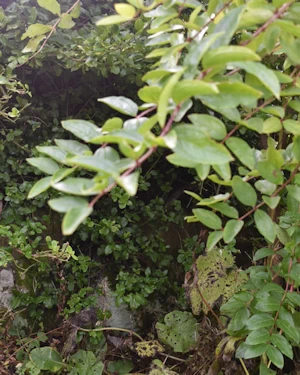
Coriaria nepalensis Coriaria - from Latin corium meaning leather, referring to the plant's high tannin content; nepalensis indicates that it was found (by N. Wallich in 1832) in Nepal.
Masuri berry
A.k.a. tanner's tree, mansur shrub and macchaino (Nepalese). It is a shrub that grows in the foothills of the Himalayas growing to 2.5 m. It blooms in spring and has bright yellow flowers and red to dark purple fruits in summer, which resemble berries but are actually achenes a type of simple dry fruit produced by many species of flowering plants. Achenes are monocarpellate (formed from one carpel) and indehiscent (they do not open at maturity). Achenes contain a single seed that nearly fills the pericarp, but does not adhere to it. In many species, what is called the "seed" is an achene, a fruit containing the seed. protected by enlarged coloured petals.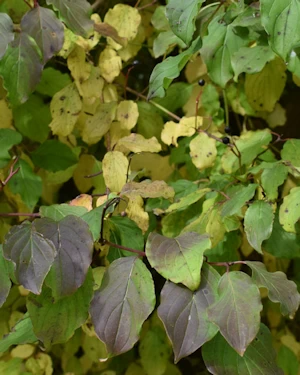 October 2024
 October 2024
Cornus australis cornus: Latin for the cornel tree, meaning 'horn'. australis: Latin, meaning 'southern'.
Southern dogwood
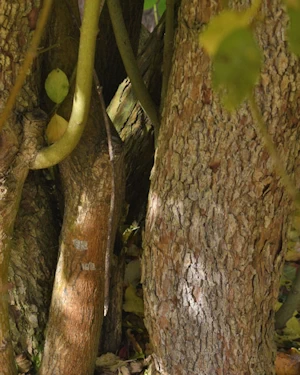
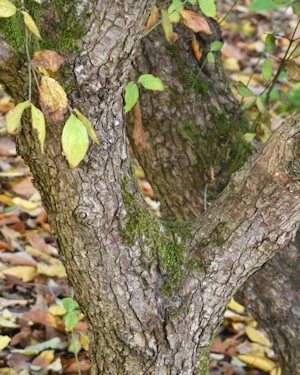
A.k.a. Black Sea dogwood. A deciduous shrub growing up to 4 m. The flowers are white, in dense terminal clusters about 5 cm across. It is native to W. Asia, and has been in cultivation since 1915. It is very hardy, but its only claim to special notice is in its red foliage in autumn.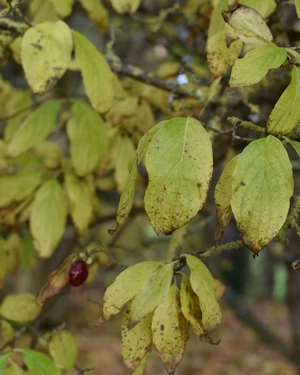 October 2024
 October 2024
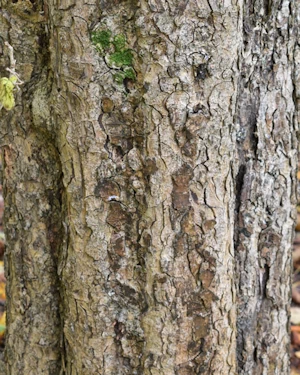
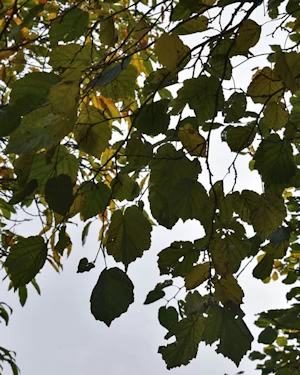
Cornus mas cornus: Latin for the cornel tree, meaning 'horn'. mas: Latin, meaning 'male', to distinguish it from c. sanguinea, which was called the female or wild cornel.
Cornelian cherry from the cherry-like fruit and its colour, which resembles the semi-precious gemstone carnelian (or cornelian).
A.k.a. European cornel or Cornelian cherry dogwood, a medium to large deciduous shrub or small tree native to W Europe, S Europe, and SW Asia, growing to 5 - 12 m. It has dark brown branches and greenish twigs. The flowers are small with four yellow petals, produced in clusters of 10 - 25 in the late winter (between February and March in the UK), well before the leaves appear. The fruit is an oblong red drupe a fleshy fruit with thin skin and a central stone containing the seed 2 cm long containing a single seed.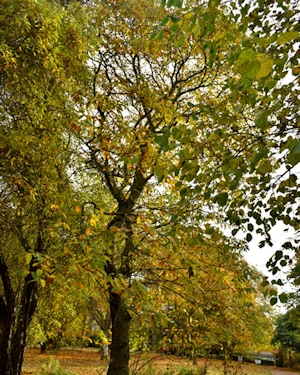 October 2024
 October 2024
 October 2024
Corylus Colurna Greek Korylos -hazelnut Colurna - Latinised name of the Turkish hazel
Turkish hazel
This is a true hazel, bearing nuts not unlike our British cobs - but smaller and lacking their taste - and surrounded by a softly spiny husk. Native across SE Europe and into W Asia, it is indeed found in Turkey. Its characteristic pendulous yellow catkins appear in late winter, with the nuts maturing in autumn as the leaves fade to a lustrous yellow. Its elegant conical shape and thick corky bark are features that can be admired year round. Although its nuts are inferior, Turkish hazel is important to commercial hazelnut production. Its non-suckering habit makes it an ideal rootstock for orchards, onto which to graft the common hazel cultivars. October 2024
 October 2024
Cotinus coggygria - from Greek kotinus, wild olive. kokkugia, smoke tree purpurea - purple, referring to the leaves
Smoke bush
The species is a.k.a. Rhus cotinus, European smoketree, Eurasian smoketree, smoke tree, Venetian sumach, or dyer's sumach. It is a multiple-branching deciduous shrub growing to 5 - 7 m with an open, spreading, irregular habit, only rarely forming a small tree. Royal purple is a popular cultivar developed for its deep purple leaves. Large feathery, pink inflorescences in summer. Most of the flowers in each inflorescence abort, elongating into yellowish-pink to pinkish-purple feathery plumes (when viewed en masse these have a wispy 'smoke-like' appearance, hence the common name).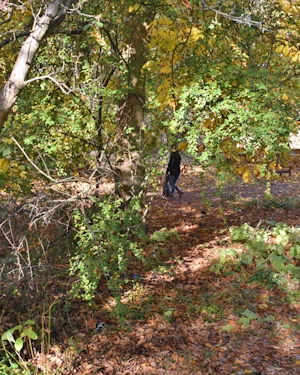 October 2024
 October 2024
Cotoneaster armenus Cotoneaster: from Latin cotoneum, quince fruit; aster: meaning resembling or partially like. Probably because the leaves of some species resemble those of the quince plant; armenus: from Armenia - where the species was first identified
Armenian cotoneaster
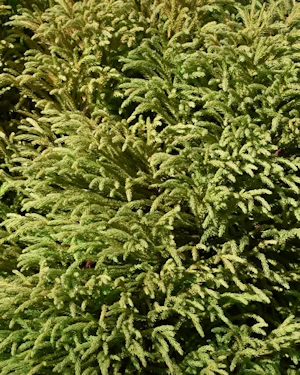
An evergreen or semi-evergreen shrub. Like many cotoneasters, it features clusters of small flowers in spring and summer, followed by showy red berries in autumn and winter. The plant is native to a region spanning from NE Turkey to NW Iran. Like other species in its genus, it has the potential to become an invasive non-native species.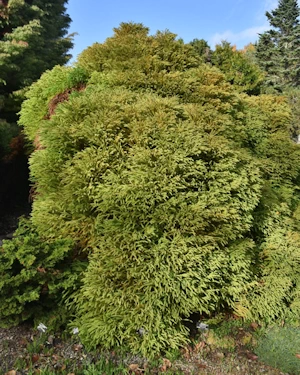 October 2024
 October 2024
Cryptomeria japonica Cryptomeria: From Greek krypto meaning hidden; meris meaning part, referring to the reproductive structures being concealed; japonica: - Japanese; Globosa Latin for globe, describing the plant's dense, dome-like shape; Nana: Latin for dwarf, indicating its slow-growing, compact size globosa nana
Dwarf Japanese cedar
An evergreen dwarf conifer forming a dense, dome-shaped plant with rich green awl-shaped leaves closely appressed to the shoots. The soft, needle-like foliage turns bronze in winter.. October 2024
 October 2024
Diervillia splendensDiervilla: after Dr. Marin Diereville, a French surgeon and botanist. splendens: Latin meaning splendid or shining, referring to the plant's attractive appearance, particularly its colourful foliage and flowers.
Bush honeysuckle
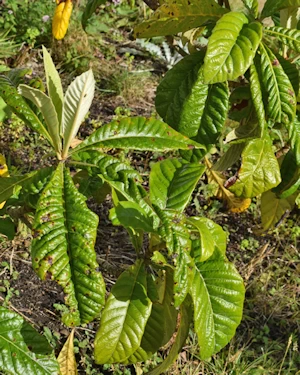
Diervilla splendens is a hybrid cross between D. sessilifolia and D. lonicera that originated in European cultivation in the mid-19th century. The common name that refers to the resemblance of its flowers to those of the lonicera genus, but the two genera are distinct. It has bright, yellow, trumpet-shaped flowers that bloom from early summer to autumn, and its foliage that turns vibrant colours in autumn.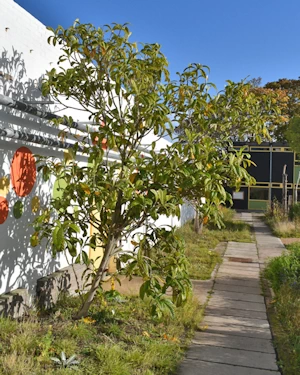 October 2024
 October 2024
Eriobotrya japonica eriobotrya from Greek erion wool and botrys, bunch of grapes, describing the plant's woolly flower clusters; Japonica" - Japanese, referring to its extensive cultivation and association with Japan, although it is originally from China.
Loquat
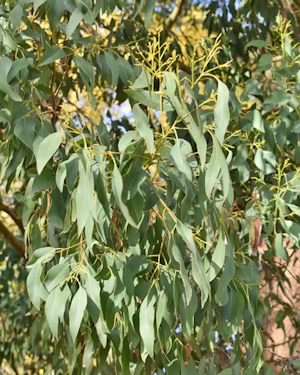
A.k.a. Japanes medlar or Japanese plum. It is native to S China, but has been grown in Japan for over 1,000 years. A large, evergreen shrub or small tree, with a rounded crown, short trunk, and woolly new twigs. The tree can grow to 10 m but is often smaller. Loquats are unusual among fruit trees in that the flowers appear in the autumn or early winter, and the fruits are ripe at any time from early spring to early summer. The flowers have a sweet, heady aroma. Oval, rounded or pear-shaped fruits grow in clusters, with a smooth or downy, yellow or orange, sometimes red-blushed skin.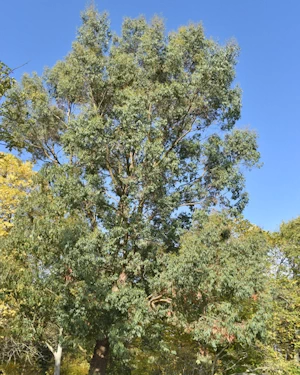 October 2024
 October 2024
 October 2024
Eucalyptus - Eucalyptus from Greek eu, meaning well, and kalyptos, meaning covered. This refers to the cap that covers the flower buds, which is shed when the flower opens; dalrympleana: after Richard Dalrymple-Hay, the first Commissioner of Forests in New South Wales, appointed in 1895. Dalrympleana
Mountain gum
A.k.a. white gum and broad-leaved ribbon gum, growing to 40m, a native of SE Australia. It has smooth bark, lance-shaped adult leaves, flower buds in groups of three or seven, white flowers and cup-shaped, bell-shaped or hemispherical fruit. The flower buds are arranged in groups of three or seven in leaf axils on a peduncle 3 - 12 mm long, the individual buds sessile or on a pedicel up to 3 mm long. Mature buds are oval, green to yellow, with a conical to rounded operculum a cap-like structure in some flowering plants, mosses, and fungi . White flowers occurs between March and June. The fruit is a woody cup-shaped, bell-shaped or hemispherical capsule 3 - 8 mm long.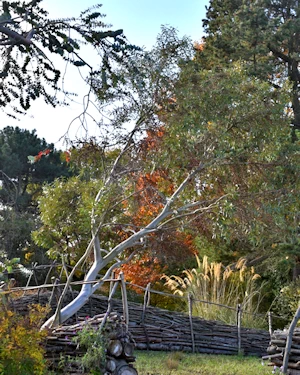 October 2024
 October 2024
Eucalyptus - Eucalyptus from Greek eu, meaning well, and kalyptos, meaning covered. This refers to the cap that covers the flower buds, which is shed when the flower opens; moorei: After Charles Moore, (1820 - 1905), director of the Royal Botanic Gardens, Sydney. moorei
Narrow-leaved sally
A a species of mallee that typically grows to a height of 6 - 10 m, native to New South Wales. It has smooth bark, linear to narrow lance-shaped or curved adult leaves, flower buds in groups of between seven and fifteen, white flowers and cup-shaped or shortened spherical fruit. Eucalyptus moorei is a mallee (20 - 33 ft) and forms a lignotuber. Adult leaves are alternate, linear to narrow lance-shaped or curved, the same glossy green on both sides, 3 - 9 cm. The flower buds are arranged in clusters of between 7 and 15 in leaf axils on an unbranched peduncle. Mature buds are top-shaped, with a conical to horn-shaped operculum a cap-like structure in some flowering plants, mosses, and fungi . White flowers appear between February and May. The fruit is a woody cup-shaped or shortened spherical capsule.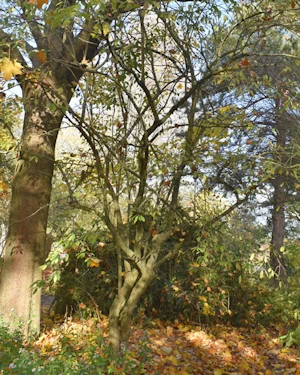 October 2024
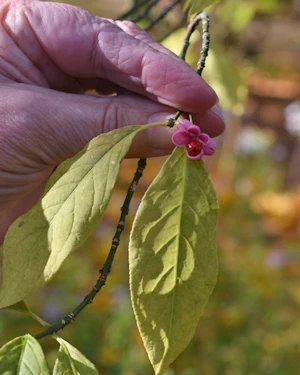 October 2024
 October 2024
Euonymous Euonymous: from Greek words eu, meaning good or lucky, and onoma (or nymus), meaning name. Possibly ironic, as all parts of the plant are poisonous if ingested. hamiltonianus: after Francis Buchanan-Hamilton (1762-1829), a Scottish physician and botanist who worked in India. lance meaning lance or spear; folius, meaning leaf. Hamiltonianus lanceifolia
Hamilton's spindle tree
A.k.a. Himalayan spindle, and Siebold's spindle. It is native to Asia, where it is distributed in Afghanistan, Russia, China, Japan, Korea, India, Nepal, Pakistan, Bhutan, Thailand, and Myanmar. In the wild, it may grow to be a shrub of 3 m or a tree up to 20 m. The The inflorescence is a cymose a cyme is a flower cluster with a flat or round top, the central flower blooms first, followed by the peripheral flowers. Each flower stalk ends in a single flower cluster of several white flowers, each nearly a centimeter wide. The brown, yellowish, or reddish fruit capsule splits into four sections holding brown seeds with orange arils.Home |
Latest additions |
Tree list |
Gardening |
Woodland |
Contact |
Oldfern woodturning
Links: oldfern Facebook page |
Ryedale Woodturners |
Ancient Tree Inventory |
Tree Register |
Woodland Trust |
The Wood Database
Woodlands.co.uk |
International Wood Collectors Society |
Tree and flower identification guide
Plant Atlas 2020 (BSBI)
Trees and shrubs online
The Conifer Society (American)
North East Fungus Study Group