×
![woodturning]()

Trees gallery - Logan Botanic Garden - page 1
Galloway
 September 2025
 September 2025
Acacia acacia - from Greek akis, a sharp point or thorn; baileyana - after Frederick Manson Bailey (1827 - 1915), a British-born Australian botanist who collected the specimen. bayleyana
Cootamundra wattle
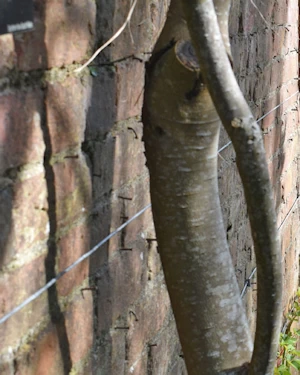
A small tree up to 10 m native to Cootamundra, New South Wales. The cultivar, A. baileyana 'Purpurea', has distinct deep purple to blue-grey young foliage. It has tiny, bright yellow to golden flowers in dense, fluffy, spherical racemes, heavily blooming between June and September in Australia (winter/early spring).B It has mooth, grey or brown bark and the fruits are leathery, flat brown pods up to 10 cm long.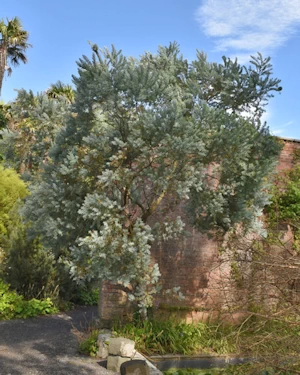 September 2025
 September 2025
 September 2025
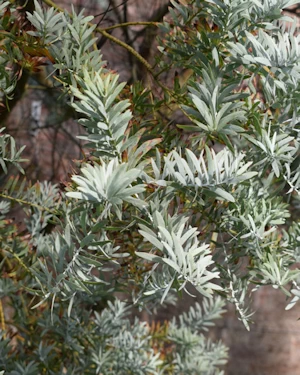
Acacia covenyi acacia - from Greek akakia meaning a point or thorn, referring to the sharp thorns of African acacia species; covenyi - after Robert George "Bob" Coveny (born 1943), a dedicated botanical collector and technical officer at the Royal Botanic Gardens in Sydney.
Blue bush wattle
A shrub or small tree native to New South Wales, Australia, growing to 7 m. The "leaves" are actually flattened, modified stems known as phyllodes modified petioles or leaf stems, which are leaf-like in appearance and function. In some plants, these become flattened and widened, while the leaf itself becomes reduced or vanishes altogether. Thus the phyllode comes to serve the purpose of the leaf. . They are narrow, elliptic, bluish-grey or glaucous colour. Flowers are profuse, luminous, fragrant mimosa-like, in spherical, bright yellow heads arranged in axillary racemes growing from an axil (the angle between the upper side of a leaf or stem and the supporting stem or branch), a flower cluster with the separate flowers attached by short equal stalks at equal distances along a central stem. The flowers at the base of the central stem develop first. These are followed by flat, papery pods that have a powdery coating, up to 7 cm long.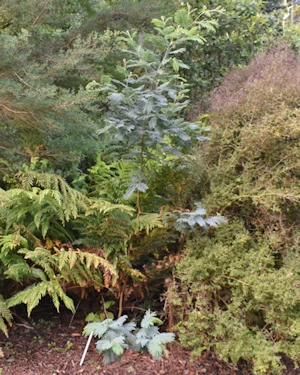 September 2025
 September 2025
Acer palmatum acacia - from Greek akakia meaning a point or thorn, referring to the sharp thorns of African acacia species; dealbata - from Latin meaning bleached or whitewashed, referring to the tree's distinctive greyish-green or silvery-blue fern-like foliage and the white, powdery bloom often seen on the young branches and seed pods
Silver wattle
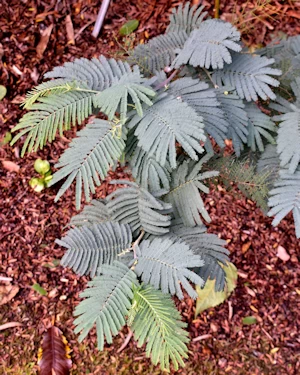
A.k.a. mimosa, a fast-growing, evergreen tree or shrub native to SE Australia. It has fern-like, silvery-blue foliage and fragrant, bright yellow pom-pom flowers, blooming from late winter to early spring. Masses of highly fragrant, bright yellow, spherical flower heads are grouped in showy clusters (racemes). It acts as a rapid pioneer species, fixing nitrogen in the soil.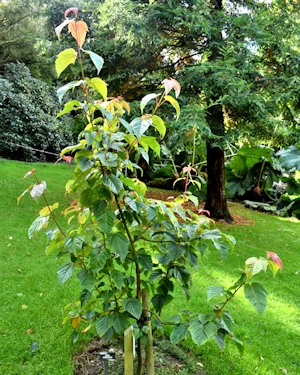 September 2025
 September 2025
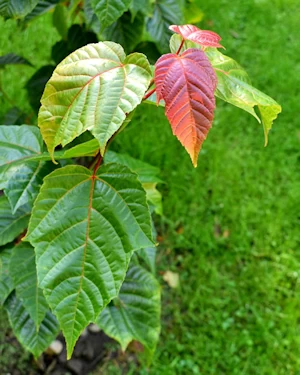
Acer davidii acer - from Latin for maple; davidii after Armand David (Père David, 1826 - 1900), who documented the tree on his travels through China. affinis
Pere David's Maple
A young tree planted in 2024. The affinis suffix indiates a tree similar to acer davidii, though subtly different, not yet classified as a separate group. It certainly has similar leaf shape. September 2025
 September 2025
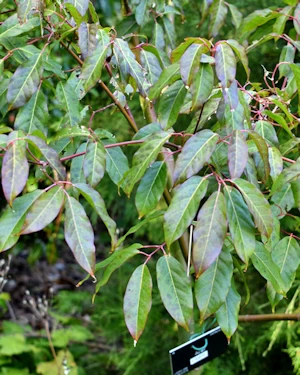
Acer fabri acer - maple; fabri - after Reverend Ernst Faber (1839 - 1899), a German missionary and botanist who collected the original specimens in China.
Faber's maple
A.k.a. Emerald Jade Maple, an evergreen small tree or large shrub, native to Asia, reaching 6 - 9 m. It has slender, unlobed, glossy leaves and striking reddish new growth. The young bark is often a smooth, bright purplish-red or green. It produces small panicles of purple-white flowers in spring, followed by samaras winged seeds often alled helicopters that take on a vibrant red hue before maturing to brownish-yellow. September 2025
Acer saccharinum acer - maple; saccharinum - sugary, referring to the sugar-rich sap often used for maple syrup
Sugar maple
A.k.a. rock maple, sweet maple, or hard maple, a deciduous tree reaching 25 - 35m, native to E Canada and E USA. Best known for being the primary source of maple syrup, and for its brightly coloured autumn foliage. Timber from it includes birds-eye maple and curly maple. Flowers grow in early spring in panicles of five to ten together, yellow-green and without petals. The fruit is a pair of samaras a winged achene, a type of fruit in which a flattened wing of fibrous, papery tissue develops from the ovary wall . September 2025
Actinidia chinensis - from Greek aktis, meaning ray or star, referring to the radiating styles of the plant's flowers; and Latin chinensis, from China.
Kiwi fruit
A fruiting vine native to China. It is one of some 40 related species of the genus actinidia, and the origin of most commercial varieties of kiwifruit. Fruit colour may vary from green through brown to gold, depending on cultivar.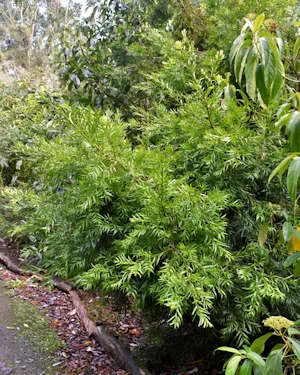 September 2025
 September 2025
Afrocarpus Afro - Latin meaning of Africa; carpus: - from Greek karpos meaning fruit, referring to the fleshy, berry-like fruits; falcatus - Latin meaning sickle-shaped, referring to the elegant, curved shape of the tree's linear leaves. falcatus
African fern pine
A.k.a. podocarpus falcatus, and Outeniqua yellowwood. A massive evergreen conifer native to the montane and coastal forests of S Africa, reaching 45 - 60 m. It is prized for its valuable timber, lush fern-like foliage, and prominent role as a food source for local wildlife. It is dioecious male and female cones grow on separate trees , with males producing small, catkin-like cones, while females produce solitary, fleshy, plum-like seeds that turn yellow-green to purplish as they ripen.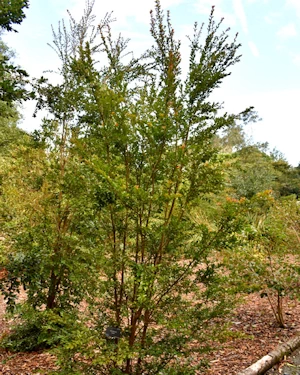
September 2025
Amomyrtus , amomyrtus - from Greek amomos meaning flawless, and myrtosmeaning myrtle, referring to its classification as an unblemished, perfect member of the myrtle family; luma: from the Chilean Mapuche name for the plant, luma, loosely translating as orange-wood, a reference to the tree's vividly coloured timber. luma
Chilean myrtle
A compact, multi-stemmed bushy shrub or small tree, native to Chile and Argentina, reaching 5 m in cultivation, up to 25 m in the wild. It blooms in late spring, producing clusters of small, fragrant, creamy-white flowers with five delicate petals and numerous prominent stamens, followed by small, edible, berry-like fruit that ripen from red to purplish-black. The bark is smooth, exfoliating on mature specimens, often revealing beautiful, mottled reddish-brown or cinnamon-orange tones.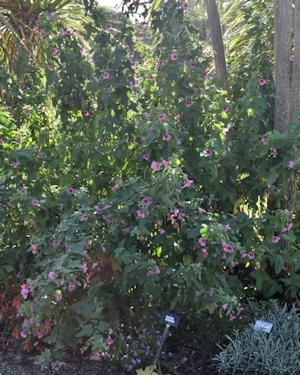 September 2025
 September 2025
Anisodontea aniso - Greek for unequal; odont - Greek for tooth; referring to the uneven, irregularly toothed edges of the plant's leaves; capensis Latin meaning of the Cape, referring to the Cape provinces of S Africa where it originates capensis
Cape mallow
A bushy sub-shrub a dwarf shrub, especially one that is woody only at the base reaching 1.5 m. It has dark green, palmately-veined, 3-lobed leaves that are often softly hairy. It has resilient, hibiscus-like pink flowers and deep red veins, and can bloom almost continuously throughout the year given mild or frost-free conditions.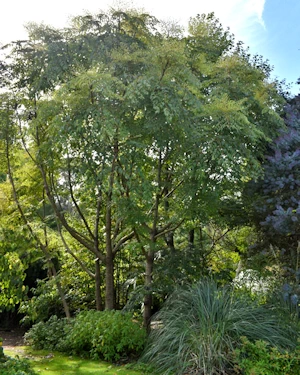 September 2025
 September 2025
Aralia Aralia - possibly a Latinized adaptation of an indigenous or French-Canadian name (aralie) used for American species; chapaensis - Latin meaning originating in Chapa, N Vietnam. chapaensis
Angelica Tree
Produces massive, bi-pinnate leaves that can grow up to 1 m in length, composed of numerous grey-green leaflets. The thorny stems are covered in yellowish-brown, woolly hairs when young. In winter it become a spiky framework, earning it the nickname of a devil's walking stick. Flowers blooms in large, branched, terminal panicles with creamy-white to greenish-white flowers in the autumn. These are followed by clusters of small, globose, dark purple to purplish-black berries in the winter, which are highly attractive to birds.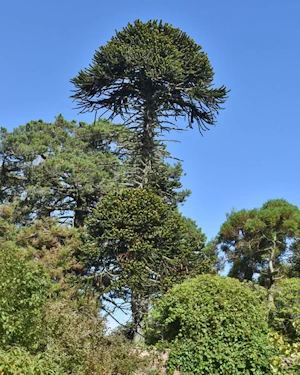 September 2025
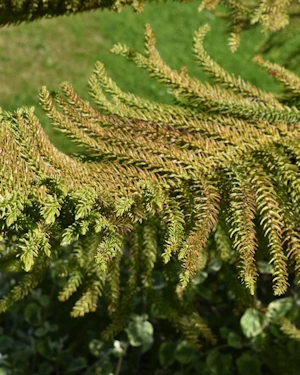
Araucaria araucana araucaria - after a region of Chile; araucana - the native tribe who used the tree's seeds for food.
Monkey puzzle
A.k.a. monkey tail tree, pewen, pehuen pine or piñonero, an evergreen tree growing to 30 - 40 m, native to C and S Chile and W Argentina. It is on the IUCN list as endangered in its native region due to logging, forest fires, and grazing. It is usually dioecious male and female cones on separate trees . The male (pollen) cones are oblong and cucumber-shaped. It is wind pollinated. The bark can be up to 15 cm thick, possibly an adaptation to resist wildfires.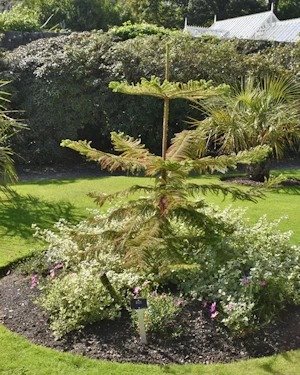 September 2025
 September 2025
Araucaria araucaria - after a region of Chile; heterophylla - from Greek heteros meaning different or varied and phyllos meaning leaf, referring to the tree's distinct foliage transition. Young plants have soft, needle-like, elongated leaves, whereas mature trees feature broader, scale-like leaves. heterophylla
Norfork Island Pine
A distinctly symmetrical conifer native to Norfolk Island in the South Pacific. It is not a true pine, but rather an ancient evergreen tree. It has a straight, vertical trunk with nearly horizontal branches arranged in perfect, tiered whorls, creating a pyramid-like structure. The trees are dioecious male and female cones on separate plants . Female cones are squat and globe-shaped, measuring about 10 cm in length.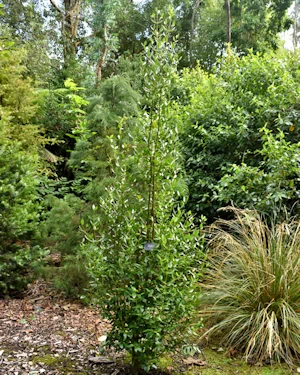 September 2025
 September 2025
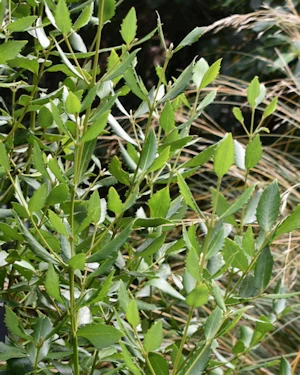
Atherosperma atherosperma - from Greek ather meaning barb or bristle and sperma meaning seed, referring to the fine, hairy, bristle-like awns attached to the seeds on the plant's fruit; moschatum - Latin meaning musk, describing the strong, spicy, perfumed aroma released by the bark and foliage when crushed moschatum
Black sassafrass
A.k.a. Southern sassafras, an aromatic, broadleaf evergreen tree or tall shrub native to the temperate rainforests of SE Australia and Tasmania. It has a fragrant, nutmeg-scented foliage and timber. Its young branchlets, flowers and the lower surface of the leaves are usually densely hairy. Flowers have cream-coloured to white tepals, followed by fruit which is a densely hairy achene.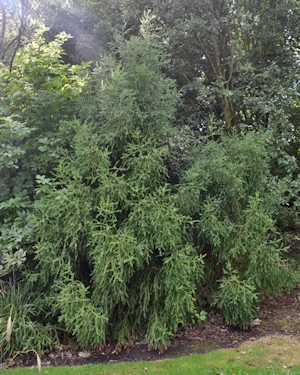 September 2025
 September 2025
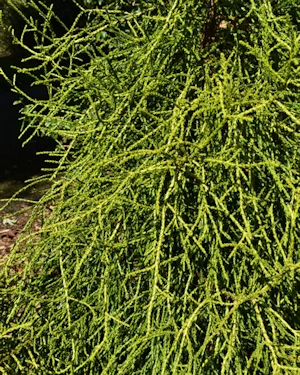
Athrotaxis athrotaxis - from Greek athroos meaning crowded and taxis meaning arrangement, describing the densely crowded tangle of leaves; selaginoides - resembling Selaginella, referring to the spirally arranged, scale-like leaves similarity to primitive clubmosses. selaginoides
King Billy pine
A.k.a. King William pine, a long-lived, slow-growing evergreen conifer native to Tasmania, growing 30 to 100 m, with a trunk diameter of up to 2 m. It is not a true pine but rather a member of the cypress family. The bark is dark orange to red, soft, spongy, and exfoliates in long, fibrous strips. It produces globose seed cones that are up to 3 cm in diameter. Small yellowish pollen cones appear in spring. September 2025
 September 2025