×
![woodturning]()

Trees gallery - Logan Botanic Garden - page 4
Galloway
 September 2025
 September 2025
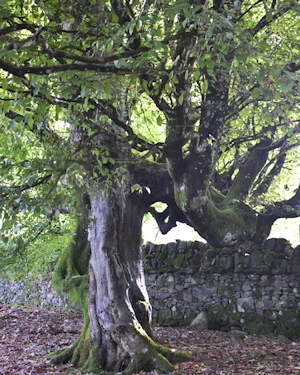
Fagus Fagus - Latin for beech; sylvatica - from Latin silvanus, of the forest sylvatica
Common beech
Native across Europe, growing to a height of more than 40 m and develop a huge domed crown. The reddish brown, torpedo-shaped leaf buds form on short stalks and have a distinctive criss-cross pattern. Beech is monoeciousboth male and female flowers grow on the same tree . In April and May the tassel-like male catkins hang from long stalks at the end of twigs, while female flowers grow in pairs, surrounded by a cup. Beech woodland is shady and characterised by a dense carpet of fallen leaves and mast husks which prevent most woodland plants from growing. Only specialist shade-tolerant plants can survive beneath a beech canopy. A common tree, but with an unusual twist at Logan.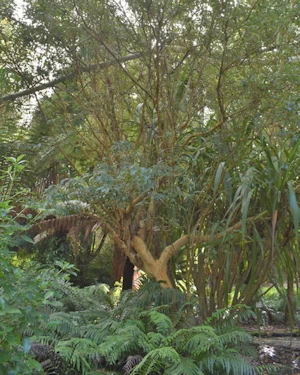 September 2025
 September 2025
 September 2025
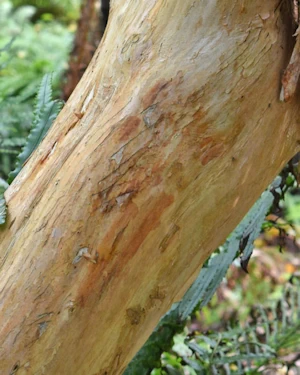
Fuchsia excorticata Fuchsia - after the 16th-century German physician and botanist Leonhart Fuchs (1501 - 1566); excorticata - from Latin meaning without bark, describing the tree's peeling orange-red bark, which flakes off in papery strips
New Zealand tree fuchsia
A.k.a. kōtukutuku or tree fuchsia, the world's largest fuchsia species growing up to 13 m, endemic to New Zealand. This deciduous tree is famous for its vibrant peeling copper bark, unusual lime-green and purple flowers that grow directly on the branches, and bright blue pollen. It holds a significant amount of water and does not burn easily. The pendulous flowers transition from yellowish-green with purple streaks to a deep, vibrant violet-purple. A unique botanical trait is its bright blue pollen. September 2025
 September 2025
 September 2025
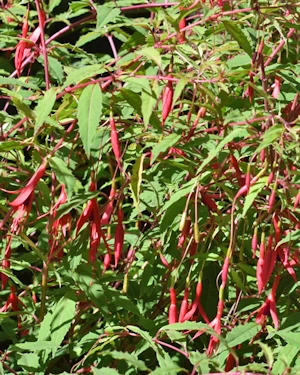
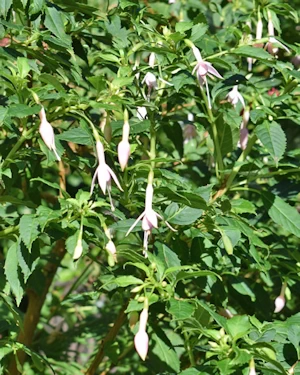
Fuchsia magellanica Fuchsia - after the 16th-century German physician and botanist Leonhart Fuchs (1501 - 1566); magellanica - magellanica - from the Straits of Magellan; gracilis - from Latin meaning slender or graceful, describing the delicate, thinner branches, longer flower stalks, and narrower leaves of this particular botanical variety compared to the standard species. gracilis
Hardy fuchsia
A medium-sized, deciduous, hardy shrub. It has a slender, arching habit, growing up to 2.5 m, with dangling, ballerina-like flowers with vivid crimson sepals and violet-purple petals.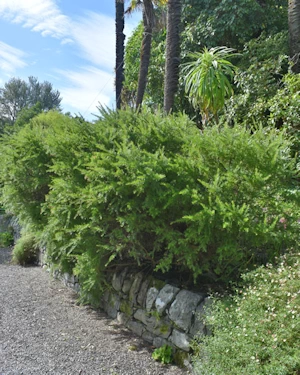 September 2025
 September 2025
 September 2025
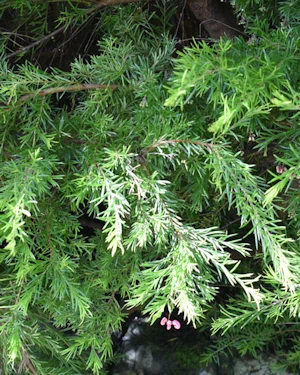
Grevillia rosemarinifolia jenkinsii Grevillia - after Charles Francis Greville (1749 - 1809), an English antiquarian, politician, and a founding member of the Royal Horticultural Society in 1804; rosmarinifolia - Latinized from rosmarinus, rosemary and folia, leaf, describing the shrub's stiff, needle-like, dark green foliage; Jenkinsii - cultivar name.
Rosemary grevillea
A.k.a. spider flower, a compact, evergreen shrub featuring stiff, rosemary-like dark green leaves and clusters of pink and cream tubular spider-like flowers. It produces honeysuckle-like tubular blooms that gather in dense, spidery clusters. The flowers are a beautiful bi-colour combination of pink and creamy white.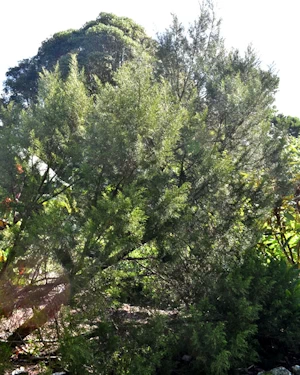 September 2025
 September 2025
Halocarpus Grevillia - after Charles Francis Greville (1749 - 1809), an English antiquarian, politician, and a founding member of the Royal Horticultural Society in 1804; rosmarinifolia - Latinized from rosmarinus, rosemary and folia, leaf, describing the shrub's stiff, needle-like, dark green foliage; Jenkinsii - cultivar name. bidwillii Jenkinsii
Bog pine
A.k.a. mountain pine, a slow-growing closely branched evergreen shrub or small tree, native to New Zealand, reaching up to 3.5 m. It has a distinct two-stage foliage and tiny, berry-like seeds nested in a fleshy white collar. : It sometimes displays a prostrate form where lower branches take root to create a ring of interconnected offshoots. The seed cones appear berry-like. The single, tiny seed rests partially exposed in a fleshy, bright white to yellowish cup known as an aril. September 2025
Hebe cupressoides ? Hebe - after Hebe, Greek goddess of youth and spring, reflecting the vibrant, evergreen resilience; cupressoides - from Latin cupressus meaning cypress and Greek -oides meaning resembling, describing the tiny, scale-like leaves closely resembling a miniature cypress or juniper conifer.
Cypress hebe
An evergreen shrub native to New Zealand's South Island. Visually resembling a dwarf conifer, with dense, mounded habit, tiny scale-like foliage that tightly clasp the stems. It produces short clusters of tiny pale lilac to white flowers from spring to mid-summer.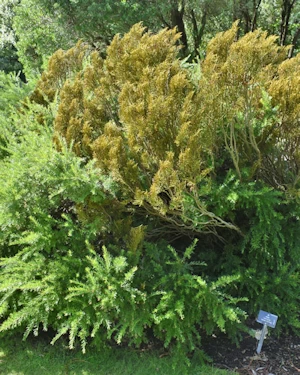 September 2025
Hebe ochracea Hebe - after Hebe, Greek goddess of youth and spring, reflecting the vibrant, evergreen resilience; ochracea - from the Latin for ochre, referring to the yellowish-brown/burnished gold colouring of the foliage; James Stirling - after the former superintendent of the Government Gardens in Wellington, New Zealand. James Stirling
Hebe James Stirling
A slow-growing dwarf evergreen shrub with a conifer-like appearance. It has brilliant bronze-yellow scale-like leaves that are tightly pressed against the stems. From late spring to early summer, it produces small, delicate white flowers near the tips of the stems.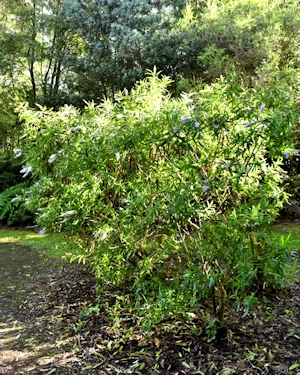 September 2025
 September 2025
 September 2025
Hebe salicifolia Hebe - after Hebe, Greek goddess of youth and spring, reflecting the vibrant, evergreen resilience; salicifolia - from Latin salix meaning willow and folium meaning leaf, hence willow-leaved hebe.
Willow-leaved hebe
A.k.a. koromiko, a fast-growing, large evergreen shrub native to New Zealand and South America, growing 2 - 3 m. It has willow-like foliage and fragrant, nectar-rich summer flowers that are exceptionally attractive to bees and other pollinators. It produces dense, long spikes (racemes) of tiny, fragrant white to pale lilac flowers during the summer months.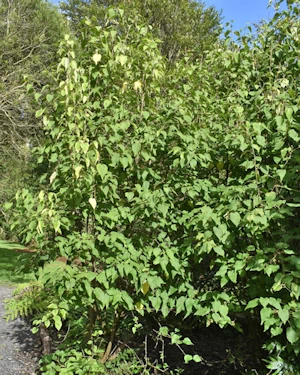 September 2025
 September 2025
 September 2025
Hoheria Glory of Amlwch Hoheria - Latinized adaptation of houhere, the Māori name for the tree in New Zealand; Glory of Amlwch - named after the coastal town of Amlwch in Anglesey, Wales as it was bred by Dr. W.R. Jones, who gardened at Bryn Tirion in Amlwc.
Lacebark
A.k.a. ribbonwood, a semi-evergreen large shrub or small tree native to New Zealand, with profuse, fragrant, star-shaped white flowers. This cultivar is a garden hybrid, naturally occurring as a cross between deciduous H. glabrata and evergreen H. sexstylosa.Hovenia Hovenia - after David ten Hove, an Amsterdam senator and financial supporter of Carl Thunberg’s botanical expeditions to South Africa in the 1770s; dulcis - from Latin meaning sweet. referring to the edible fleshy fruit stalks (peduncles). When ripened, these stalks dry up and taste exactly like raisins dulcis
Chinese raisin tree
A.k.a. Japanese raisin tree, a hardy, deciduous, medium-to-large tree reaching 10 - 30 m, native to E Asia. The swollen, sweet, and edible fruit stalks taste like raisins. In summer it produces clusters of small, fragrant, cream-colored flowers. The true fruit is a small, hard, blackish-brown capsule, but the stalk supporting it swells, turns red/brown, and becomes fleshy, twisted, and sweet.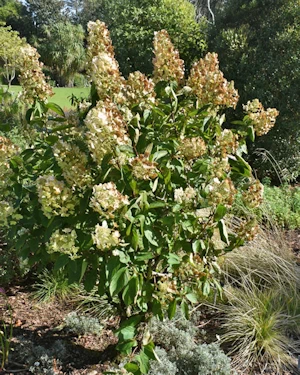 September 2025
 September 2025
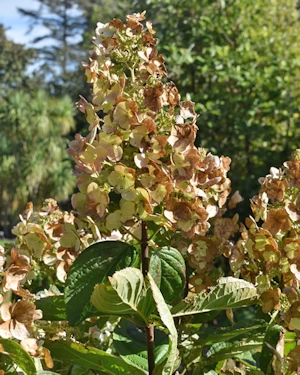
Hydrangea Hydrangea - from Greek hydor meaning water and angeion meaning vessel or "jar"), referring to the cup-like, jug-like shape of the plant's seed capsules; paniculata - from Latin panus meaning tuft or swelling; describes the sharply pointed, conical cluster of flowers; tardiva - cultivar name from Latin meaning late, referring to the plant blooming later than other varieties paniculata tardiva
Panicle hydrangea
A hardy, deciduous shrub or small tree native to Asia, multi-stemmed and vase-shaped seed capsules, growing from 1 to 5 m. It bears large, cone-shaped flower clusters, blooming from mid-summer into autumn, with colour transitioning from creamy white or lime green to vibrant shades of pink and red as the season cools.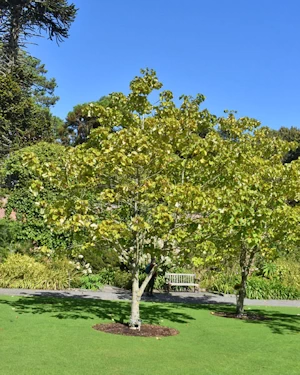 September 2025
 September 2025
 September 2025
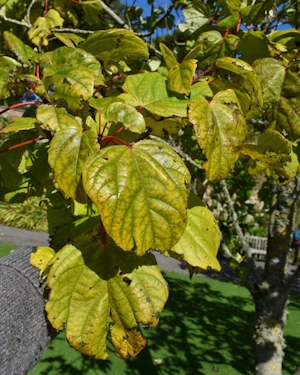
Idesia polycarpa Idesia - after 17th-century German-born Dutch traveller and merchant Eberhard Isbrand Ides; polycarpa from Greek, meaning many fruits, referring to the female tree producing copious, dense, drooping clusters of small, fleshy, pea-sized berries
Igiri tree
A.k.a. Chinese Wonder tree,a fast-growing deciduous tree growing 10 - 20 m, native to East Asia. It has large, heart-shaped leaves, highly fragrant summer flowers, and vibrant autumn berries. The leaves are held on scarlet or reddish stalks (petioles) and turn bright yellow in autumn. The tree is dioecious Small, petal-less, yellow-green flowers bloom in early summer and exude a very sweet fragrance. These are followed (on female trees) by long, heavy clusters of grape-like edible berries that ripen bright red.
September 2025
Lagarostrobos Lagarostrobos - from Greek lagaros meaning narrow, and strobos meaning cone, referring to the loose, lax structure of the tree's female seed cones and their widely spaced bracts; franklinii - after Sir John Franklin (1786 - 1847), an English naval captain and Arctic explorer who served as the Lieutenant-Governor Tasmania from 1837 to 1843. Franklinii.
Huon pine
A medium sized conifer growing 10 to 30 m with a trunk diameter of up to 2 m, native to Tasmania. Young trees have conical crowns that become spreading and irregular with age. The bark is covered in thick, fibrous, grey-brown bark that peels off in longitudinal strips. It is dioecious meaning male and female cones grow on separate trees . Female cones are highly modified and berry-like.It is one of the longest-living organisms on Earth. Individual trees can easily live for over 2,000 years, with some ancient stands in Tasmania estimated to be up to 3,000 years old.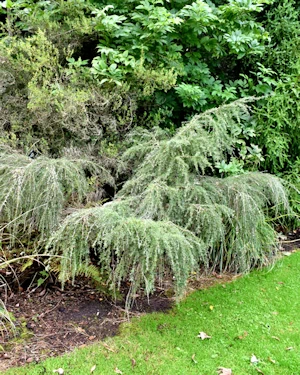 September 2025
 September 2025
 September 2025
Leptospermum Leptospermum - from Greek leptós meaning slender and sperma meaning seed, referring to the fine, narrow seeds of the genus; nitidum - from Latin nitidus meaning shining, referring to the glossy, shiny green leaves.. nitidum
Shiny tea tree
A compact, evergreen shrub endemic to Tasmania, in dwarf forms reaching 0.6 m, taller varieties up to 6 m. It has glossy, aromatic foliage and profuse white flowers. The bark is fibrous or flaky, with hairy, erect young shoots. Leaves are highly aromatic when crushed, and covered with minute oil glands. The flowers are relatively large, reaching about 15 - 20 mm in diameter. They are usually white but can sometimes feature reddish centres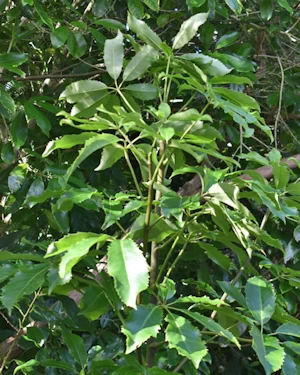 September 2025
 September 2025