×
![woodturning]()

Trees Gallery - Royal Botanic Gardens Edinburgh (RBGE) - page 10
 November 2023
 November 2023
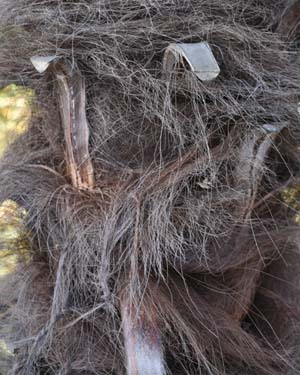
Trachycarpus fortunei
Chusan palm
A.k.a. windmill palm, Chinese palm. A single-stemmed fan palm, growing 12 – 20m, with a trunk diameter up to 30cm. The leaves have long petioles stalks joining leaf to stem which are bare except for two rows of small spines, terminating in a rounded fan of numerous leaflets. Each leaf is 1.5 to 2m long, with the petiole up to 1m long, and the leaflets up to 90cm. Flowers are small, yellow (male) and greenish (female), borne in large branched panicles a loose branching cluster of flowers . it is dioecious male and female flowers produced on separate trees . The fruit is a yellow to blue-black, reniform drupekidney-shaped, fleshy fruit with thin skin and a central stone containing the seed ripening in mid-autumn. There are 31 photos on the RBGE Garden Explorer website.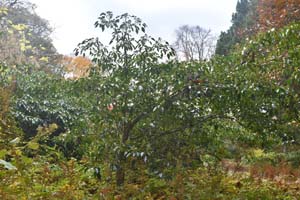 November 2023
 November 2023
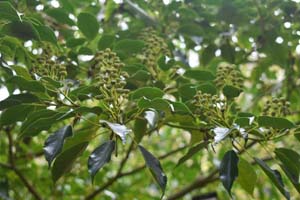
Trochodendron aralioides
Wheel tree
A.k.a. cartwheel tree. The sole living species in the genus Trochodendron, which also includes several extinct species. A native to Japan, southern Korea and Taiwan. An evergreen tree or large shrub growing to 20m. The yellowish green flowers form an exceptionally neat, spiral arrangement 5–13cm in diameter, without petals, but with a conspicuous ring of 40–70 stamens (the wheel) surrounding the 4–11 carpels. There are 26 photos on the RBGE Garden Explorer website.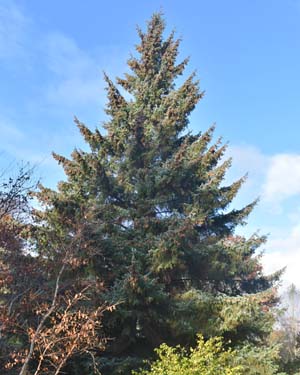 November 2023
 November 2023
 November 2023
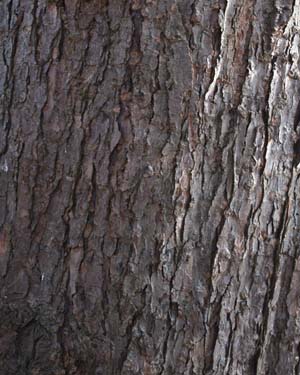
Tsuga sieboldii
Japanese hemlock
Native to the Japanese islands of Honshū, Kyūshū, Shikoku and Yakushima. Often multiple-stemmed from the base, and the dense crown is broadly conical and pointed. The deep dark brown cones are pendulous, with blunt tips, ovoid-conic in shape, with flat-tipped scales. There are 4 photos on the RBGE Garden Explorer website. November 2023
 November 2023
 November 2023
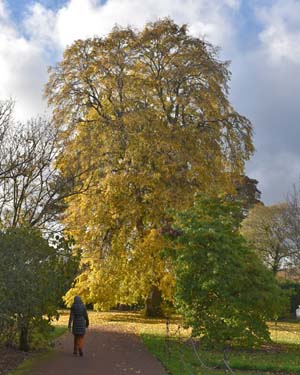
Ulmus minor
Field elm
A.k.a. English elm, smooth leaved elm, narrow leaved elm, ulmus procera. Elms are hermaphrodites both male and female reproductive parts are contained within the same flower . Flowers, which appear in February and March, are dark pink to red and hang in tassels. Once pollinated by wind, the flowers develop into tiny winged fruits, known as samaras, which are dispersed by wind. There are 4 photos on the RBGE Garden Explorer website. November 2023