×
![woodturning]()

Trees Gallery - Royal Botanic Gardens Edinburgh (RBGE) - page 4
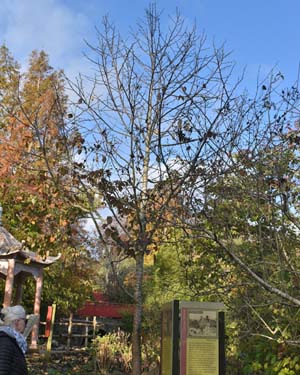 November 2023
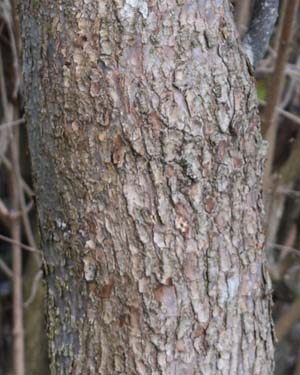 November 2023
Davidia involucrata var. vilmoriniana
Handkerchief tree
A.k.a. dove tree, ghost tree. A native of S China,it can grow to 25m. There are two slightly different varieties: involucrata, and vilmoriniana. The first has thinly pubescent having hair, in this case on the underside leaves, on the second the leaves are glabrous free from hair or down; smooth. . The variety tag is usually dropped and it is just named as d. involucrata. Its most notable feature is the inflorescence that features large, white bracts surrounding a small purplish-red flower head. The fruit is a very hard nut about surrounded by a green husk, hanging on a 10 cm stalk. The nut contains 3–6 seeds. There are 61 photos on the RBGE Garden Explorer website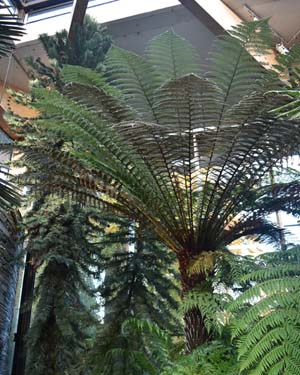 November 2023
Dicksonia antarctica
Woolly tree fern
A.k.a. man fern or soft tree fern. Native to S Australia. It can grow to 15 m, but more typically 5m. It has an erect rhizome forming a trunk, which is very hairy at the base and the crown. The "trunk" of this fern is merely the decaying remains of earlier growth of the plant and forms a medium through which the roots grow. The large, dark green, roughly-textured fronds spread in a canopy of 2–6m across. Reproduction is primarily from spores, but it can also be grown from plantlets occurring around the base of the rhizome. November 2023
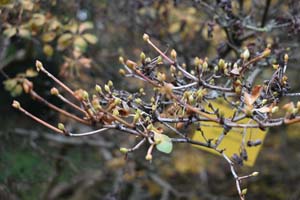 November 2023
 November 2023
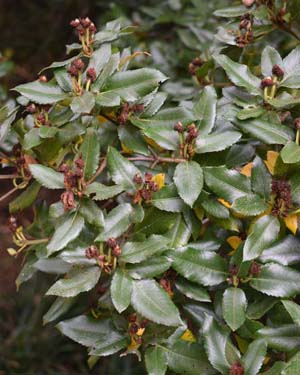
Enkianthus campanulatus
Enkiantus
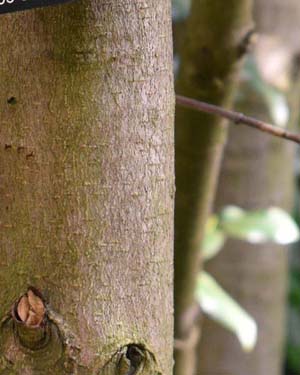
Native to Japan. A medium-sized, narrow, upright, deciduous shrub. In spring it offers a profusion of bell-shaped creamy white flowers with red veins, similar to those of the distantly related pieris, and to those of heather (it belongs to the ericaceae family). There are 53 photos on the RBGE Garden Explorer website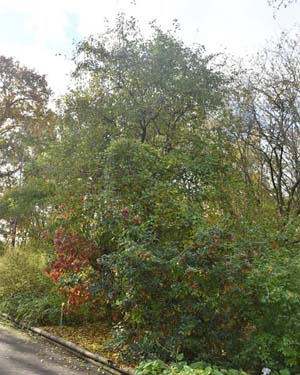 November 2023
 November 2023
 November 2023
Eucryphia Nymansensis
Nyman's eucryphia
Native to Chile and Argentina. An evergreen tree of dense, broadly columnar habit, with rose-like pure white flowers (occasionally tinged pink) in late summer and autumn. A garden hybrid between the two Chilean species, E. cordifolia and E. glutinosa. It can reach 22 m height, and is naturally inclined to be multi-stemmed. Both leaf surfaces and shoots are downy when young. It is on the IUCN red list International Union for Conservation of Nature - red is near threatened. There are 18 photos on the RBGE Garden Explorer website November 2023
 November 2023
 November 2023
Fagus sylvatica
Common beech
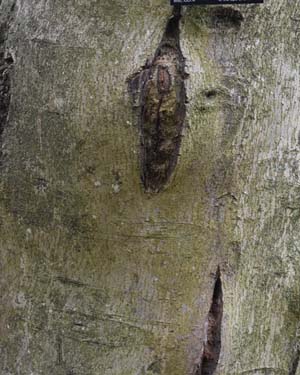
Known as Faidhbhile in Gaelic. Mature trees grow to more than 40m, developing a huge domed crown. Triangular beech nuts (known as beechmast) form in prickly four-lobed seed cases. They often hold on to their leaves throughout winter, a trait known as marcescence. Beech is monoecious male and female flowers grow on the same tree , and is wind pollinated. In spring tassel-like male catkins hang from long stalks at the end of twigs, while female flowers grow in pairs, surrounded by a cup. There are 73 photos on the RBGE Garden Explorer website. November 2023
 November 2023
 November 2023
Fraxinus ornus
Manna ash
A.k.a. flowering ash. Native to S Europe and SW Asia. A medium-sized deciduous tree growing to 15–25 m. The buds are pale pinkish-brown to grey-brown, with a dense covering of short grey hairs. Flowers are produced in dense panicles after the new leaves appear in late spring, followed by slender samaras. A sugary extract from the sap may be obtained by making a cut in the bark, giving rise to the manna ash name. There are 13 photos on the RBGE Garden Explorer website. November 2023
 November 2023
Hippophae Rhamnoides
Sea buckthorn
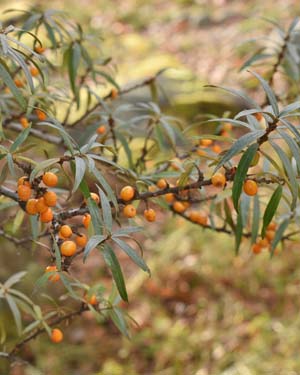
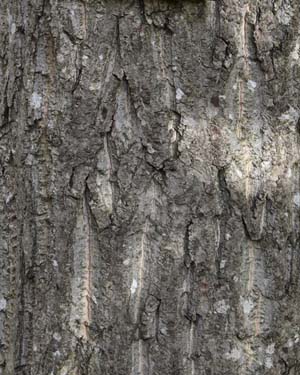
Native to Europe and N Asia. A spiny deciduous shrub that can grow between 2 and 4 m high. It has a rough, brown or black bark and a thick, grayish-green crown. It is dioecious male and female flowers grow on different shrubs . The plants have a very developed and extensive root system, and the roots live in symbiosis with nitrogen-fixing Frankia bacteria. Vegetative reproduction of the plants occurs rapidly via root suckers. There are just 2 photos on the RBGE Garden Explorer website November 2023
 November 2023
 November 2023
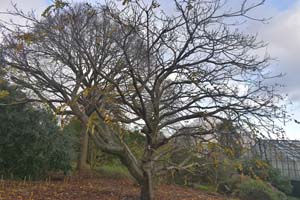
Juglans Ailantifolia var. cordiformis
Japanese walnut
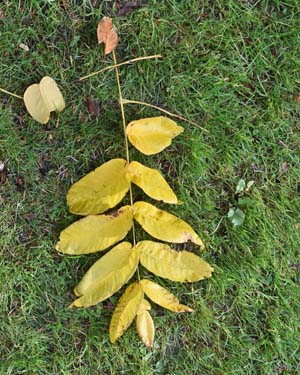
A.k.a. Heartseed walnut, heartnut, j. mandschurica (Manchurian walnut). A deciduous tree growing to 20 m, rarely 30 m. The male flowers are inconspicuous yellow-green catkins produced in spring at the same time as the new leaves appear. The female flowers have pink/red pistils. Edible nuts with an oily texture are produced in bunches of 4–10 together, spherical, surrounded by a green husk before maturity in mid autumn. The husks are also used to make a yellowish dye. There are 6 photos on the RBGE Garden Explorer website.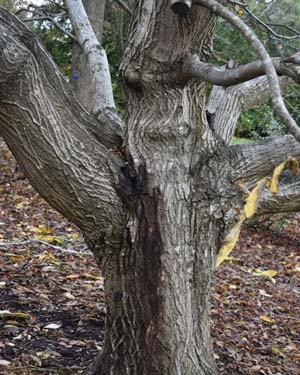 November 2023
 November 2023
Juglans cinerea
Butternut
A.k.a. white walnut. A native of E North America and S Canada. A deciduous tree growing 20 - 40m. , rarely 40 m (130 ft). It rarely lives longer than 75 years. The leaves are alternate and pinnate, with 11–17 leaflets, onne being a terminal leaflet. The whole leaf is downy-pubescent, and a somewhat brighter, yellower green than many other tree leaves. The species is monoecious having male and female flowers on the same plant . Male (staminate) flowers are inconspicuous, yellow-green slender catkins that develop from auxiliary buds and female (pistillate) flowers are short terminal spikes on current year's shoots. Each female flower has a light pink stigma. Flowers of both sexes do not usually mature simultaneously on any individual tree. Nuts appear in bunches of two to six together, surrounded by a green husk before maturity in mid autumn. There are 27 photos on the RBGE Garden Explorer website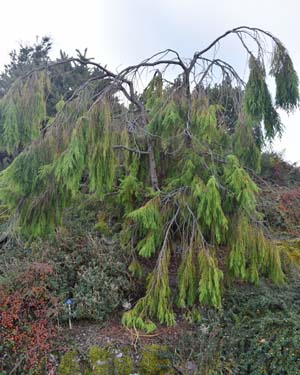 November 2023
 November 2023
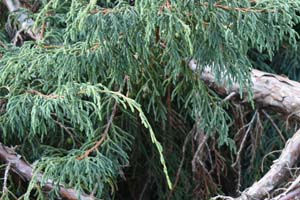
Juniperus flaccida
Mexican juniper
A.k.a. weeping juniper or drooping juniper. A tree producing long, weeping, graceful branches; young shoots are very thin and slender. Fruits are reddish brown, covered at first with glaucous bloom, carrying six to twelve seeds. There are 3 photos on the RBGE Garden Explorer website. November 2023
 November 2023
Juniperus recurva var. recurva
Himalayan juniper
A large shrub or tree reaching 20m, with a broadly conical to rounded or irregular crown. The cones are berry-like, globose to ovoid, glossy blue-black, and contain one seed; they are mature in about 18 months. The male cones are 3–4 mm long, and shed their pollen in early spring. It is largely monoecious seed and pollen cones produced on the same plant . A second variety, j. recurva coxii, has slightly longer needles. There are 18 photos on the RBGE Garden explorer website. November 2023
 November 2023