×
![woodturning]()

Trees Gallery - Royal Botanic Gardens Edinburgh (RBGE) - page 6
 November 2023
 November 2023
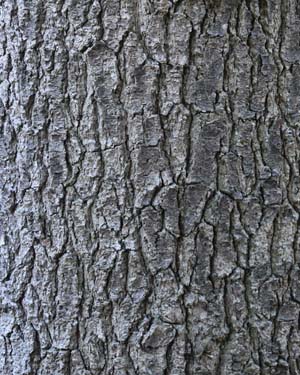
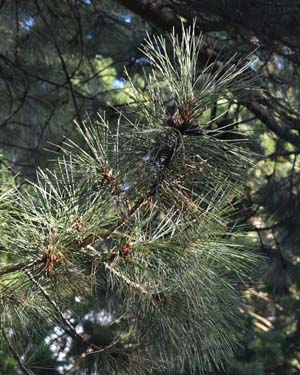
Pinus monticola
Californian mountain pine
A.k.a. Mountain White Pine, Western White Pine. A large tree, regularly growing to 50m. A member of the white pine group, and like all members of that group, the needles are in fascicles of five, with a deciduous sheath. The needles are finely serrated, The cones, appearing even on young trees, are long and slender, with thin, flexible scales. There are 24 photos on the RBGE Garden Explorer website.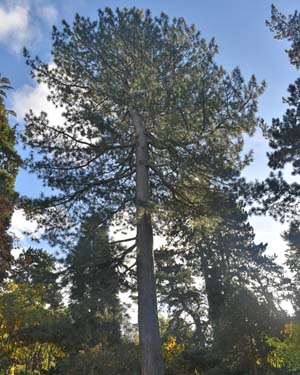 November 2023
 November 2023
 November 2023
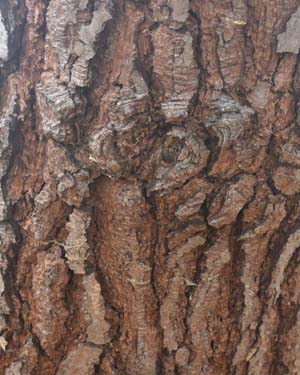
Pinus nigra ssp. pallasiana
Crimean pine
A.k.a. p. nigra spp. caramanica, Turkish black pine. A native of E Turkey, N Iran and Caucasia. It can reach 40m. This variety or subspecies is not very clearly distinguished from typical P. nigra, but the cones are usually larger – up to 10cm. The subspecies is named after Peter Pallas, a Prussian biologist who sent seeds to a British company in the 1790s. There are 49 photos on the RBGE Garden Explorer website.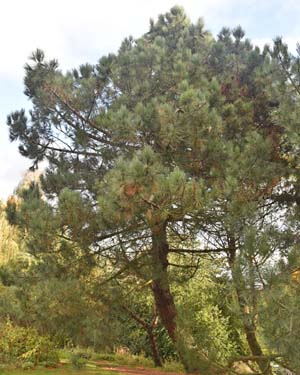 November 2023
 November 2023
 November 2023
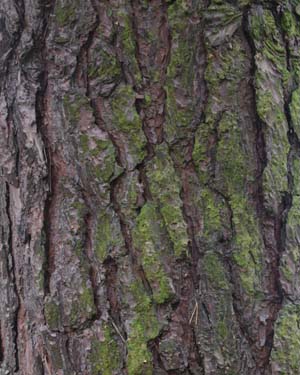
Pinus pinaster ssp. escarena
Escarena pine
A.k.a. Cluster pine, Maritime pine. Native to the W Mediterranean. This subspecies has longer leaves than the type (18–25 cm long vs. 10–20 cm), and larger cones (14–22 cm long vs. 9–18 cm). It grows around the Mediterranean on low-lying coastal plains in sandy soils. There is just one photo on the RBGE Garden Explorer website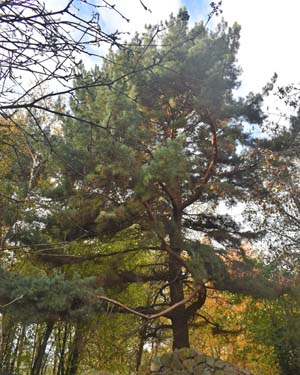 November 2023
 November 2023
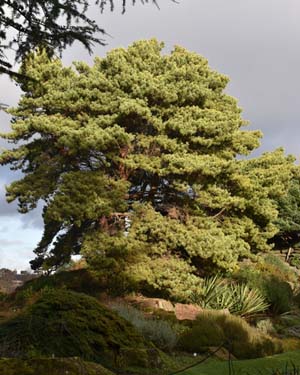 P. sylvestris aurea, November 2023
Pinus sylvestris
Scots pine
A.k.a. guithas in Gaelic. An an evergreen coniferous tree growing to 35m. The oldest recorded specimen is in Lapland, at over 760 years. Needles are a glaucous bluish grey , often darker green to dark yellow-green in winter, occuring in fascicles clusters of needles of two, occasionally three or four on the tips of strong shoots. Leaves persist from two to four years, up to nine years in subarctic regions. There is a golden Scpts pine cultivar, p. sylvestris aurea. There are 82 photos on the RBGE Garden Explorer website.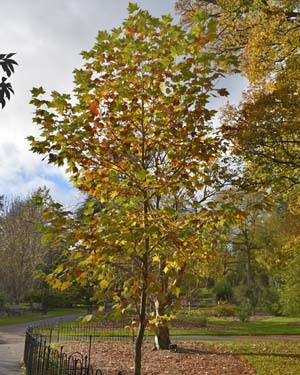 November 2023
 November 2023
 November 2023
Platanus mexicana
Mexican sycamore
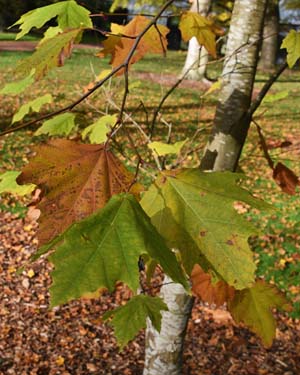
A plane tree native to NE and C Mexico, and Guatemala. It can grow to 24m, with large leaves up to 20cm wide. It is deciduous and monoecious male and female reproductive parts grow on the same plant , with leaves turning yellowish brown in autumn. It is valued for its tolerance of hot dry conditions in the arid southern parts of the United States, and is used – as is traditional for planes – as a street tree. There are 3 photos on the RBGE Garden Explorer website.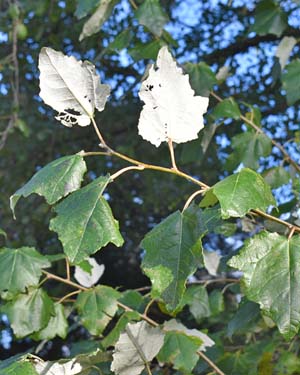 November 2023
Populus alba
White poplar
A.k.a. silver poplar, and abele. A medium sized deciduous tree to 30 m, native to Europe and C Asia. The bark is smooth and greenish-white to greyish-white with characteristic diamond-shaped dark marks on young trees, becoming blackish and fissured at the base of old trees. The leaves are five-lobed, with a thick covering of white scurfy down on both sides, but thicker underneath. It is dioecious male and female catkins on separate trees , with male catkins grey with dark red stamens, female catkins greyish-green. It can propagate by root suckers growing from the lateral roots, often as far as 20–30 m from the trunk, to form extensive clonal colonies. There are 5 photos on the RBGE Garden Explorer website.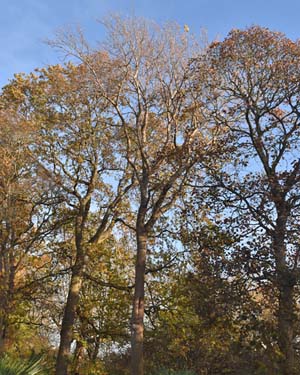 November 2023
 November 2023
Populus tremula gigas
European aspen
Widely distributed aross Europe, growing to 17m. Leaves are grey-green, round to broadly ovate, with a pointed apex and straight base, with large-toothed margins. Its best known attribute is the perpetual quiver of the leaf. The epithet 'gigas' suggests having a thicker stem, taller growth, thicker and darker leaves, and larger flowers and seeds than the standard type. There is a photo of the leaves on the RBGE Garden Explorer website November 2023
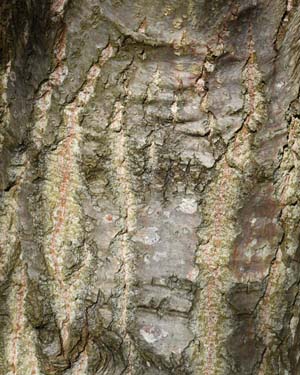 November 2023
Populus wilsonii
Wilson's poplar
Native to C & W China. A deciduous tree growing to 25m. Leaves are elliptical to heart-shaped, with minutely toothed margins. They are pale green above, pale greyish beneath and soon quite glabrous on both surfaces. Flowering occurs from April to May, and fruiting begins in May and lasts until June. The female catkins are slender, downy, 7-15cm long. So far as is known there is only one clone in cultivation, which is female. There is a photo of the leaves on the RBGE Garden Explorer website.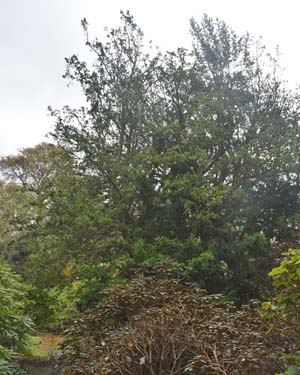 November 2023
 November 2023
Prumnopitys andina
Chilean plum yew
A.k.a lleuque, a native to Chile and Argentina, where it is on the IUCN International Union for Conservation of Nature vulnerable list. An evergreen coniferous tree, growing up to 30 m, with a trunk up to 2m in diameter. . The seed cones mature berry-like ( arils an exterior covering of seeds that develops after fertilization as an outgrowth from the ovule stalk ), oval, green turning to dark purple, with a soft edible pulp covering the single seed. The wood is yellowish, of good quality, used in furniture and construction. There are 12 photos on the RBGE website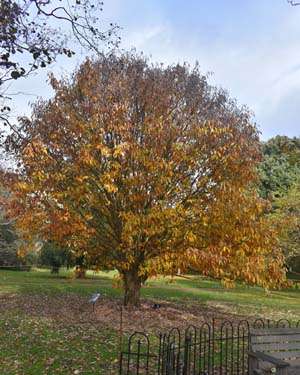 November 2023
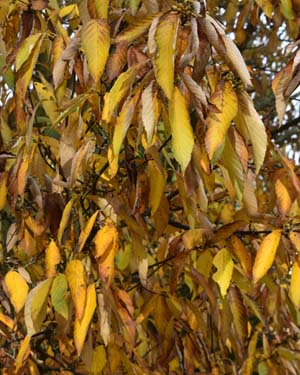 November 2023
Prunus maackii
Manchurian cherry
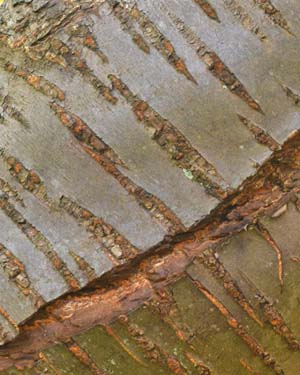
A.k.a. Amur chokecherry, native to Korea and both banks of the Amur River. Deciduous, growing to 10 m tall. The bark on young trees is very distinct, smooth, glossy bronze-yellow, but becoming fissured and dull dark grey-brown with age. Erect spikes of 5-petalled white flowers are followed by small cherry-like drupes a fleshy fruit with thin skin and a central stone containing the seed , first green, turning red then dark purple or black. The fruit has been used in the manufacture of juice, jelly and jam. There were no photos on the RBGE Garden Explorer website.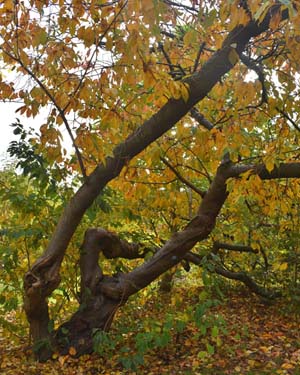 November 2023
 November 2023