×
![woodturning]()

Trees Gallery - Royal Botanic Gardens Edinburgh (RBGE)- page 2
 November 2023
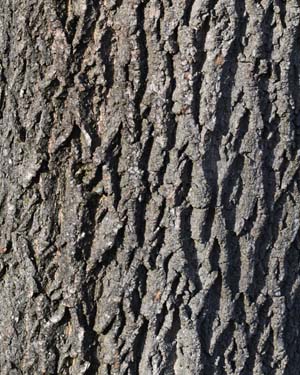 November 2023
Acer platanoides crispum
Norway maple crispum
Native to Europe and W. Asia. A variety of the Norway maple. A large deciduous tree with dark green foliage. It will grow dense and roundish, height up to 30 m and width to 22 m. There are 5 photos on the RBGE Garden Explorer website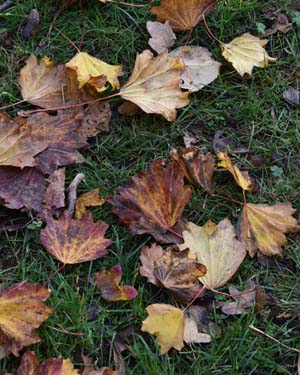 November 2023
 November 2023
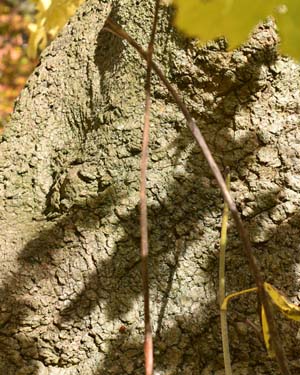
Acer platanoides cucullatum
Crimpleaf Norway maple
This variety of Norway maple has curiously crinkled, fan-shaped leaves, with lobes often lying on top of one another and nearly orbicular spherical or circular in outline. Will grow to 20m tall.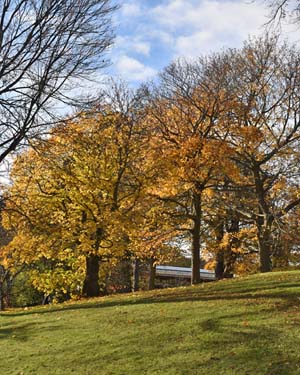 November 2023
 November 2023
 November 2023
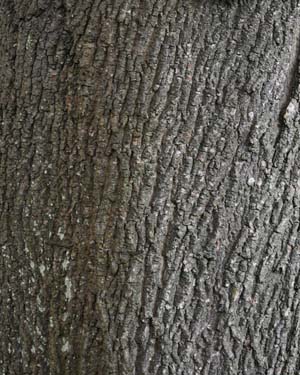
Acer platanoides palmatifidum
Norway maple 'palmatifidum'
A.k.a. A. platanoides Lorbergii, one of many Norway maple cultivars. Growing to around 15m high, with a slightly twisted growth habit. It has large, very deeply lobed dark green leaves. Leaves turn golden yellow in autumn. There are 4 photos on the RBGE Garden Explorer website.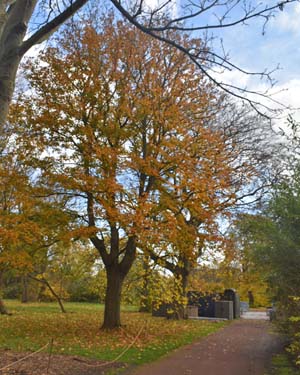 November 2023
 November 2023
 November 2023
Acer platanoides schwedleri
Norway maple 'Schwedleri'
This Norway maple cultivar can reach a height of 20 - 25m. The tree has a dense, large, closed crown, in maturity more rounded. The large, broad leaves unfurl brown red and turn dark green later. The second outgrowth also unfurls brown red. The abundant, conspicuous ochre-yellow flower panicles a loose branching cluster of flowers are produced before the foliage opens in early spring and may be followed by brown winged fruits, though not always. Named after Carl Heinz Schwedler (1807–1880), a garden supervisor for Prince Hohenlohe of Slawentitz, Poland. There are 3 photos on the RBGE Garden Explorer website. November 2023
Acer sempervirens
Cretan maple
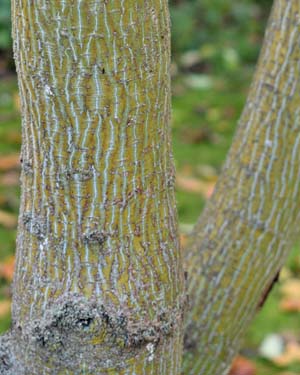
An evergreen or semi-evergreen shrub or small tree, one of the very few evergreen species in the genus. It grows to 10 m tall - this photo is of a young specimen, planted in 2007. The bark is dark grey, smooth in young trees, becoming scaly and shallowly fissured in mature trees. The shoots are green at first, becoming dull brown in the second year. The leaves are opposite, hard and leathery in texture, glossy dark green with a short yellow petiole the stalk attaching a leaf to the stem. It is capable of twisting the leaf to face the sun , variably unlobed or three-lobed (often on the same shoot). The flowers are yellow-green, produced in small pendulous corymbs a type of inflorescence in which the lower flowers have longer pedicels than the upper ones, creating a flat-topped appearance. . The fruit is a double samara with two rounded, winged seeds, spread at an acute angle.[Wikipedia]. There are 9 photos on the RBGE Garden Explorer website November 2023
 November 2023
Acer sikkimense
Sikkim maple
Native to Sikkim in the Himalayas, as well as Bhutan, Nepal, N India, Myanmar, Tibet, and Yunnan. A deciduous or semi-evergreen tree up to 20 metres tall, though more shrub-like in cultivation. It has small flowers from March to April, with greenish-yellow petals, followed by brown samaras which spread obtusely. There are 2 photos on the RBGE Garden Explorer website.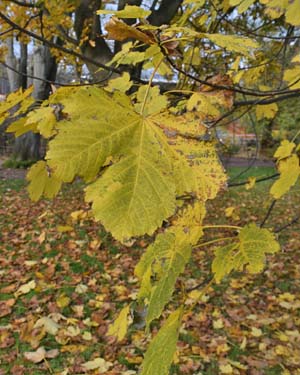 November 2023
 November 2023
Acer velutinum
Velvet maple
A.k.a. a. velutinum van volxemii . Native to Azerbaijan, Georgia and N Iran, where it was discovered by Belgian nurseryman Jean van Volxem in the 1870s). A deciduous tree to 40m in the wild. In leaf it looks similar to A. pseudoplatanus, with which it can hybridise, but the leaves of A. velutinum tend to be larger, with longer, stout petioles. The two are however easily separated by their inflorescences a group or cluster of flowers arranged on a stem : in A. velutinum they are held erect, while in A. pseudoplatanus they are pendulous. There are 7 photos on the RBGE Garden Explorer website.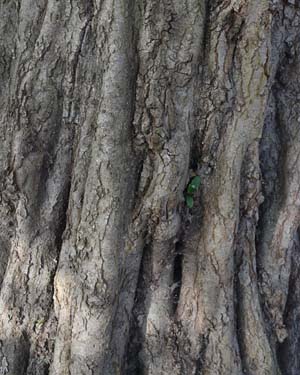 November 2023
Alnus formosana
Formosan alder
A.k.a. a. maritima var. formosana, a native of Taiwan. Leaves are green with an elongated shape, pink when young then shiny green until they fall in autumn. Male catkins hang in large numbers in spring and female woody 'cones' persist on the branches through the winter. The spreading branches create a pyramidal shape, and bear a dense canopy of narrow, long-pointed leaves; younger specimens resemble Prunus padus. I didn't manage a photo of the full tree, but there are 19 photos on the RBGE Garden Explorer website. November 2023